
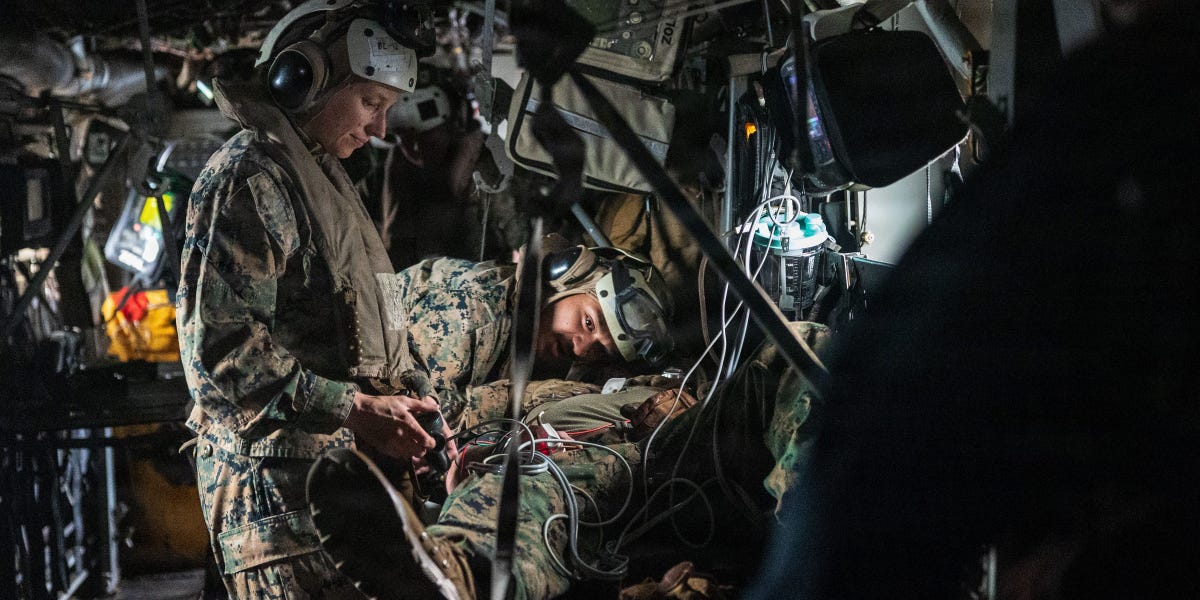
The Marines are getting new lifesaving gear for a war where help may not come quickly Navy corpsmen check the airway of a simulated Marine casualty during a flight training event off the coast of California. LCpl. Nicole Stuart/US Marine Corps The US Marine Corps has begun fielding new medical equipment meant to help troops survive when wounded service members can't be quickly evacuated from the battlefield.The new technology is designed to store blood, identify internal injuries, and treat wounded service members closer to the battlefield as the military prepares for future wars in which casualties may be unable to reach a hospital for hours or even days.The equipment includes improved, lighter-weight mobile blood coolers, better blood warmers, and small AI-assisted ultrasound devices and is designed to help Navy corpsmen and other providers treat casualties with less bulky equipment and less reliance on extensive medical infrastructure.During the wars in Iraq and Afghanistan, US air supremacy frequently allowed helicopters to quickly evacuate wounded troops to well-equipped and defended medical facilities near the battlefield.The proliferation of drone warfare and other technological advancements seen in Ukraine has, however, raised doubts about whether rapid casualty evacuations will be possible in future conflicts. Now, military planners assume that a sophisticated foe is likely to possess tools that could severely disrupt military tasks such as casualty evacuation, resupply, and communications.Throughout the post 9/11 wars in the Middle East, the military planned on getting wounded troops to advanced medical facilities within an hour, said Navy Capt. Shari Gentry, the Marine Corps' deputy medical officer, speaking to reporters at a media event near Quantico, Virginia. "And we do not foresee that being the case."The Corps has already begun distributing the systems to medical units, with some equipment reaching troops deployed to the Middle East.Among the new devices is a portable refrigerator capable of storing approximately 30 units of blood, potentially enough for four seriously wounded Marines, according to military medical guidance. Each battalion aid station is set to receive one, giving medical personnel a supply of blood closer to the battlefield.Weighing about 60 pounds, it replaces a system that weighs over twice as much and uses rechargeable batteries already common throughout the Marine Corps. The smaller refrigerator allows medical teams to maintain blood supplies without relying continuously on generators or fuel deliveries, said Navy Cmdr. Kyleigh Hupfl, the Corps' clinical lead for Expeditionary Medical Systems. The capability has already proved useful in the Middle East, Hupfl said. The Corps accelerated delivery after units raised concerns about the reliability of existing refrigeration equipment. One unit told her that the new device allowed it to maintain a ready supply of blood throughout its deployment.Small deviations in temperature can render blood and other pharmaceuticals unusable. "We need to be able to bring cold chain distribution forward without relying on heavy generators, and we need to be able to do that in a sustainable way," she said.The service is also fielding new portable blood warmers that can deliver warmed fluids faster than the previous equipment. The warmer works by passing blood through a tube, warming it before it flows into a patient's veins. Such warmth is crucial to prevent hypothermia, a serious complication in injured patients.Another major change involves portable ultrasound machines equipped with AI-assisted imaging. Previously held only at higher levels of battlefield medical care, the new machines are now being pushed toward the lowest level of tactical care, known as Role 1 facilities, where Navy corpsmen and physicians provide immediate life-saving care for wounded Marines.The AI software helps users identify anatomical structures on ultrasound images, allowing providers with less ultrasound experience to spot signs of internal bleeding or other injuries that might otherwise be difficult to detect. That information can also help medical teams determine which casualties need evacuation or surgery most urgently, said Navy Chief Petty Officer Matthew Brown, the chief biomedical equipment technician for the Corps' Expeditionary Medical Systems."I have 10 people that are hurt. Who should I get out?" Brown said of the dilemma and the new ultrasounds being fielded to front-line medics to address it. "And at the end of the day, that's what's going to save their life." Read next Business Insider tells the innovative stories you want to know Business Insider tells the innovative stories you want to know Business Insider tells the innovative stories you want to know Business Insider tells the innovative stories you want to know Kelsey Baker is a military affairs reporter with Business Insider. She joined in 2025 and covers military personnel issues and how the military is overhauling how it prepares for future conflicts.Prior to joining BI, she worked at The Washington Post as a Military Veterans in Journalism Fellow covering human interest stories and international news and at The Chronicle of the Horse magazine covering horse sports. She holds a graduate degree in Journalism from Northwestern University, a degree in Diplomacy from Norwich University, and an undergraduate degree in History from the University of Denver. She previously served in the Marine Corps as a logistics officer, and later in the reserve.Contact her via email at kbaker@businessinsider.com, or via Signal at KelseyBaker75.75. Use a personal email address, a nonwork WiFi network, and a nonwork device; here's our guide to sharing information securely.
The Marines are getting new lifesaving gear for a war where help may not come quickly
Full Article
Original Source
Read the full article at Businessinsider →KhanList aggregates and links to publicly available news content. We do not host full articles from third-party sources. Always verify important information with original sources.