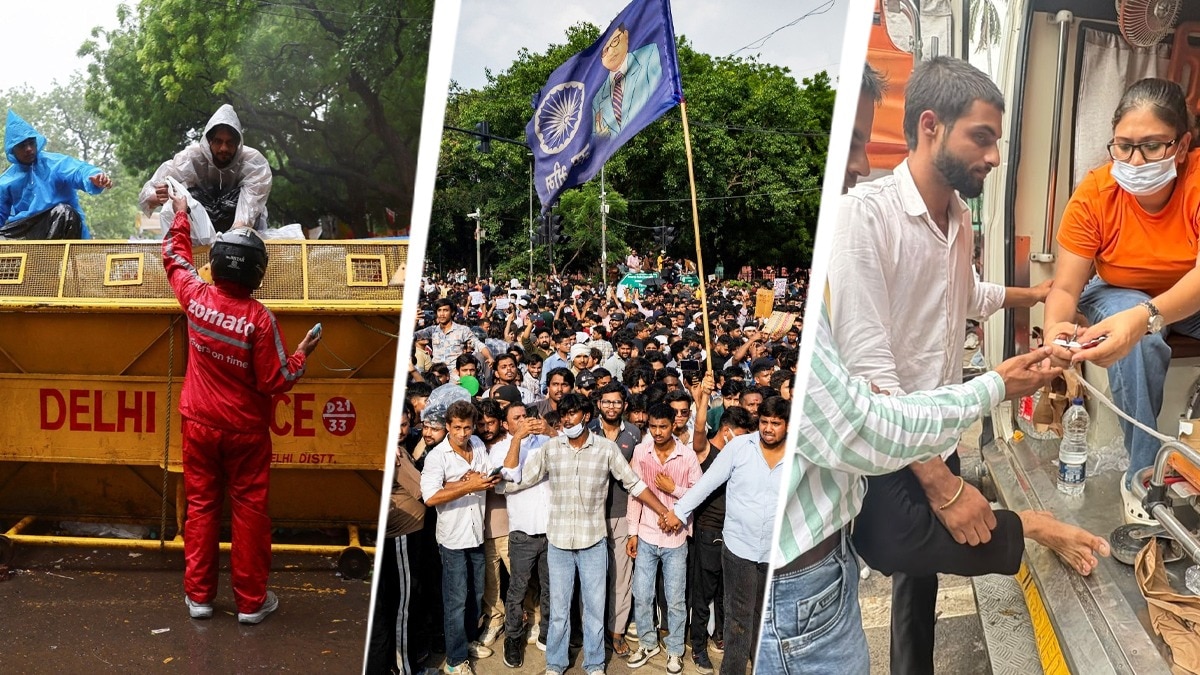
At Jantar Mantar, delivery workers, sanitation volunteers and doctors are quietly sustaining the Cockroach Janta Party protest. They might not be headlining the movement, but they sure are keeping it running.(L) A delivery boy handing over food at protest site (M) Human chain formed at CJP protest at Jantar Mantar (R) Doctors treating patients at the protest sit (Photo: Reuters)Who does a protest actually belong to? The person who started it? The people who eventually show up? Or the ones working quietly in the background just to keep it running? There's no single right answer — but one thing is hard to argue with: the dais and the microphone might belong to one person, or three, as is the case here, but neither survives a single day without the people doing the unglamorous, unavoidable work behind them — the medical aid, the food, the sanitation. The Cockroach Janta Party's site at Jantar Mantar is no exception.The delivery executivesYou've probably seen the videos: people from across the country ordering food and having it delivered straight to the protesters at Jantar Mantar. It's a fair question — why does this matter so much? Because a protest, at its most basic, runs on people staying fed and hydrated, and there are hundreds here who haven't been home in days. These parcels, sent from cities the senders may never visit, keep protesters going through the heat, the rain and the humidity. They're also something else entirely: a way for people who can't be at Jantar Mantar themselves to feel like they've still done something — even if it's just making sure one more person eats a proper meal that day. Delivery executives dropping water bottles at Jantar Mantar protest site. (Photo: Author) That's where the delivery executives come in. We watched several of them moving through the crowd, distributing water bottles and food packets sent in from elsewhere, handing them off to volunteers who made sure the aid reached the people who needed it most. Away from the cameras, there were smaller, quieter acts too — auto drivers in the area giving protesters lifts for next to nothing, at a time when several nearby metro stations had shut and overcharging would have been easy money.The sanitation volunteersIt's easy to admire the sheer volume of relief material pouring in — until you see what it leaves behind. On our visit, the streets near the site were lined with bags of food waste, plastic bottles, pizza boxes and paper bags. It was hard not to wince at first. But walking closer to the main stage told a different story: volunteers, many of them students from privileged families who could easily have stayed home, were out with brooms and garbage bags, doing the cleaning themselves. Volunteers clearing out the protest site. (Photo: Jigyasa Sahay) "We're simply grabbing gloves and trash bags and trying to clean up whatever's spilled on the roadside, as much as we can, on our own," said 27-year-old Radhika. "Towards the end of the road, there are a few spots where we're dumping the trash for now, which is then taken further ahead." She wasn't sure if anyone was collecting it regularly. We did spot an MCD garbage truck at the site, though we couldn't confirm whether pickups happened daily. Several volunteers trying to keep the protest site clean. (Photo: Jigyasa Sahay) The medical campsScattered around the protest site are several medical camps — orthopedics, general physicians, even pediatricians, all taking time out to be there. Friends and colleagues had pooled in money to help stock a decent supply of medical essentials, and camp after camp had volunteers doing their bit for the protesters at Jantar Mantar. Doctors treating people on the protest site. (Photo: Avinash Kateel) "We're all medical professionals volunteering here," said Sameya, an orthopedic doctor. "We've brought some basic medical supplies to help people out as best we can, especially in this weather." On July 20, when security forces fired tear gas shells and resorted to lathi charges during the Cockroach Janta Party's 'Chalo Sansad' march, it was these same doctors who tended to the wounded and treated people affected by the tear gas. It wasn't only protesters who came to them, either — we saw ordinary passersby walk up with unrelated complaints and get treated with the same patience and a smile.The human chainWhen the barricade at the site was breached, it wasn't the police who moved first to contain the situation — it was the volunteers and protesters themselves, forming a human chain to hold the line between the crowd and security personnel and keep any confrontation from spiralling further.It became necessary partly because policing at the site's own entry and exit points had visibly thinned out — left unmanned for stretches at a time — even as heavy security and barricades stayed deployed on the roads surrounding it. Into that gap stepped the volunteers, managing the crowd with a discipline that looked almost professional, averting what could easily have turned into a stampede. They held a proper queue, gave women and children priority through the entry and exit points, and weren't shy about calling out — loudly, publicly — anyone who tried to jump the line.The small actsPerhaps the smallest gestures at Jantar Mantar were also the ones that stayed with us the longest. There were people who spent hours simply fanning the person next to them in the heat — not themselves, but whoever happened to be sitting beside them. It took a while to notice, but once we did, it was hard to look away.Then there was a man walking through the crowd with a bag of roses, handing them out one by one. When we asked why, his answer was simple: "Agar police aa jaaye, unhe de ke bolna — aap tear gas leke aaye ho, hamare paas toh aapke liye gulab hai." (If the police come, hand this to them and say — you brought tear gas, we brought you roses.)And then there were the volunteers who simply refused to let anyone leave hungry or thirsty — pressing energy bars, water bottles, cold drinks and food into your hands, and insisting, every single time, that you take it.None of these people will end up on a banner, in a press quote, or on the six o'clock news. But ask the question we opened with — who does a protest actually belong to — and the honest answer at Jantar Mantar isn't the dais or the microphone. It's every hand that distributed a lunch, swept a street, cleaned a wound, or held out a rose instead of a lathi. A protest doesn't survive on conviction alone. It survives on the people nobody remembers to thank.- EndsPublished By: Tiasa Bhowal Published On: Jul 23, 2026 16:06 IST
The invisible workers of the Cockroach Janta Party protest
Full Article
Original Source
Read the full article at Indiatoday →KhanList aggregates and links to publicly available news content. We do not host full articles from third-party sources. Always verify important information with original sources.