
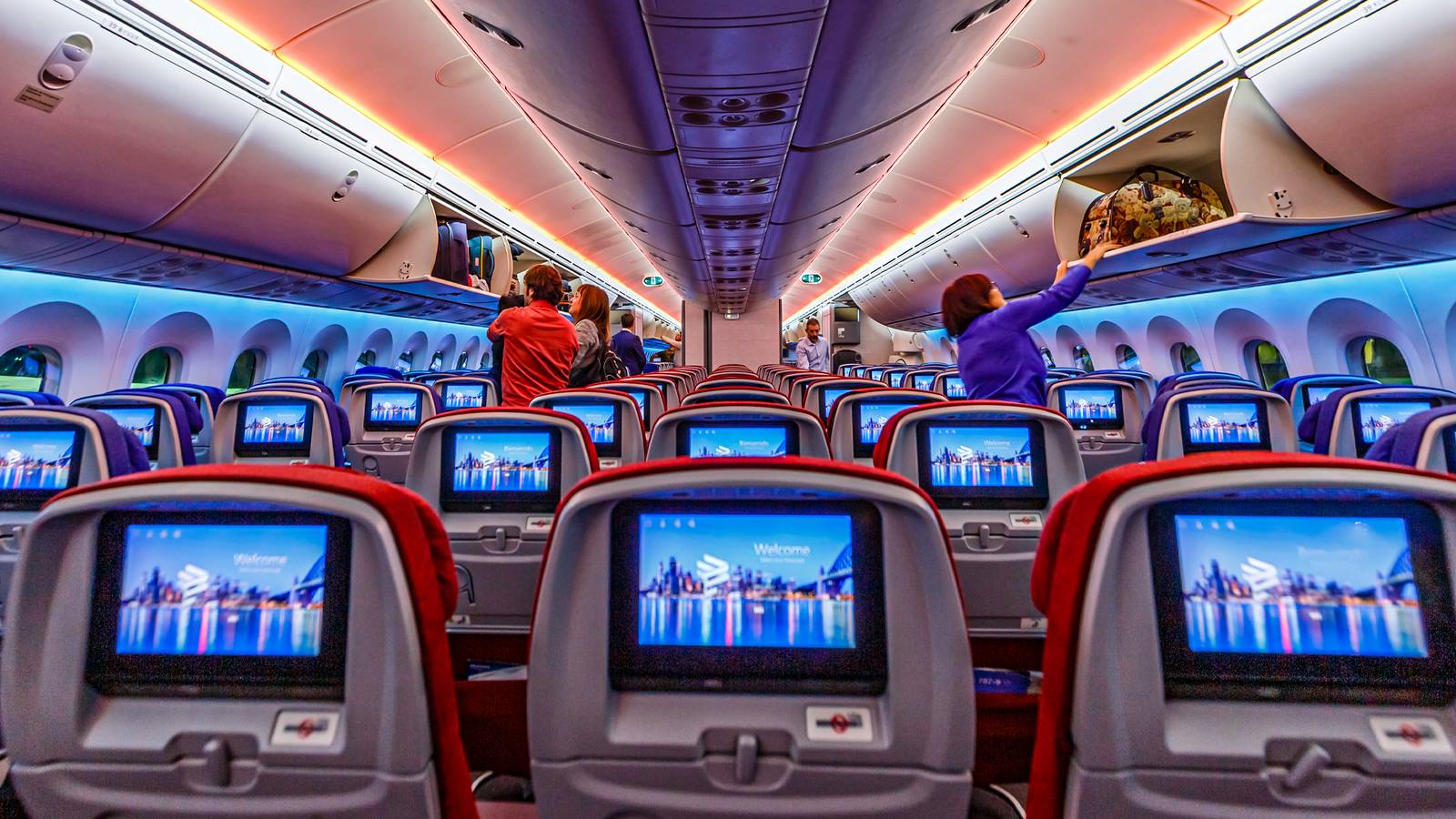
Commercial aircraft engineering has largely been defined by mechanical efficiency: range, fuel burn per seat-mile, payload capacity, and engine thrust. Boeing set out to design the 787 Dreamliner in the early 2000s, and the manufacturer shifted the design baseline toward human physiology. Recognizing that long-haul travel places immense strain on the human body, Boeing’s engineers sought to use advanced materials and systems to actively mitigate jet lag, dehydration, and high-altitude fatigue. The resulting passenger experience is defined by a 6,000-foot cabin altitude, a 9.06 psi pressure differential, 25% relative humidity, and windows 65% larger than industry standards. However, this physiological equation carries a notable commercial trade-off. While carbon-fiber composites and smart flight controls create one of the healthiest atmospheric environments in the sky, economic realities in the economy cabin work directly against those spatial metrics. Lowering The Cabin Altitude On conventional aluminum airframes, such as the 767 or Airbus A330, maximum cabin altitude at a typical cruising altitude of 40,000 feet is capped at approximately 8,000 feet above sea level. Boeing set the 787's maximum cabin altitude significantly lower, holding the interior environment at approximately 6,000 feet. This adjustment requires a maximum structural pressure differential (ΔP) of roughly 9.06 pounds per square inch (psi), compared to the 8.11 psi typical of legacy aluminum jets. The decision to target a 6,000-foot cabin environment was directly informed by medical research. A landmark study published in the New England Journal of Medicine evaluated human physiological responses across extended flight durations and found that after three to nine hours at a simulated cabin altitude of 8,000 feet, blood oxygen saturation SpO2 dropped by an average of 4.4 percentage points compared to ground-level baselines. The drop in blood oxygen saturation triggers the classic symptoms of long-haul travel fatigue, including headaches, cognitive sluggishness, and muscle aches. On the 787, blood oxygen levels are kept significantly closer to sea-level norms all through that 6,000 feet cabin altitude, directly reducing post-flight exhaustion. Sustaining an internal pressure of 9.06 psi without exceeding the structural fatigue limits of the airframe requires advanced materials. Traditional riveted aluminum fuselages expand and contract under cyclic pressurization, making high-pressure differentials a primary driver of metal fatigue and cracking over thousands of flight hours. The 787 solves this by utilizing carbon fiber reinforced polymer (CFRP) composites for roughly 50% of its airframe by weight, including the main fuselage barrel sections. Carbon fiber's high tensile strength and fatigue resistance allow the hull to withstand higher internal pressure stresses without structural degradation. The Bleedless Engine Design Alongside cabin altitude, relative humidity plays a pivotal role in inflight comfort. On conventional jetliners, cabin air is supplied by bleed air extracted directly from the compressor stages of the jet engines. Air at 35,000 feet contains virtually no moisture, and because traditional aluminum fuselages are highly susceptible to corrosion caused by condensation, a phenomenon known in aerospace engineering as cabin rain. Other airliners intentionally restrict cabin humidity to under 10%, which causes mucosal dehydration, dry eyes, and heightened fatigue during transoceanic flights, according to TravelGrom. The 787 removes this constraint through a bleedless engine design. Instead of piping hot compressor air from the engines into the cabin, the Dreamliner uses dedicated, electrically driven compressors to draw fresh outside air directly into the environmental control system. A composite CFRP airframe is completely immune to rust and moisture corrosion, so Boeing equips the 787 with active cabin humidifiers, pushing relative humidity levels up to 15% to 25%. As Simple Flying previously explored, the move to electric compressors also improves air purity. As a result of disconnecting the cabin air supply from the engine oil seals, the 787 entirely takes away the risk of synthetic engine oil fumes entering the passenger deck during severe seal wear, ensuring a cleaner, more consistent breathing environment. A Very Unique Window Looking from the inside, the most visually prominent feature of the 787 cabin is its window design. Measuring 10.7 by 18.4 inches, the Dreamliner’s windows are up to 65% larger than standard passenger aircraft windows, matching the vertical viewing dimensions of classic airliners like the Douglas DC-8. The size and positioning ensure that passengers seated anywhere in the cabin, including middle seats, maintain a direct line-of-sight view to the horizon. Rather than relying on traditional plastic pull-down shades, the 787 adopts electrochromic dimming technology supplied by Gentex. Embedded within the window assembly is an electrified gel layer containing light-absorbing particles. When flight crews or passengers adjust the control buttons beneath the window, small electric currents alter the alignment of these particles across five distinct opacity levels, transitioning from fully transparent to a deep blue dim state. These electrochromic windows block over 99.99% of visible light and thermal infrared energy in their darkest setting, keeping the cabin cool under direct sunlight without blocking the view outside entirely. Additionally, as noted in Simple Flying flight deck operational guides covering aircraft where cabin crew controls the view, flight attendants can centrally override individual window settings via the Cabin Services System (CSS) panel, ensuring all windows are instantly undimmed during takeoff, landing, or emergency situations to maintain external situational awareness. Making Turbulence Unnoticeable? Inflight turbulence is one of the leading contributors to passenger anxiety and motion sickness. To create a noticeably smoother cabin experience, Boeing combined the natural structural elasticity of high-aspect-ratio carbon wings with an automated, sensor-driven active flight control system known as Smooth Ride Technology. Unlike older aircraft that react only after turbulence displacements pass through the airframe, the 787 uses flush-mounted pressure sensors embedded in its nose cone to detect incoming vertical wind gusts milliseconds before they strike the lifting surfaces. The flight control computers process these pressure differentials instantly, calculating precise counteracting control surface adjustments. Complementing this predictive sensor architecture is the aircraft's wing design's shock-absorbing capacity. The 787’s long, sweeping wings feature raked wingtips and a high degree of structural flexibility under aerodynamic load. Built from carbon fiber reinforced polymer (CFRP), these wings bend upward and act as massive, organic leaf springs that absorb severe gust energy across the wing spar rather than transferring sharp G-force spikes directly into the fuselage frame. Simultaneously, the flight control system outputs symmetric micro-deflections of the trailing-edge flaperons, ailerons, and elevators, dumping or generating lift in real time to neutralize rough air. Human perception of motion still varies by cabin geography, with passengers seated over the wing box near the aircraft's center of gravity experiencing the most stable ride, while the aft cabin has a longer moment arm. Despite this, the integration of predictive active controls and composite elasticity makes traditionally jarring bumps become low-amplitude undulations. A Cabin That Needs A Specific Configuration The atmospheric, optical, and aerodynamic metrics of the 787 bring passenger comfort up to significantly higher standards than seen on airliners that came before, but one critical spatial dimension works directly against it: seat width in economy class. Boeing originally designed the 787’s interior cabin cross-section, measuring roughly 215 inches (546 cm) across, around an 8-abreast economy configuration arranged in a 2-4-2 layout. The intention was clear, but only a few carriers such as All Nippon Airways (ANA) and Japan Airlines (JAL) actually stuck to this configuration. In this intended baseline, individual economy seats would have offered an exceptionally generous width of roughly 18.5 inches, giving passengers ample lateral space on long-haul routes. However, as airline economics shifted toward higher-density passenger yield, other operators chose a 9-abreast (3-3-3) configuration instead. Fitting nine seats across a 215-inch cabin cross-section narrows individual seat width down to between 17.0 and 17.3 inches, making it noticeably tighter than legacy 8-abreast aircraft or widebody competitors optimized for lateral room. Compared directly with competitors like the A350 XWB, which features a wider cabin cross-section of 221 inches that comfortably accommodates 18-inch seat widths in a 9-abreast layout, the 787's design seems significantly less favorable for passengers. Passengers on the 787 must therefore weigh the distinct physiological benefits of a lower 6,000-foot cabin altitude and active humidification against a tighter lateral seating setup. Changing The Norms Of Passenger Comfort The engineering behind the 787 completely redefined how aircraft manufacturers approach long-haul passenger comfort. Taking on design priorities toward blood oxygen retention, active humidification, visual open space, and automated ride smoothing, Boeing proved that advanced materials and systems could be used effectively to actively mitigate the persistent strains of long-haul travel. The 787's commercial success demonstrates that while passengers may not consciously compute pressure differentials or electrical compressor systems, their bodies feel the difference upon landing. Lower fatigue, reduced dehydration, and less motion sickness have made the Dreamliner a preferred platform for ultra-long-haul, point-to-point routes worldwide. Ultimately, the Dreamliner stands as a study in modern aviation compromise. Common 9-abreast economy seating layouts squeeze lateral elbow room, but the cleaner air, higher cabin pressure, and smoother flight continue to set a gold standard for long-haul travel health and operational excellence.
The Hidden Math Behind The Boeing 787's Legendary Long-Haul Passenger Experience
Full Article
Original Source
Read the full article at Simpleflying →KhanList aggregates and links to publicly available news content. We do not host full articles from third-party sources. Always verify important information with original sources.