
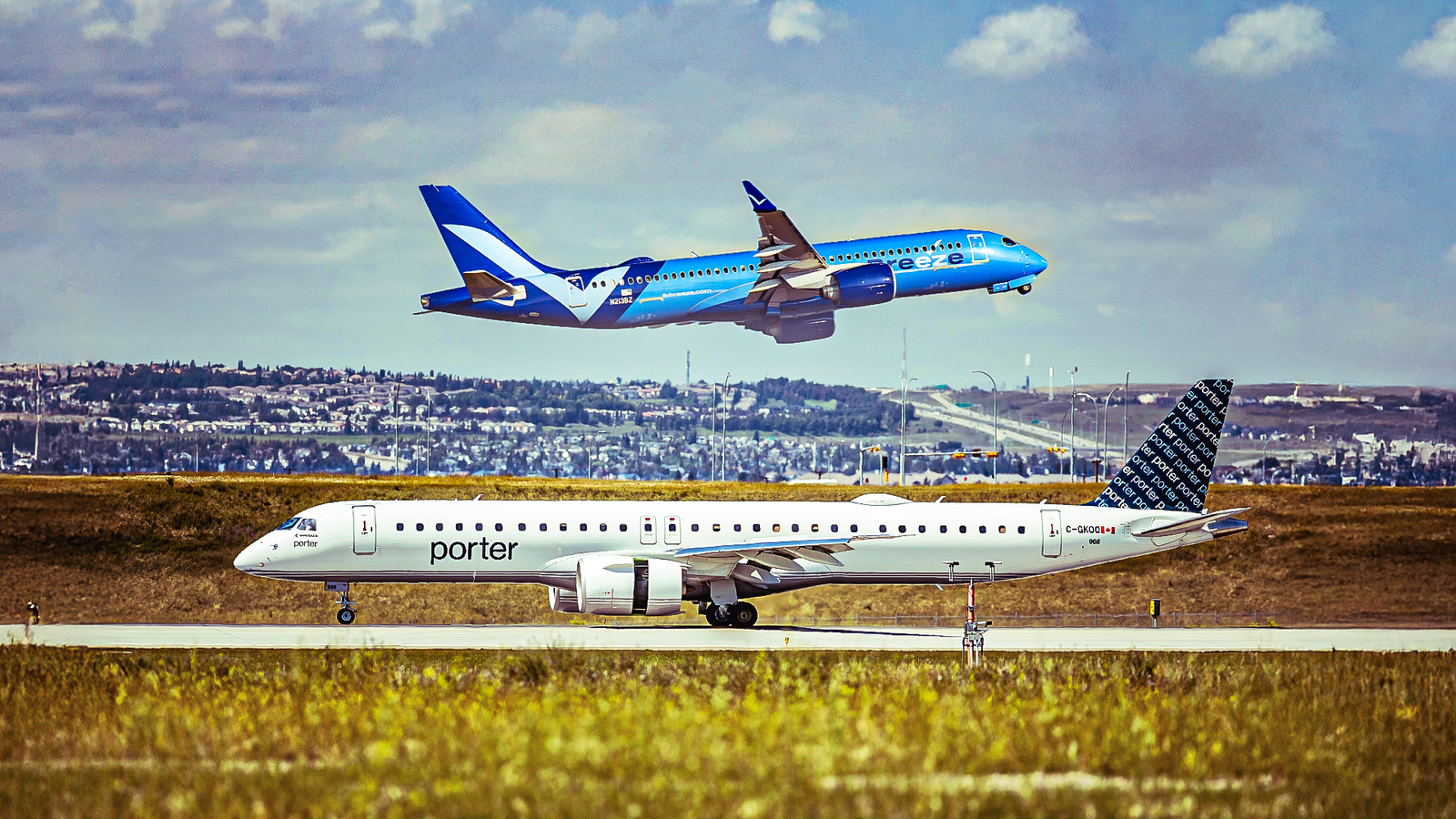
Published Sep 29, 2026, 2:00 PM EDT Daniel comes to Simple Flying with a business focused approach to the aviation world. Daniel enjoys analyzing strategy and how companies move against each other to gain a step ahead in the skies. Besides strategy, Daniel also has a passion for aircraft design and the history of aviation. Based in New York The Embraer E2 and the Airbus A220 are the two main players in the small narrowbody market. Within these families, it's the E195-E2 and A220-300 variants that have proven to be the most popular models, and they're quite competitive with one another. However, there's one benefit to the Embraer that's not discussed very often: the E2 is cheaper than the A220. This applies to purchase and ownership costs, but also in terms of fuel costs, as the E2 simply burns less fuel than its Airbus rival. In addition, airports tend to charge lower fees for the E2 than the A220. Charges like landing fees matter disproportionately more for small airliners like the E2 and A220 due to their low passenger capacity, but this also illustrates the E2's real advantage over the A220: size. The A220 is a much larger airliner than the E2 in terms of passenger capacity, but also in terms of its wingspan, fuselage size, and overall structure. This gives the A220 more range and payload capacity than the E2, but this only benefits the Airbus if an airline needs the extra capability. If it doesn't, then the E2 starts looking very compelling. Size & Weight Comparisons Credit: Matheus Obst I Shutterstock Airport landing fees are calculated differently by operator and may take into account the aircraft's certified Maximum Takeoff Weight (MTOW) or Maximum Landing Weight (MLW). Usually, airports calculate based on the weight that a specific aircraft is actually certified for, rather than the maximum that the aircraft type can be rated for. Still, the E2 is almost always specced with a lower MTOW and MLW than what a typical A220 is optioned with, given the overall size and weight difference between the two. The E195-E2, the largest E2 variant, can be specced with an MTOW of up to 62.5 tons along with an MLW of up to 54 tons. Meanwhile, the A220-300 (the largest A220 variant) comes with an MTOW of up to 70.9 tons and an MLW of up to 61 tons, nearly as much as the highest MTOW of the E195-E2. Flying the A220 means that airport fees are typically much higher, but it also demonstrates that the A220 is a much heavier plane, and that matters when it comes to fuel burn in particular. The E195-E2 will also burn less fuel per hour than the A220-300. Combined with the plane's lower landing fees and potentially lower pilot costs (the E2 pays less than the A220 at some airlines), the E195-E2 has noticeably lower trip costs than the A220-300. Then, when you take into consideration that the E2 generally comes with a lower purchase price/leasing costs than the A220, this makes the E2 a much cheaper aircraft to both own and operate compared to the A220-300, although the A220 has a major advantage. The Added Capabilities Of The A220-300 Credit: Austin Deppe I Shutterstock In an all-economy layout, the E195-E2 will seat between 130 and 140 passengers. This is similar to a two-class capacity for the A220-300, and when you move into an all-economy layout, you're looking at just under 150 passengers. The E195-E2 is certified with an exit limit of 146 passengers, whereas the A220-300's exit limit is set at 160 passengers. Although it's more expensive to own and operate, the A220-300 makes up for the added costs through the extra revenue offered by its capacity. Not only does the A220-300 seat more passengers, but it has more payload capacity than the E195-E2, and it can fly farther. The brochure range of the E195-E2 (which can differ significantly in real-world operating conditions for all aircraft types) is listed as 3,000 NM (5,600 km), whereas the A220-300's brochure range is listed as 3,400 NM (6,300 km). Aircraft Brochure Range Airbus A220-100 3,600 NM (6,700 km) Airbus A220-300 3,400 NM (6,300 km) Embraer E190-E2 2,950 NM (5,460 km) Embraer E195-E2 3,000 NM (5,600 km) The A220 is a much more capable aircraft that flies farther with more passengers and has competitive per-seat costs with its less expensive but less capable, smaller rival. In terms of size, the E195-E2 is roughly between the A220-100 and A220-300, while the A220-100 has even more range than the E195-E2. However, although the E195-E2 is a smaller aircraft than the A220-300, this is the variant that airlines put it up against because carriers often look at manufacturer packages as a whole rather than comparing specifications of two variants that are visually comparable. They are the most economical members of their families, and they are therefore more direct competitors than you realize. Sales Figures Of The A220 Vs The E2 Credit: Michael Derrer Fuchs I Shutterstock The Airbus A220 has received more than double the orders of the Embraer E2, and almost all of that is due to the A220-300. On its own, the A220-300 has received over 1,000 orders because, although the E195-E2 does have a trip and ownership cost advantage, the A220-300 fundamentally hits a stronger section of the market with higher demand. It has similar capacity and capability to an Airbus A319-100 or Boeing 737-700, while the E195-E2 is fundamentally evolved from a regional jet. However, with 464 orders, the E195-E2 isn't exactly a sales slouch either. The aircraft's lower capital costs make it quite appealing for airlines that don't need the A220's range or payload capacity, and its lower capacity is a benefit for some airlines. Another factor that has become a major advantage for the E2 is that it's generally available sooner for new customers. In the current age of supply-chain constraints, short lead times and reliable delivery dates have become very important, and the E2 has the advantage in this field. The A220-100 has only received 108 orders, while the E190-E2 has only received 76 orders (the A220-100's sales figures include orders for the corporate jet version). Neither is a bad plane, but they both face the same issue: they're smaller, and therefore less economical than their larger siblings since fuel burn is almost the same. Their lower capacity isn't a benefit because the operating costs are virtually the same, and their ranges are practically identical to those of the larger variants. The Thorn In The Side For The A220 Credit: Michael Derrer Fuchs I Shutterstock The Pratt & Whitney PW1000G is an amazingly fuel-efficient engine that has delivered fantastic cost reductions for airlines. There are three main variants, which are the PW1100G for the A320neo family, the PW1500G for the A220, and the PW1900G for the E2, and they've proven cost-effective on all three platforms. However, the problem with the engine is durability, as components of the engine have been wearing out prematurely, requiring early repairs and replacements. As such, Pratt & Whitney has been unable to meet the demand, resulting in aircraft groundings. All three variants have suffered durability issues, but the PW1500G has been particularly troublesome, and several A220 operators have therefore been impacted by expensive maintenance issues as well as groundings. This has led to EgyptAir and Air Austral retiring their A220 fleets altogether, while SWISS (the launch operator of the A220) is retiring its A220-100s to instead use their engines so that its more economical A220-300s may continue flying. The E2 has also experienced difficulties stemming from its Pratt & Whitney engines, but generally less so. A smaller percentage of aircraft have been grounded worldwide, and the PW1900Gs have not been as problematic as the A220's engines. Pratt & Whitney is rolling out improvements that should fix the issues, but for the time being, the E2 is actually the more reliable aircraft. This is a major benefit for the Embraer, although it should narrow once the engine improvements are fully implemented. The Contest For Small Narrowbodies Credit: Markus Mainka I Shutterstock Ethiopian Airlines has issued a request for proposals to Airbus, Boeing, and Embraer for roughly 25 new small narrowbody aircraft. It's actively studying the A220, the E195-E2, as well as the Boeing 737 MAX 7, and the results of this contest will be quite revealing as to the future of the market. Of the three, the 737 MAX 7 is the most interesting choice, as it's the largest, heaviest, and least popular of the three. Likely, it's being considered because Ethiopian already operates the 737, making it the easiest aircraft from an integration perspective. The E2 is the least expensive aircraft to own and operate, but it's the least capable and carries the least amount of passengers. Boeing's 737 MAX 7, meanwhile, is the largest aircraft with the best hot-and-high performance, but it also has the highest operating costs. The A220 falls in the middle. Which manufacturer will win the order comes down to what capabilities the airline requires and the deal that each manufacturer is willing to offer. The A220 generally appears to capture the sweet spot of the small narrowbody market, but the E2 has been increasing its sales figures in recent years and has established its own niche. Just as carriers such as LOT, AirAsia, and JetBlue have gone with Airbus, Embraer has won orders from airlines like SAS, Porter Airlines, and Avelo Airlines in recent years. In this specific contest, the 737 MAX 7 is the wildcard entrant, but generally, the E195-E2 and A220-300 have the small narrowbody market cornered, and each is as compelling as the other depending on the use case.
The Hidden Landing-Fee Math That Makes The Embraer E195-E2 Cheaper Than The Airbus A220-300 Per Trip
Full Article
Original Source
Read the full article at Simpleflying →KhanList aggregates and links to publicly available news content. We do not host full articles from third-party sources. Always verify important information with original sources.