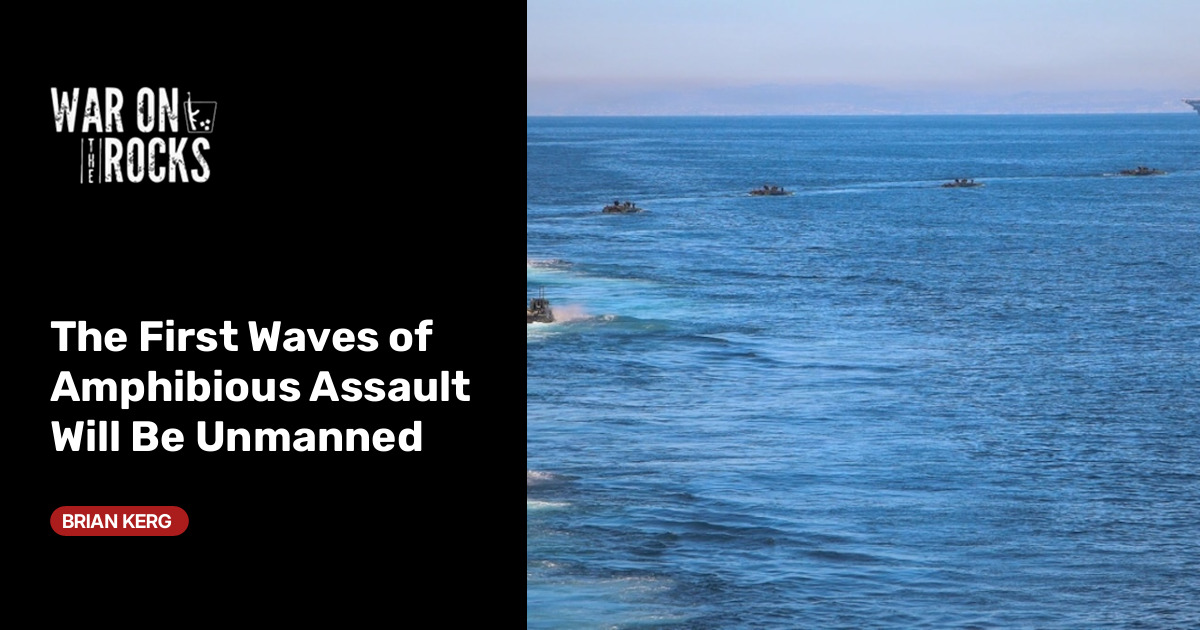
In the Pacific War, the U.S. Navy’s underwater demolition teams prepared the way for U.S. and allied amphibious landings on enemy-held islands. Through beach reconnaissance, obstacle breaching, mine clearance, and other missions, these teams paved paths for the first waves of amphibious assaults conducted by naval task forces and subsequent landings by marines and soldiers throughout the island hopping campaign. These critical first steps of an amphibious operation were incredibly risky in World War II. And the underwater demolition teams, which were the predecessors of the Navy SEALs, were understandably proud of their work. The Marine Corps prided itself on being first to hit the beach. And when marines did hit the beach, they often arrived to find signs left by the underwater demolitions team saying, “Welcome Marines.” Precision strike weapons make such operations more perilous than ever. There may never be an American servicemember preparing or landing with the first wave of an opposed amphibious assault again. And it may be robots welcoming marines and soldiers to the beach in these future fights. In the wake of the precision-strike regime, where surveillance is ubiquitous and belligerents can mass long-range strike capabilities cheaply and at scale, the likelihood of an opposed, large-scale amphibious operation succeeding appears increasingly bleak. Embarked forces on amphibious shipping are far too vulnerable so long as the attacker lacks command of the air and seas in the amphibious operating area. Naval task forces should successfully defend against every attack to maintain the viability of the landing force, especially during the window of vulnerability that characterizes the first waves that must seize and establish a lodgment. But the defender only needs to be right or lucky only once to send an amphibious ship full of thousands of troops into the briny deep, rendering the landing operationally infeasible, and perhaps making the military campaign politically untenable for the political leader who ordered it. The evidence of this hesitation to risk amphibious forces is evident in the dearth of opposed amphibious landings conducted since the precision-strike regime emerged. Many such operations have been planned, but nearly all have been abandoned as the risk to the force was just too great. When modern opposed amphibious landings occur, they do so only when the defenders lack substantial anti-ship weapons, and when the attacking force so overwhelmingly outmatches the defenders that they offer only token resistance. But this does not mean belligerents will never again attempt such operations. Rather, these operations are and remain viable by transferring and transforming the risk the attacking force assumes during the first phase of the assault. On July 13, 2026, the Ukrainian military released a video showing a remarkable breakthrough: the first completely unmanned amphibious assault. An uncrewed amphibious boat landed at a beach, dropped its ramp, and released an unmanned ground vehicle which moved ashore and opened fire by remote-control machine gun. The Ukrainian side did not, therefore, place at risk any human being during the amphibious phase of this assault. As with most technological leaps in warfare, the initial instance is often small, seeming to lack significance. In this instance, the Ukrainian operation involved only a single ship and a single ground vehicle. This is a far cry from a fully uncrewed Normandy. But adaptation at scale by a modern nation fully mobilized for war, like Ukraine, happens more quickly and feasibly than ever. It is reasonable to expect that within one or two years, such operations could occur, consisting of forces analogous to a manned brigade or larger. Even if the losses inflicted by a defending force were devastating, the attacking side could rapidly reproduce such equipment far faster than traditional amphibious capabilities designed to enable human survival, and without the political cost of losing thousands of lives. Uncrewed amphibious forces obviate the traditional and gravest risks of an amphibious assault. Those nations that adapt to this reality can execute such assaults as a viable course of action during future military operations. Risk Drives Hesitation for Manned Amphibious Waves Amphibious assaults are one of the most complex and dangerous military operations any force can undertake. They require extensive coordination among different military services that specialize in the separate operational spheres of warfare characterizing these assaults — navies afloat must project ground combat power ashore, while air forces secure the skies over both sea and land. Command-and-control issues abound. Among others, the main effort and supported commander change mid-operation as the attacking side constitutes the landing force ashore, an event characterized by friction and rife for enemy exploitation. The landing force is particularly vulnerable while embarked and moving to the shore. The amphibious task force remains in place as combat power is projected ashore and sustained, offering a lucrative target largely pinned to a single operating area for an extensive period. Sea states and weather conditions — uncontrollable factors — can turn the tide and doom an operation, no matter how well planned. Additional dangers exist, but the essential point is that it is far easier for the amphibious force to make mistakes or suffer from bad luck, while a defender ready for the coming assault holds myriad advantages in terms of time, space, and force. The defender’s advantage is at its zenith during the first waves of the initial assault. The critical task of landing the force largely pins the amphibious task force to the operating area, the assault force is incapable of contributing to the fight while moving from ship to shore, and the first waves to hit the beach are disorganized, unconsolidated, and easy targets while they seek to stabilize the beachhead. Only when significant combat power is ashore such that the landing force can break out of the lodgment does the attacker start to gain relative advantage. Military planners understood these risks before the emergence of the precision-strike regime. Massive amphibious assaults were possible and successful at points throughout World War II and the Korean War. But these successes were contingent on achieving surprise, local command of the sea and skies, and overwhelming mass and firepower relative to the defending force. Even in the latter stages of World War II, commanders carefully chose or abandoned amphibious operations with these factors in mind. The Allies shelved Operation Causeway, the planned attack on the imperial Japanese forces occupying modern-day Taiwan, largely because Taiwan’s geography alone gave the defenders too much of an advantage.The risks presented to opposed amphibious assaults have only grown with the technological advances leading to the precision-strike regime. Quite simply, an enemy that can see and strike the amphibious force is one that will not face an amphibious assault. The Falklands War was perhaps the transition point at which this operational risk became gravely apparent to operational planners. Before the campaign, British Adm. Sandy Woodward recognized that the loss of but a few key ships would make a continued naval campaign infeasible. He quite nearly reached the point of aborting the campaign. The British amphibious task force, detected by Argentinian forces and in range of strikes, was subjected to sustained air and missile attacks that nearly rendered the naval campaign infeasible. Argentinian forces did not stop shooting because of British actions, but only because they ran out of Exocet missiles. American military officers planned Operation Desert Storm, conducted a few years later, in the shadow of the Falklands War. Many of these officers deeply studied the Falklands War at American war colleges prior to going to war with Iraq, and those studies shaped the war plan and amphibious doctrine. Gen. Norman Schwarzkopf famously scrapped plans to use two Marine expeditionary brigades to liberate Kuwait City with an amphibious assault because the risk to amphibious shipping and their embarked forces was too high. Schwarzkopf abandoned this plan due in large part to Iraq’s naval mining of the Persian Gulf, as well as concerns of Iraqi anti-ship missiles, including the still haunting Exocet. That risk has only accelerated as the battle-network of surveillance, reconnaissance, and strike warfare matures and proliferates. Moreover, such weapons and networks have become affordable and obtainable at scale. This is evident in the ability of powers to strike at maritime targets even when there is no intent to put forces ashore. Despite Operation Rough Rider, a March 2025 campaign of punishment inflicted by the United States against the Houthis, the Houthis can still strike nearly at will within the Red Sea. Ukraine, without a navy, rendered the Russian Black Sea fleet rudderless. Iran, in the face of sustained and withering strikes from the United States and Israel, can still deny access to the Strait of Hormuz. This gap between defender and attacker in amphibious assault has only widened, evidenced by the continued phenomenon of amphibious assault plans dying on the vine. In the opening weeks of Russia’s 2022 invasion of Ukraine, Russia’s navy massed landing ships in the Black Sea in hopes of conducting an amphibious assault at Odesa, but Ukraine sunk the Russian Black Sea Fleet flagship Moskva with Neptune missiles and struck other landing ships, forcing the Russians to withdraw their fleet and spike the plan. As the war between the United States and Iran continues, talks of an amphibious assault on Kharg Island arise, but go nowhere. Despite having the most massive and rapid buildup in naval military power the world has ever seen and a constant campaign of regional aggression, China has not attempted an amphibious assault on Taiwanese territory since 1955. The last known major opposed amphibious assault on record — defined here as consisting of at least a brigade-sized element and attacking a significantly defended area — was the Sri Lankan Armed Force’s Operation Balavegaya in 1991. Such a feat was possible only because the defenders, the Liberation Tigers of Tamil Eelam, had nothing in the way of anti-ship weapons that could have held Sri Lanka’s amphibious shipping at operational risk. While there have since been amphibious landings of many sorts, they have not been against seriously defended areas, and not against enemies who could target the attacking force’s ships. This suggests policymakers and military commanders alike recognize that manned, opposed amphibious assaults are not presently feasible, operationally or politically. Operationally, the large amphibious ships built to embark, host, transport, and land the landing force are too vulnerable given the realities of the precision-strike regime that decidedly favor the defender. The loss of a single major ship could render the entire operation untenable due to the loss of combat power necessary to prosecute and complete the landing and follow-on operations. Politically, the loss of even a single ship puts the attacking country’s executive in a brutal dilemma. The military defeat of the operation and the loss of so many lives drives political leaders into two dismal options: withdraw in embarrassing defeat to prevent further losses and ire from their electorate, or pursue massive military escalation to salvage the war effort and their political support. Savvy leaders anticipate this dilemma and seek to avoid it by not selecting high-risk, opposed amphibious assaults which place thousands of young servicemembers in a precarious position. If you take humans and large, expensive ships out of the equation, this changes. Unmanned Landings Transform the Risk Decision An unmanned amphibious assault wave is not a potential political liability, nor is it likely to be an operational liability — at least not nearly to the same degree that a manned amphibious assault is. If unmanned boats and robotic attackers are struck and sink to the ocean floor, there is no sudden and massive loss of human life. A political leader does not need to explain why the sacrifice was worth the political objective that may no longer be obtainable, nor does the loss encourage massive retaliation and escalation. This has borne out in prior military cases featuring the loss of unmanned assets. In June 2019, Iran shot down a U.S. Navy RQ-4A Global Hawk surveillance drone over the Strait of Hormuz. While the incident raised tensions and nearly produced retaliatory strikes, these were ultimately called off and tensions rapidly cooled. In contrast, after Iranian forces shot down a U.S. F-15E Strike Eagle over Iran in April 2026 during Operation Epic Fury, massive retaliatory strikes and threats of escalation against Iran accompanied the follow-on combat search and rescue mission for the human pilots. The rescue itself entailed incredible risk to the rescue force and resulted in aircraft loss and damage. Moreover, landing craft built specifically for a robotic landing force are cheaper and faster to manufacture than traditional L-Class ships. These landing craft must account for a host of life-support systems and require force protection and defense systems to protect their very precious human cargo. This cost, compounded by the investment in manning, training, and equipping the ship’s company, further incentivizes navies with amphibious forces to build relatively few of these ships, rather than a massive fleet of smaller amphibious ships that could complicate an enemy’s targeting dilemma. L-class ships and landing craft designed exclusively for an unmanned assault force don’t require such considerations, which significantly reduces their cost and allows nations to more quickly build and replace them. The rate at which a mobilized nation such as Ukraine can replace the drones it expends daily in operations against Russia offers a useful starting point in assessing how quickly and cheaply the rate of production and combat replacement can overcome combat losses. These same manufacturing differences translate into the ability to produce many small and inexpensive landing vessels, which would complicate the defender’s targeting efforts, rather than a few large amphibious ships that would be subject to discovery and massed fires that could easily overwhelm their air defenses.Considerations Despite their enormous risks, amphibious assaults offer critical options to commanders otherwise limited by geography and position. They can bypass massed forces and strongly defended points, insert ground forces into an enemy’s rear area, and create sudden or renewed momentum for a military campaign. While the shifting technological tide favoring counter-landing operations has largely obviated the amphibious assault since the Falklands War, the proliferation of unmanned systems across the air, land, and sea offers a chance to interrupt this dilemma by removing or reducing the political and operational risks inherent in amphibious assaults. Rapidly capitalizing on this technological moment will be key to ensuring American leaders have maximum options for military campaigns, translating into greater latitude to pursue strategic objectives in foreign policy and war. But the obstacles are many. Given that the United States is not presently under military pressure, it may be too slow to develop such a capability. In a fiscally restrained environment where demand for resources to supplement a host of technological adoptions is soaring, this is one more competing request for dollars. Such a shift raises key questions for the Force Design initiative that has dominated transformations within the U.S. Marine Corps since 2020. The Marine Corps moved away from opposed forcible entry at scale precisely because of the rise of the precision-strike regime, in favor of expeditionary advanced bases and stand-in forces. Recalibrating U.S. amphibious forces again and so suddenly based on new technological possibilities could appear as an abrupt and unsupportable U-turn for a host of practical, financial, and political factors. Even if pursuit of these capabilities made military sense, some key corners of the Marine Corps and the Department of Defense may be loath to pursue them. Still, amphibious operations writ large remain a core competency, crown jewel, and legal mandate for the Marine Corps. As for amphibious assault specifically, there is still a line of thought within the service that sees assault in some form as a future capability. The unclassified executive summary the Marine Corps Warfighting Lab recently published — 21st Century Concept for Amphibious Operations — anticipates, among other things, the seizure of key maritime terrain, the penetration of contested areas in conflict, and the proliferation of unmanned systems for amphibious operations. Because the authors of this concept envisioned a 2040 to 2045 time horizon, and published it before the first completely uncrewed amphibious assault demonstration by Ukraine, the Marine Corps would be well served by reframing its assessments and time horizons for the implications for future amphibious operations. There is risk of leaping too far forward into adoption or assuming away the role of humans in amphibious operations. The first wave of an amphibious assault assumes the greatest risk and is the decisive point where belligerents should offload such risk to unmanned systems. Amphibious assaults are not objects unto themselves, but they support follow-on operations in support of a campaign. It is unclear if an uncrewed landing could do more than land on a beach and establish initial combat power ashore. Can they stabilize and expand the lodgment? Can they break out of the lodgment and move on to attack nearby objectives, such as ports, airfields, and crossroads? Such possibilities may represent a technological aspiration, but no one has yet demonstrated them. In the meantime, follow-on waves beyond the first will almost certainly require human formations to employ other elements of combat power that enable such operations, as well as to maintain and repair these systems to keep them in the fight to either maintain combat power at the beachhead, or to otherwise support follow-on human waves. Finally, the proliferation of such unmanned technology may render similar advantages to belligerents defending against an amphibious assault. If defenders anticipate or detect the landing, they could deploy drones at scale to neutralize the uncrewed attacking force at sea or at the beach. If two such opposing robotic forces collide, the contest will become one of mass, attrition, production capacity, and replacement speed. But the central advantages making this an option to the attacker remain. Politically, this is more acceptable than loss of life. Militarily, this is more acceptable than the loss of human forces and large, expensive amphibious task forces, each of which takes years to train and produce. And if the attacker’s industrial base lets them outproduce the defender, they have the option of using brute force and mass to overwhelm a landing site or hit more landing sites than their opponent can defend. Despite these challenges, the technology and opportunity are present. As with every new leap in military technology, fortune favors the bold. If any nation hopes to maintain amphibious assaults as a military option, it must mitigate the increasing military and political risk that so heavily characterizes the first waves of these assaults — they can do this by embracing unmanned amphibious solutions.Brian Kerg is a Marine Corps operational planner, communications officer, prior enlisted mortarman, a nonresident fellow in the Indo-Pacific Security Initiative at the Atlantic Council’s Scowcroft Center for Strategy and Security, and a board member of the Military Writers Guild. He is currently serving as a Commandant of the Marine Corps Strategist Fellow at the University of Notre Dame. The views in this article are those of the author and not those of the Marine Corps, the Department of Defense, or any part of the U.S. government. **Please note, as a matter of house style, War on the Rocks will not use a different name for the U.S. Department of Defense until and unless the name is changed by statute by the U.S. Congress.Image: Seaman Adam Bishop via DVIDS
The First Waves of Amphibious Assault Will Be Unmanned
Full Article
Original Source
Read the full article at Warontherocks →KhanList aggregates and links to publicly available news content. We do not host full articles from third-party sources. Always verify important information with original sources.