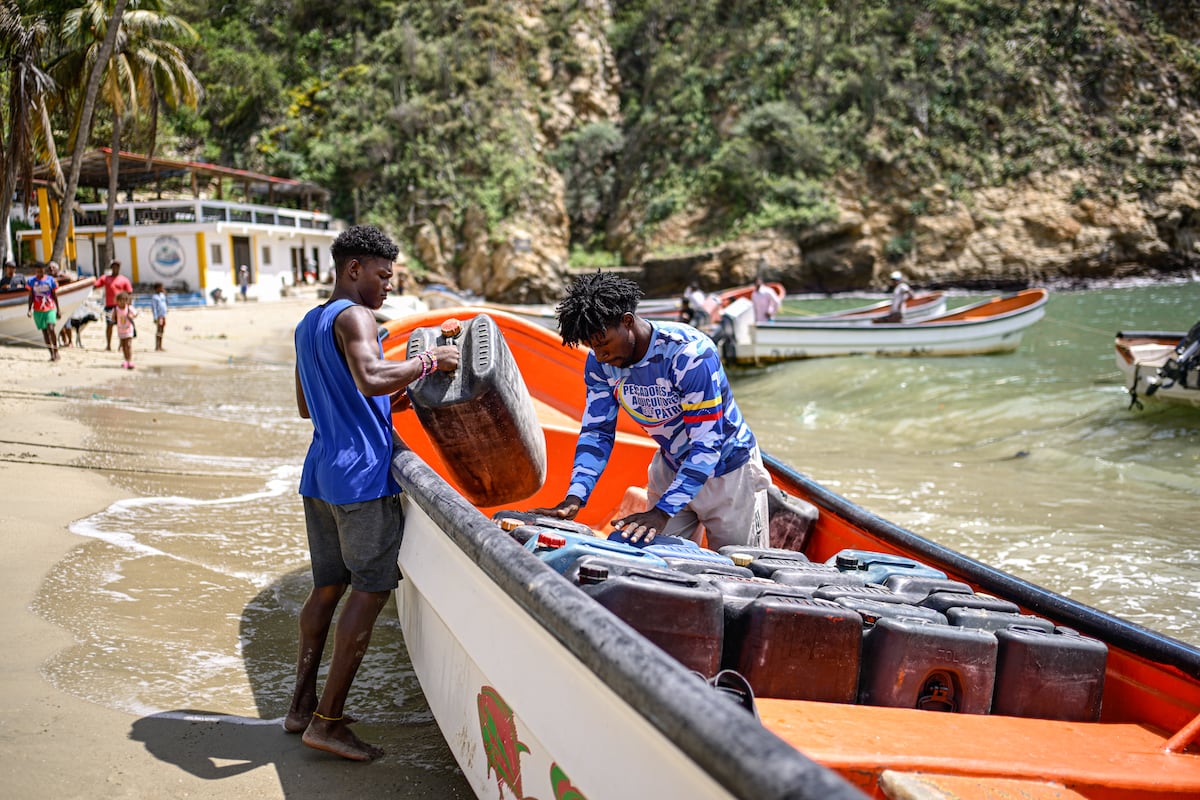
It is midday on the Venezuelan coast, but the breeze feels like evening. The waves cross at odd intervals, silencing everything on the boat and making it feel, at the very least, like a rollercoaster. “You have to feel the sea to be able to cross it,” says Will from the stalled engine of his fishing boat. The boat has been used to carry donations to towns such as Puerto Cruz, Puerto Maya, and Cepe, about two hours by boat from La Guaira, the coastal city hardest hit by the June 24 earthquakes. The quakes left these coastal communities partially cut off from Catia del Mar, their main source of supplies.Brisón is a word heard along Venezuela’s central coast to describe that strange breeze — not very strong, not very cold, but rare — that began that day at 6.00 p.m. during the San Juan festivities, when the ground opened. Since then, the sea has behaved differently and locals do not want to bathe. They fear the water more than solid ground. That day, during the quake, the sea pulled back several meters, leaving the boats that usually anchor in the water stranded on the sand, yards from the shore. “I’m afraid my youngest son will go swimming and the sea will take him if it pulls back again, because that was very strong,” Brígida says in Puerto Maya, tears in her eyes.As soon as the earthquakes ended, a tsunami alert was issued in Venezuela, forcing everyone to abandon the sea. For days, coastal villagers gathered to sleep in town squares or in their characteristic cacao-drying yards. “We don’t know what this means. We only know we had never experienced anything like it and our ancestors never saw it,” Enrique Liendo says from his hammock in Cepe, at the water’s edge.Eighteen days later, an aftershock with an epicenter at sea renewed fears along the entire coast. “The sea is like it is in December — you have to respect it,” Laurimar Salazar says from her wheelchair in Puerto Cruz as she supervises repairs to her restaurant, Mamita, which collapsed in the earthquakes. “Here, whoever comes I will serve, even if I have to go to Caracas to buy supplies from now on,” she sighs.In Chichiriviche de la Costa, Puerto Cruz, Puerto Maya, and Cepe there were no human casualties and the damage to houses is not comparable to the widespread destruction in La Guaira. But they cannot supply their shops and pantries because their main provider was Catia La Mar, and now they must travel by land to more distant towns or, if they are among the luckier, shop in other cities. “On the first day, if we received a little kilo of rice it was hugely appreciated, but the other day I had to go to Carayaca to shop and that’s an hour by road from here,” Rosa María Liendo says in Chichiriviche de la Costa.— How are things around here?— Quiet.Marbelis Meléndez was in the shade of a tree at the water’s edge in Puerto Maya when a boat arrived with two people who were not from the town. “Come see how my house turned out, we need help,” she said, not knowing who they were. “No one has come here, we don’t know what to do to get the bags of cement we need to rebuild our room.” Together with her cousin Brígida, she set off from the beach, crossing two rivers on foot and climbing a hill, to show at least four collapsed houses and another six with walls cracked by the quakes.Most of the houses that collapsed were slightly larger than a double bed and were handmade from unfinished concrete blocks sometimes held together with cardboard or bahareque (a system of interwoven sticks or reeds, with a covering of mud), always without plaster. “This is my little room. That wall fell on top of me and I had to pull my mother out of the rubble alive,” Brígida says, referring to Mrs. Marcimina, who, ever since that day, has been collecting the blocks one by one to carry them from her room to the drain, blocking the only water outlet in the area.“And now what do I do? Where do I go if the ground keeps opening?” Karina Blanco thought as she watched her house collapse. Since she arrived in Puerto Maya with her mother 21 years ago from Colonia Tovar, her house has always been at risk of falling because it sits next to the ravine. “The first time the river rose it knocked down one of my rooms. Every time they said the river was rising I would grab my things and take them up there. I know it was worse in La Guaira than here, but the truth is you need a home, and if they gave me a house somewhere else I would accept it,” she says.One of the businesses in front of the pétanque court hosts a Starlink antenna that mitigates the lack of phone service in the area. A few months ago the antenna of the town’s only operator (a state-run company) collapsed and since then everyone has been without signal. When the power goes out there is neither WiFi nor antenna. This happens for more than five hours a day because of an unofficial, rotating power-rationing system that has affected many towns outside Caracas for years, and that has now been prolonged after the earthquake.The boats, which are the main means of communication between coastal towns, operate on restricted fuel supplies. They must sail for over an hour to La Zorra Port to refuel. Now, they usually gather the town’s jerry cans on a single boat to fill as many as they can and share them out. With the little gasoline they get, they go out fishing and carry supplies to other towns.Fishing has also suffered because the earthquake changed the seabed. In Trinidad, the island off Venezuela’s eastern coast, the ground rose six meters after the quakes; NASA also confirmed that the earthquakes displaced the earth’s surface by up to 60 centimeters, drastically altering local geography; and in Chichiriviche de la Costa fishermen have seen sand replaced by rock and previously 10-meter depths now deeper. “After the tremor we were catching many fish, but for about two days now nothing has been found out there,” Enrique Liendo explains.Locals trust that tourism will return. “We believe more people will start coming here now because La Guaira was left without beaches,” Will says from his boat. Meanwhile, six tourists from Barquisimeto arrived in Choroní and from there came to Cepe as the first adventurers. “We had a trip planned and, seeing that everything here was fine, we came.” That is why La Morocha opens every day in the hope someone will arrive; Richard prepares passion fruit guarapo in the freezer and Micaela De Fisher, the town’s retired schoolteacher, keeps her guesthouse open daily. They know they must carry on.Sign up for our weekly newsletter to get more English-language news coverage from EL PAÍS USA Edition
The earthquake beyond La Guaira: Venezuelan coastal towns cling to the sea
Full Article
Original Source
Read the full article at English →KhanList aggregates and links to publicly available news content. We do not host full articles from third-party sources. Always verify important information with original sources.