
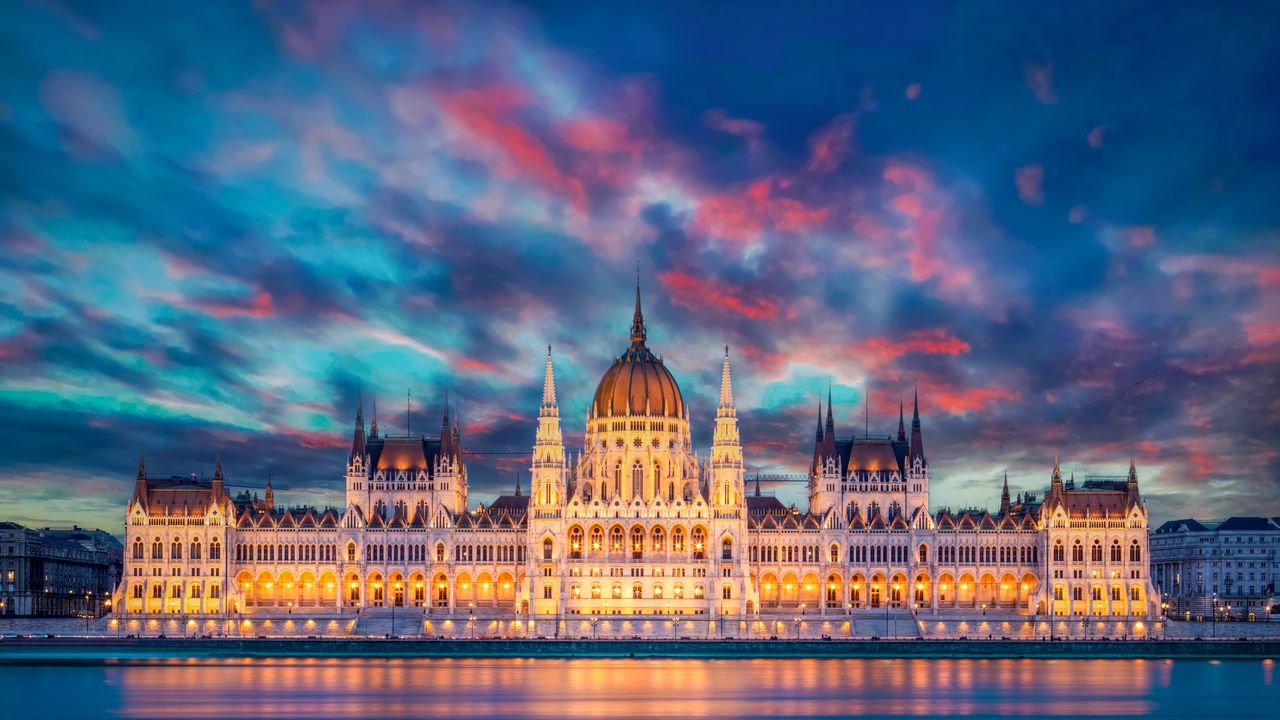
The style reemerged nearly 500 years after it first appeared, fueled by nostalgia, Romanticism, and national prideThe Hungarian Parliament Building in Budapest, Hungary.Photo: Amith Nag Photography/Getty ImagesSquint at most beautiful Gothic Revival buildings and you can practically picture a stonemason from the Middle Ages on the premises. But in truth, most of these buildings are significantly newer than they appear, often constructed between the mid-18th and early-20th centuries. The Gothic Revival movement (also described as neo-Gothic style) reimagined elements of Gothic design—think pointed arches, ribbed vaults, flying buttresses, and soaring spires—but nearly 500 years after the original aesthetic emerged. Where traditional Gothic architecture (a fixture of Europe’s 12th to 16th centuries, think Basilica of Saint-Denis to the Canterbury Cathedral) grew out of engineering breakthroughs and religious devotion, the revival was a deliberate stylistic choice, driven largely by nostalgia, national identity, and Romanticism. Below, discover 9 beautiful Gothic Revival buildings that every architecture fan should know.Photo: Sam Mellish/Getty ImagesStrawberry Hill House (Twickenham, England)In 1749, British politician Horace Walpole began the construction of his summer residence, a home he called Strawberry Hill House, in Twickenham. His sprawling property took direct inspiration from Gothic buildings, and was complete with battlements, turrets, and a gallery ceiling crafted to imitate medieval stone vaulting in papier-mâché.Often cited as the first Gothic Revival house, it marks the moment in architectural history where the historic style became fashionable again. “Medieval style started to be associated with the romantic spirit and appreciated as a contrast to classical rules [which had been popular just before],” explains Nicole Krammer, principal at Studio Karalis.Photo: Gary Yeowell/Getty ImagesPalace of Westminster (London, England)Often flocked by tourists squeezing in to capture photos with Big Ben, the Palace of Westminster (also known as the Houses of Parliament) was rebuilt after a catastrophic 1834 fire destroyed most of the medieval palace. Parliament required a Gothic or Elizabethan structure for the new building. The winning plan, conceived by architect Charles Barry, paired a symmetrical layout with Gothic interiors, including stained glass and brass work, designed by A.W.N. Pugin. Completed around 1870, the Palace of Westminster established Gothic Revival style as part of British national identity. The palace, which also drew inspiration from the adjacent Westminster Abbey, is also a UNESCO World Heritage site.Photo: Izzet Keribar/Getty ImagesSt. Patrick’s Cathedral (New York City, New York, USA)Hemmed in by Midtown’s skyscrapers, St. Patrick’s Cathedral, which was designed in 1858, still commands attention on Fifth Avenue. For its design, architect James Renwick Jr. drew on European Gothic cathedrals, including Cologne Cathedral in Germany. The result is a white marble structure with twin 330-foot spires and a grand rose window, the crown jewel of its stained-glass windows. It is the largest Roman Catholic cathedral in the US, and, since 1976, also a National Historic Landmark.The church’s sheer scale also displays how Gothic Revival architecture was adopted and embraced by larger civic projects. “These buildings used Gothic style to absorb a fundamentally modern agenda: new urban scale, new iron construction technology, new civic ambition, while still carrying ecclesiastical craft and rich materiality,” explains Dan Kaplan, senior partner at FXCollaborative Architects LLP.Photo: Getty ImagesHungarian Parliament Building (Budapest, Hungary)Overlooking the Danube in Budapest, the Hungarian Parliament Building was designed by Imre Steindl and completed in 1904. The Houses of Parliament at Westminster and English Gothic architecture were the clear inspiration. With pinnacles, pointed arches, and an unmissable soaring dome, its riverside façade blends Neo-Gothic design with Renaissance and Baroque touches.A notable fact: The building stands 96 meters—about 321 feet—tall, a nod to 896, the date of Hungary’s founding. By law, no other building in Budapest can be built taller than 96 meters, making the Parliament building one of the tallest structures in the city (the only exception being the 143-meter MOL Campus, designed by Foster + Partners, which received planning approval before the ban took full effect).Photo: Ziao ZhouSmithsonian Institution Building (Washington, DC, USA)In 1826, James Smithson, a British chemist and mineralogist, wrote a will leaving his estate to his nephew, Henry James Hungerford. There was one stipulation: If Hungerford died without an heir, the fortune would go to the United States to found “an establishment for the increase and diffusion of knowledge.” No heir was ever born, and with Hungerford’s passing in 1853, the bequest launched the Smithsonian Institution.The organization’s first office—often called “the Castle”—was designed by James Renwick Jr. and completed in 1855. The red sandstone building has a number of Gothic touches, including clusters of towers that give the building its storybook profile and battlements and turrets that evoke a medieval fortress.Photo: Andria Patino/Getty ImagesWoolworth Building (New York City, New York, USA)Soaring 792 feet above Broadway near City Hall Park in downtown Manhattan, the Woolworth Building was the world’s tallest when it opened in 1913. Financed in cash by five-and-dime magnate F.W. Woolworth, architect Cass Gilbert fashioned a steel skyscraper with pinnacles, gargoyles, and a vaulted lobby that make it distinctly Gothic Revival in style. Nicknamed the “Cathedral of Commerce,” it shows how the Gothic Revival style was adopted beyond just churches and parliaments.Photo: Philip Dumas/Getty ImagesTrinity Church (New York City, New York, USA)Another fixture of Gothic Revival architecture in New York City, Trinity Church in downtown Manhattan has served the area since 1697, though the present building, designed by English-born Richard Upjohn, was consecrated in 1846. Its brownstone design includes a 281-foot spire that made it the city’s tallest structure until 1890.The church became a template for American Gothic Revival churches, with its cruciform plan, buttressed walls, pointed-arch stained-glass windows set within stone tracery, and ribbed interior vaulting.Photo: Michael Kaletha/Getty ImagesCologne Cathedral (Cologne, Germany)In 1248, construction began beside the Rhine River in Cologne for a cathedral, but stalled around 1473. Its towers were left unfinished for centuries, but work fatefully resumed in 1842 when the medieval plans were rediscovered. Finally in 1880, the twin 515-foot spires were completed and the building was officially done. A UNESCO World Heritage site, it represents Gothic Revival style because 19th-century builders finished the original medieval design, replete with flying buttresses ringing its choir and gargoyles lining the walls. Germans also embraced the project as a symbol of national pride: Completed just after Germany unified in 1871, the finished building read as a monument to the new nation.Photo: Bruce Yuanyue Bi/Getty ImagesSt. Pancras Station & Hotel (London, England)The St. Pancras Station and Hotel are actually two buildings in one. Architect William Barlow’s train station, opened in 1868, spans 243 feet in a single wrought-iron arch and rises about 100 feet above the platforms. Five years after the opening of St. Pancras Station, George Gilbert Scott’s Midland Grand Hotel (now the St. Pancras Hotel) officially opened, built as a direct attachment to the station. The hotel boasts a red-brick façade of gables, turrets, and a clock tower, with a sweeping interior staircase (to describe it as breathtaking would be an understatement). After a 62-year run as the Midland Grand Hotel, it was transformed into railway administrative offices for a period before finally reopening as the luxury St. Pancras Renaissance Hotel in 2011. St. Pancras Station is also still fully operational, remaining one of London’s busiest transportation hubs.“The thin steel arches supporting expanses of glass make it feel like a cathedral to rail travel,” says Ross Padluck, partner at Kligerman Architecture & Design. He notes that some parts of the façade lean more Romanesque, like the tan-and-red checker arches on the exterior. However, “those same arches are also pointed and adorned with quatrefoils, key elements of the Gothic Revival,” he says.All in all, St. Pancras is a sight to behold. “It certainly makes one long for the era of elegant rail travel,” adds Padluck.
The 9 Most Beautiful Gothic Revival Buildings Prove Some Design Is Too Good to Stay Gone
Full Article
Original Source
Read the full article at Architecturaldigest →KhanList aggregates and links to publicly available news content. We do not host full articles from third-party sources. Always verify important information with original sources.