
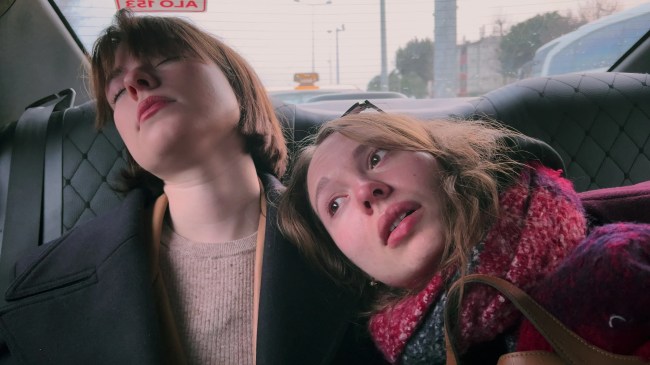
The first part of Julia Loktev’s riveting dissident journalism saga, “My Undesirable Friends,” saw the collapse of Russia’s last remaining independent news channel happen in real time. The second part, “My Undesirable Friends: Part II — Exile,” follows those voices of TV Rain in global freefall after fleeing their country following Putin’s invasion of Ukraine in 2022 — as they try to reconstitute and reckon with the guilt and shame they feel over leaving Russia and over Russia’s fascist-imperialist actions. The staff, a network of mostly women, found targets on their backs in the lead-up to the war as they were labeled “foreign agents” by the Kremlin for disseminating news deemed critical of Putin’s regime. In “Exile,” they’re now spread across Eastern and Western Europe, jettisoned out of the homeland they’re now beginning to recontextualize under accusations of espionage. “It took him starting a war for us to understand that this is fascism,” one of our “foreign agent” protagonists says early in the film. It’s divided across five sections that could potentially make “Exile” more digestible on a streaming platform, than as one immense slab of footage, but expect to find yourself riveted to what appears on its head to be a journalism “epic” but is really more of a vibe movie. One where our main characters (and their filmmaker) use dark humor and self-deprecation to get through the day, even when that day involves shuffling from place to place — an ordeal whose at times bleakly comic absurdism Loktev captures through patient, on-the-fly, iPhone-shot footage, where she is the only crew member. Spanning Tbilisi to Jaffa, Istanbul to Prague, Amsterdam to New York, “Exile” follows the dispersed operation as they try to keep their journalism alive online through fuck-the-war podcasts and YouTube channels (which is how TV Rain functions today). Many of the Russian journalists working in Ukraine at the start of the war, where atrocities wage on, now have criminal cases against them. One of the protagonists from “Part I — Last Air in Moscow,” the former TV Rain anchor Anna Nemzer, ends up in a lonely pocket of Georgia with her family after deciding against exiling to Israel, where she’s about to renew a passport. The perpetually vaping, pessimistic but never cynical Nemzer serves as both films’ moral compass and as the way Loktev was ultimately introduced to the journalism collective. Those also include the out-queer journalist Elena Kostyuchenko, aka Lena, who continues her work out of Berlin while wrestling with her vulnerable position as one of Russia’s star reporters. She recounts in harrowing detail falling suddenly ill while traveling through Germany to acquire a Ukrainian visa, only to suspect she’s been the victim of poisoning by the Kremlin. Lena is anchored, however, by her relationship with Yana Kuchina, a former editor of a Moscow publishing house who writes openly about living with cerebral palsy. Much of “Exile” unfolds in the backseat of cars, driving through the night or early hours of the morning, where worrying monologues play out in front of Loktev’s camera. One of the documentary’s most emotionally compelling strands tracks the geographically divided but never estranged marriage between Russian former TV Rain journalist Peter Ruzavin and Ukrainian reporter Nataliya Gumenyuk. Much of their relationship unfolds sweetly over Zoom calls while Peter, aka Petya, operates out of Vienna with Natalia still in Ukraine. Their relationship being reduced to video calls offers a profound microcosm — as a result of Russia’s war, this is likely just how many relationships now have to unfold. You might recall the startup vibes of TV Rain in “Part I,” and that spirit remains in a film about people, often young and somehow still harnessing hope, themselves trying to start back up. Late into “Exile,” Loktev happens upon the sort of inherently dramatic material that would delight any documentary or fiction storyteller (her previous films include the politically charged suicide-bomber time capsule “Day Night Day Night” and the moody relationship travelogue “The Loneliest Planet”). After TV Rain attempts to rebuild itself out of Latvia, host Alexey Korostelev is swiftly fired over a linguistic gaffe in which he made it sound as if the news outlet was assisting Russian soldiers on the front line. He was fired, and TV Rain dissolved again — though it now lives on as a YouTube channel covering the gamut of news items, from the war to broader human-interest issues. But the firing and the fallout make for an invigoratingly melodramatic chapter in a movie that is, again, about a vibe of in-betweenness, of hurry up and wait. That Loktev is an American citizen born in the Soviet Union gives her a unique viewpoint on her subjects — she can mostly avoid the ramifications that imperil the protagonists as they risk their lives telling the truth. “My Undesirable Friends: Part II — Exile” was masterfully edited by Loktev herself with Michael Taylor over a long and intense period of pre-production, making these and myriad other strands completely cohesive even as we span many different points and places on a map. Working as a one-woman crew out of necessity creates a uniquely streamlined production process, freed from filmmaking constraints, so Loktev can focus on her subjects. Grand in scale but entirely intimate in scope, what she’s achieved here is a landmark work that will go down as one of the boldest documentary achievements of the 21st century — don’t feel intimidated by the length, or even if you’re behind on your Russian history. Being a human in a confusing mess of a world is the only requirement for entry. Grade: A- “My Undesirable Friends: Part II — Exile” opens in theaters starting Friday, October 9.
‘My Undesirable Friends: Part II — Exile’ Review: Don’t Be Intimidated by Julia Loktev’s Gripping Six-Hour Wartime Journalism Epic
Full Article
Original Source
Read the full article at Indiewire →KhanList aggregates and links to publicly available news content. We do not host full articles from third-party sources. Always verify important information with original sources.