
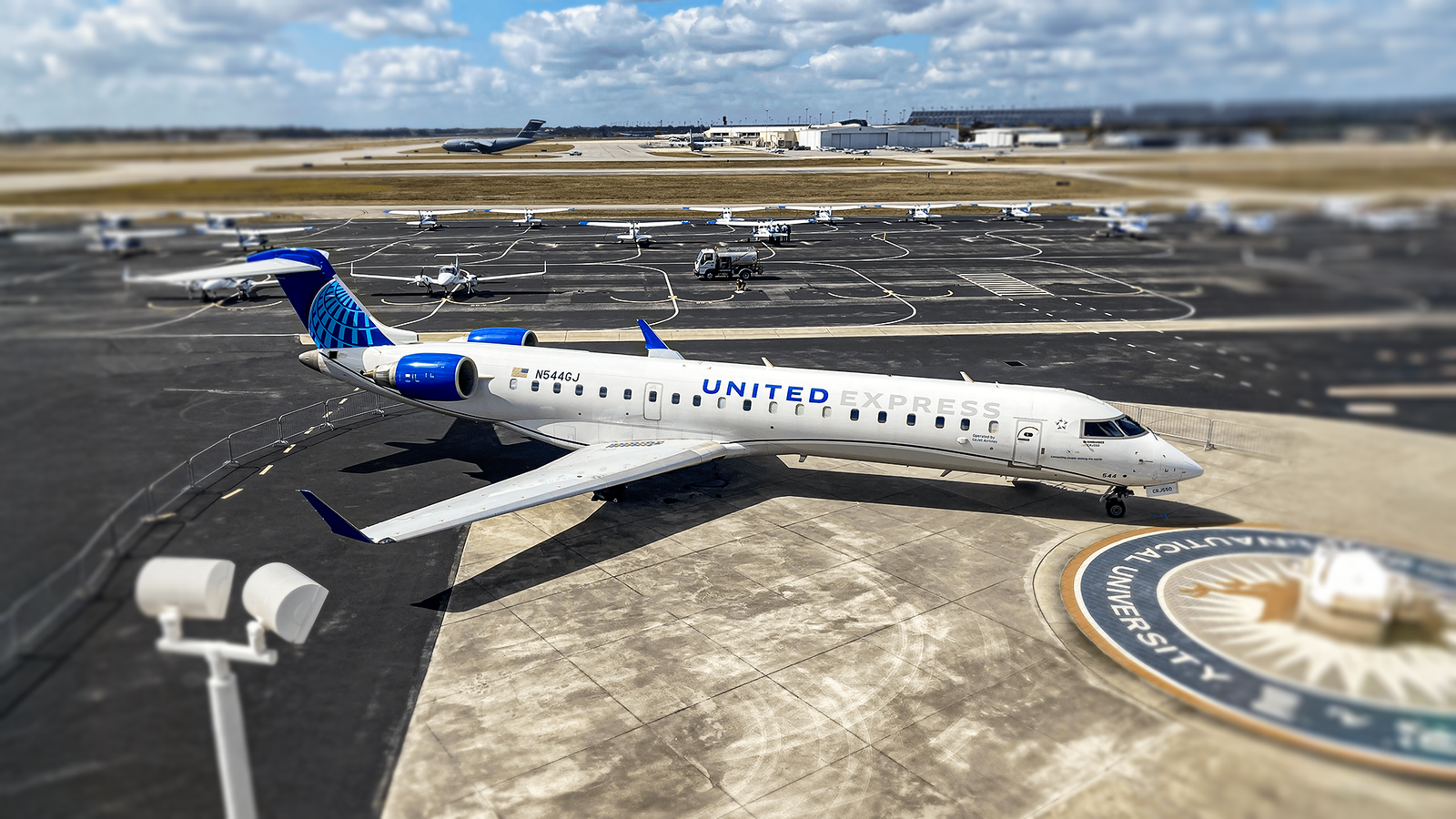
Published Oct 24, 2026, 8:00 AM EDT Airline and Airport Management Graduate, Student Commercial Pilot and Commercial Aviation Writer. Based in London & Nagoya Traditionally, thin secondary markets need austere, high-density turboprops or cramped single-class jets to keep operating costs manageable. Legacy carriers routinely scale back mainline service to smaller cities, substituting minimalist cabin layouts where comfort is sacrificed for seat count. United Airlines has ignored this convention entirely by deploying a premium-heavy regional fleet to bolster its latest domestic network expansion. Pairing GoJet's three-class Bombardier CRJ550 with Republic Airways' Embraer E175 aircraft totally reshapes connection potential at Newark Liberty International Airport (EWR). What United is able to show is that using regional aircraft can still bring in high-yield premium revenue even though the seat count is substantially lower than other popular jets. In addition, this strategy can keep premium revenue high without impacting the mainline fleet. Returning To Lost Routes United Airlines launched four domestic routes from EWR on September 24, 2026, establishing direct links to Charlottesville, Virginia (CHO), Knoxville, Tennessee (TYS), Northwest Arkansas National Airport serving Bentonville, Arkansas (XNA), and Omaha, Nebraska (OMA), as per AeroRoutes. The expansion targets regional cities that lost direct service during pandemic-era contractions or long-term capacity realignments. Omaha and Knoxville services were suspended in 2020, and Bentonville's direct link went dark in 2022, leaving corporate and leisure travelers with cumbersome multi-stop itineraries. Historical continuity varies across these restored city pairs, particularly for Charlottesville, where previous Newark operations dated back to Continental's schedule in 1997 or subsequent United Express frequencies ending in 2012, as noted in Simple Flying analysis. Network planners designed these flights to re-establish vital spoke connections into the New York metropolitan area, so that regional economies regain direct access to an international hub. Rather than launching unproven speculative markets, the airline chose to reactivate established demand pools backed by steady regional business and tourism. Operational frequencies reflect varied demand density across these restored markets. Knoxville (TYS) received twice-daily service to accommodate heavy regional travel demand, while Charlottesville, Northwest Arkansas, and Omaha each operate on a once-daily schedule, establishing reliable baseline frequencies across each corridor. Bringing The Premium Edge To Regional Travel Operating short regional hops with mainline-level passenger comfort meant deploying a specific aircraft type: the CRJ550 operated by regional partner GoJet Airlines. Unlike standard regional jets that force passengers to gate-check rolling luggage due to cramped overhead compartments, the CRJ550 is engineered around a spacious 50-seat cabin layout that provides dedicated overhead bin capacity for every traveler. According to United Airlines seat maps, the three-class configuration includes a genuine first-class cabin featuring 10 seats, Economy Plus seating offering 34 inches to 36 inches (86.4 centimeters to 91.4 centimeters) of pitch, and standard economy rows, all packed into an airframe designed to bypass strict pilot union scope clauses limiting regional seating capacity to 50 seats. Passengers in the premium cabin have access to a self-serve refreshment center and upgraded seat width dimensions measuring 19.75 inches to 20 inches (50.2 centimeters to 50.8 centimeters) that mirror narrowbody mainline standards. This design philosophy gives corporate travelers on routes like Newark to Charlottesville or Knoxville an elevated onboard experience without needing a large mainline aircraft on low-volume sectors. Deploying a low-capacity, high-amenity aircraft on thinner routes completely changes passenger perception of regional flying. Travelers accustomed to regional turboprops or cramped regional jets experience consistent product standards that align seamlessly with United's domestic and international fleet. Where Slightly More Capacity Is Needed Thin markets like Charlottesville are served by the highly specialized CRJ550, but higher-density corporate and commercial corridors need a slightly larger regional platform to satisfy passenger volume. United paired GoJet operations with Republic Airways, bringing in the 76-seat E175 aircraft to handle daily rotations to Northwest Arkansas and Omaha. The E175 provides an effective capacity step-up for markets driven by major corporate headquarters and agricultural trade. Northwest Arkansas serves as the main commercial gateway for Walmart and its extensive vendor network, demanding consistent multi-class seating capacity to accommodate corporate executives traveling to eastern financial centers. Similarly, Omaha generates robust business and agricultural demand that easily fills up a 76-seat regional cabin. Restored Spoke Market Operating Partner Assigned Aircraft Frequency & Flight Numbers Charlottesville, VA (CHO) GoJet Airlines Bombardier CRJ550 Once daily (UA4414 / UA4168) Knoxville, TN (TYS) GoJet Airlines Bombardier CRJ550 Twice daily (UA4550 / UA4445) Northwest Arkansas (XNA) Republic Airways Embraer E175 Once daily (UA3485 / UA3611) Omaha, NE (OMA) Republic Airways Embraer E175 Once daily (UA3429 / UA3512) Integrating both the 50-seat CRJ550 and the 76-seat E175 allows United Express to fine-tune capacity deployment across its eastern seaboard hub. Fleet harmonization across regional partners helps ground handlers and flight crews to manage standardized equipment types efficiently within congested terminal environments. Feeding Traffic At Newark Strategic scheduling of these four regional arrivals serves a singular purpose. The goal is to feed United's heavy bank of afternoon and evening international departures at EWR, so that load factors remain high across all potential connecting flights. Network schedulers structured flight times to land aircraft during midday connection banks, funneling regional passengers directly into widebody departures heading across the Atlantic to Europe and south toward Latin America. Flight UA4414 from Charlottesville arrives at Newark at 2:12 PM, according to Deeparrival, providing sufficient cushion for travelers to connect smoothly onto transatlantic banking waves without enduring excessive terminal layovers. Overall, the hub-and-spoke mechanism used here makes regional flights less like standalone point-to-point loss-leaders, instead becoming far more vital revenue generators that support high-yielding long-haul routes. This precision hub feed leaves zero room for schedule slippage, mainly because these regional arrivals are tightly synchronized with afternoon widebody departures. As a result, a single delayed inbound rotation from Charlottesville or Knoxville threatens to sever high-yield connections. Newark's hub control center maintains constant oversight of these arrival streams, deploying tactical mitigation strategies when air traffic control constraints or localized congestion threaten the integrity of the banking wave. Taking On The Rivals Restoring these EWR spokes places United in direct competition with established legacy carriers dominating alternative New York-area airports. Approximately 82,330 local passengers traveled between Charlottesville and Greater New York in the 12 months ending April 2026, with most traffic historically using Delta Air Lines and American Airlines operating into LaGuardia Airport (LGA) from regional hubs, as per Simple Flying analysis. Targeting point-to-point local travelers who prefer arriving directly in Manhattan is not what United wants to do. Instead, United's commercial strategy focuses on intercepting regional passengers who require seamless worldwide access. United's powerful MileagePlus loyalty ecosystem and the unmatched global reach of the Newark hub help capture this high-yield traffic. Travelers based in regional centers like Charlottesville or Knoxville frequently prioritize one-stop connectivity to international destinations across Europe and Asia over a domestic flight that terminates at a local New York facility with complex ground transfers. By packaging these regional feeder flights directly into multi-segment international itineraries, the carrier converts regional origin points into captive markets for its long-haul widebody network. Operating regional jets into a high-density international hub also exposes incoming flights to airspace congestion and taxi delays that have become an everyday challenge in the New York area. Ground operations and hub dispatchers need to maintain rapid turnaround protocols to ensure regional airframes exit gates promptly, preventing knock-on delays that could jeopardize outbound transatlantic banking waves. Balancing gate assignments between widebody flagships and regional feeders at Newark Terminal C is therefore an ongoing logistical challenge that dictates the operational success of these restored routes. Do Not Overlook Regional Jets United Airlines' strategic deployment of premium-heavy regional aircraft to restore Newark feed highlights the evolving role of regional partners in modern hub network design. By bringing in GoJet's 50-seat CRJ550 and Republic's 76-seat E175 aircraft across Charlottesville, Knoxville, Northwest Arkansas, and Omaha, the carrier has addressed thin-market economic constraints and matched high passenger comfort expectations. United's targeted approach demonstrates that regional connectivity does not need to compromise cabin amenities or alienate corporate travelers accustomed to mainline standards. Sustaining this regional network expansion ultimately depends on winter weather reliability, crew availability, and consistent feed performance into Newark's rigid long-haul banking waves. Because these regional airframes operate within the same congested airspace and taxi queues as heavy widebody traffic, schedule integrity needs constant tactical oversight from hub controllers. Any disruption to inbound regional arrivals risks breaking the delicate timing required to feed lucrative transatlantic and transpacific departures. Restored routes will begin to mature through their initial operational windows, and as they do, connection volume metrics and corporate yield data will determine whether United expands this premium regional model to other dormant spoke markets across North America. Whether competitors respond by upgrading their own regional fleets or adjusting hub frequencies will shape the competitive landscape of East Coast connecting traffic for years to come. Overall, the success of the CRJ550 and E175 feed at Newark shows that regional aircraft have far more potential to offer legacy airlines than many give them credit for.
The 50-Seat Jet With A First Class Cabin United Airlines Is Using To Rebuild Its Newark Hub Feed
Full Article
Original Source
Read the full article at Simpleflying →KhanList aggregates and links to publicly available news content. We do not host full articles from third-party sources. Always verify important information with original sources.