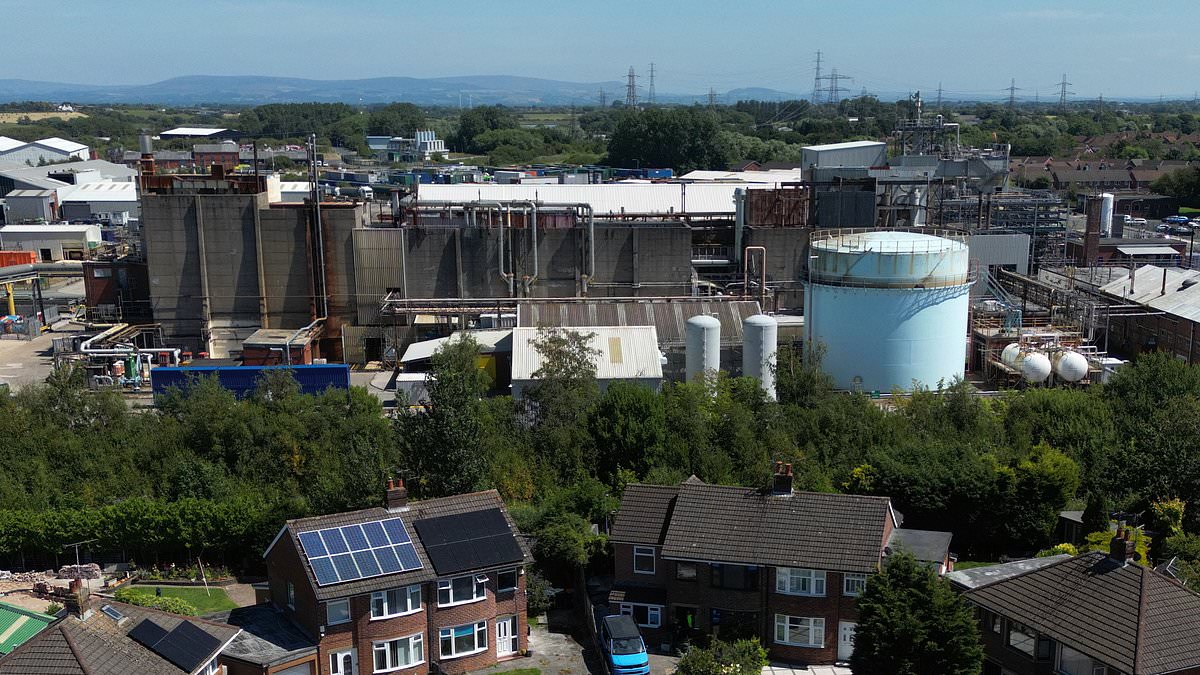
'You think you're doing the right thing,' says mother-of-five Sam Hammond from her garden in Thornton-Cleveleys, a small town north of Blackpool. 'But I've been teaching my kids to eat poisoned fruit, poisoned veg and poisoned eggs.'Two years ago, Sam noticed people taking soil samples from the Occupation Road Allotments which border her property. It emerged they were from the Environment Agency and they had been called in amid fears the land may have been contaminated by pollutants from the nearby AGC Chemicals Europe plant.Between the 1950s and 2012, the manufacturing facility emitted 49 tons of highly carcinogenic Perfluorooctanoic acid (PFOA) into the atmosphere via large extraction chimneys. To make matters worse, the toxic gas was also likely to have contained small solid particles of the compound. The 'forever chemical' – so-called because it is virtually indestructible – is known to cause cancer and has since been banned globally.Sam, 48, was understandably worried. After all, for 20 years she'd been growing everything from lettuces and beans to strawberries and cabbages in her garden, as well as rearing chickens and ducks for their supposedly highly nutritious eggs. She duly had her own soil tested.When the results came back in February this year, they made her sick to the stomach. Not only was her garden contaminated, but one duck egg alone contained ten times the safe weekly limit of PFOA for a human being. And Sam and her family had been eating these eggs from their flock of 30 ducks daily for three years.'My little boy is worried,' Sam continues, clearly emotional. 'He keeps asking me: "Are my ducks going to die?" It's had a massive effect on me, too.'Sam – who now believes the unexpected stroke she suffered in 2020 may have been caused by the toxin – adds: 'I don't sleep at night. It just doesn't stop. It's just going round and round in my head. I don't really spend much time out in the garden anymore either, because I just look at it and I'm like… is it safe?' Between the 1950s and 2012, this chemical plant in Thornton-Cleveleys, Lancashire, emitted 49 tons of highly carcinogenic Perfluorooctanoic acid (PFOA) into the atmosphere via large extraction chimneys Sam Hammond's results found that one duck egg alone contained ten times the safe weekly limit of PFOA for a human being. Her family has been eating these eggs from their flock of 30 ducks daily for three yearsLast month, a government-commissioned multi-agency investigation found that two areas within a five-kilometre radius of the AGC chemical plant in Thornton-Cleveleys had 'higher-than-expected' rates of kidney cancer – a disease the World Health Organisation has previously linked to PFOA. One of the two areas had 14 cases of kidney cancer between 2003-22 against an expected number of just six. The second area had 17 cases over the same period against an expected number of nine.The report also found evidence of the toxic compound in a 'majority' of the 71 properties tested within a kilometre of the factory, including seven they now consider to be 'high-risk' plots.This is the horrifying story of how a multinational chemical firm quietly poisoned a working-class Northern town over six decades, and how residents now fear not only for their lives, but of being trapped in worthless homes.The controversial history of the Lancashire-based facility – on the Hillhouse Industrial Estate – stretches all the way back to the 1890s when it was established by a now defunct chemicals giant United Alkali.For many years, the plant was run by another industry behemoth, Imperial Chemical Industries, before AGC bought it in 1999. The plant produces the compound best known by the brand name Teflon – a widely-used material found in everything from nonstick cookware to electrical wiring.For around six decades, PFOA was used as part of that manufacturing process and both ICI and AGC used the compound. However, whilst ICI never knew how dangerous it was prior to selling the plant in 1999, documents obtained by the investigative outlet Ends Report reveal that AGC Chemicals Europe helped to fund research into PFOA as early as the late 1990s.Its study involved monkeys being fed the toxin in capsule form over a six-month period, an approach that sounds outrageous by modern standards.The results were irrefutable: every monkey involved showed an increase in liver weight, a classic sign of poisoning, while several of them died.Despite the study's findings, it took AGC a further decade to stop using PFOA. In other words, they knew the chemical was lethally toxic and yet they continued to pump out emissions containing it over the town of Thornton-Cleveleys for another ten years.Defending themselves, a spokesman for the firm told the Daily Mail that, despite what happened to the monkeys, the study – published in 2002 – 'did not provide a complete basis for definitive conclusions about human risk'.By 2012, the plant had stopped using PFOA. Five years later, following further research, the European Union declared PFOA to be a 'substance of very high concern' on which global restrictions were placed in 2020 as part of the Stockholm Convention on Persistent Organic Pollutants.However, as a 'forever chemical', PFOA does not break down naturally and therefore remains in the soil and waterways of Thornton-Cleveleys to this day – a truth laid bare by the June report identifying the high rate of kidney cancers in the area.Reacting to the findings, Dr Dan Middleton, a senior lecturer in environmental cancer epidemiology at the Centre for Public Health, Queen's University Belfast, confirmed that 'kidney cancer is one of the cancers most consistently linked to PFOA exposure'. Dr Dan Middleton, a senior lecturer in environmental cancer epidemiology, says kidney cancer is 'consistently linked' to PFOA exposureSurely then, this is evidence that the chemical plant has adversely affected the health of local residents?Bizarrely not. For the report went on to conclude that despite two areas with unexpectedly high rates of kidney cancer, they were sufficiently 'geographically dispersed' to show there was 'no clustering of cases' close to the AGC chemical plant. Therefore, concluded the report: 'no further cluster investigation is warranted at this stage'.Unsurprisingly, the medical community was appalled by the findings. Dr David Megson, a forensic environmental scientist at Manchester Metropolitan University, claimed the report 'seems to downplay the findings rather than assess it [sic] objectively'.Locals were still in a state of simmering outrage when the Daily Mail visited Thornton-Cleveleys. 'My grandad bought this house when it was first built in the 1950s,' says Paul Jackman in the searing afternoon sunshine. 'He died at 65 of prostate cancer, which is known to be caused by PFOA. We're all aware of it, we just don't know what we can do about it. I'm worried for myself.'I've just been with the doctor now, and I'm only 51. Stomach issues… and I've been eating strawberries out of this garden since I was three. 'I'm concerned for myself, and for my family. We've had dogs that have died, strangely and very quickly. We used to have a vegetable patch, but we stopped because of all this.''First of all, we want a clean-up,' Paul continues. 'Then we want them to admit they've done wrong. And then compensation.' He trails off, gazing beyond his garden perimeter to the brutalist metal chimneys of the AGC plant: 'I'll really like them to clean up and then push off.' Paul Jackman, pictured with his wife Vicki, says he is concerned for himself and his family and that they have had 'dogs that have died, strangely and very quickly' Last month, a government-commissioned multi-agency investigation found that two areas within a five-kilometre radius of the chemical plant had 'higher-than-expected' rates of kidney cancer, which is linked to PFOAThe practicalities of such a clean up operation, however, are far from straightforward with one resident claiming they'd been advised that the only failsafe method was to remove all the soil from gardens, even underpinning homes during the process, and replacing it with fresh compost.Another local, Steve Barton, has a home that borders the factory to the east. 'We've lived here for 20-odd years,' he explains. 'We were certainly surprised when we heard. We never had our soil tested. 'It's funny though, because I have friends who used to work on the plant and they always had health issues, like blackouts, because of what they'd been handling. And now we know the chemical is linked to some cancers.'Steve pauses to highlight the noise emitted 24 hours a day by the ventilation fans of the chemical plant that only shuts down on Christmas Day.'We used to have 40-foot trees at the back of the garden,' adds Steve, who works for the government in IT. 'I thought they soaked up the emissions but National Rail, who own that land, cut them down about two years ago. So far, my wife and I have no health issues. But you just don't know about the future.'Our major concern is property prices. There were people at a local meeting the other day saying that they were being denied mortgages to move into the area. We bought this house for about £45,000 in 1995 – it should be worth about £200,000 today. 'I would like compensation if we're going to lose out and we can't sell the property. You never know when you might need to pay for elderly care.'So, what happens next?Earlier this month, AGC Chemicals Europe announced plans to cease operations, citing 'significant financial and operational challenges' as well as 'ongoing market volatility and increasing competition'.If the plant does close following consultation with stakeholders, it will put as many as 200 jobs at risk in a part of the world where employment opportunities are few and far between.'There are no jobs here anyway,' grumbles an elderly resident who asks not to be named. 'Young folk either head down to Blackpool or out to Manchester, and losing the plant will be the final straw. Used to be a job for life, that.'Regarding the chemical pollution, AGC tells the Daily Mail it had 'voluntarily' phased out the use of PFOA in 2012 but insists: 'Release of the substance was within the permit held by AGC Chemicals Europe Ltd at the time and also UK legislation in place at the time.'A spokesman continues: 'We take our responsibilities to our employees, the local community and to the environment very seriously. All our essential chemical processes and products are rigorously monitored and controlled and today we are compliant with current UK and EU environmental laws and regulations.'Naturally, residents in Thornton-Cleveleys are less than convinced and 90 have thus far expressed an interest in joining a lawsuit against the company. Sam Hammond – who unwittingly fed her children those fruits – is already working with legal firm Leigh Day on her own case.And there is precedent on this front, for in the US more than 4,000 lawsuits have been filed against chemical manufacturing companies for their involvement in 'forever chemicals' pollution.Perhaps the most notable victory on this front came in 2023, when 3M – a firm that produces Post-it notes and Scotch Tape, among other industrial products – agreed to pay $10.3billion over a 13-year period to test and treat residents of towns and cities, as well as public water systems it may have polluted.Whether or not the residents of Thornton-Cleveleys see any money at all, however, only time will tell. For now, the Occupation Road Allotments where this all began remain closed while, according to Wyre Council, 'contaminated land is remediated to its original use'.The Food Standards Agency has told people living within a kilometre of the site who are growing fresh fruit and vegetables to 'wash and peel their produce to remove soil, dust and bacteria before eating' and to 'consider the use of raised beds and fresh soil when growing produce'.Washed or unwashed, it would take a brave person to set their green fingers to work here in Thornton-Cleveleys.Back in Sam Hammond's garden, she gestures towards an apple tree, pointing out three fresh, plump green fruits.'When the tree first bore apples my daughter and I made a crumble. It was the most delicious we'd ever had… probably the most dangerous too.'
The 1950s industrial town where dogs are mysteriously dying, cancer cases are rocketing and residents are too scared to go into their own gardens
Full Article
Original Source
Read the full article at Dailymail →KhanList aggregates and links to publicly available news content. We do not host full articles from third-party sources. Always verify important information with original sources.