
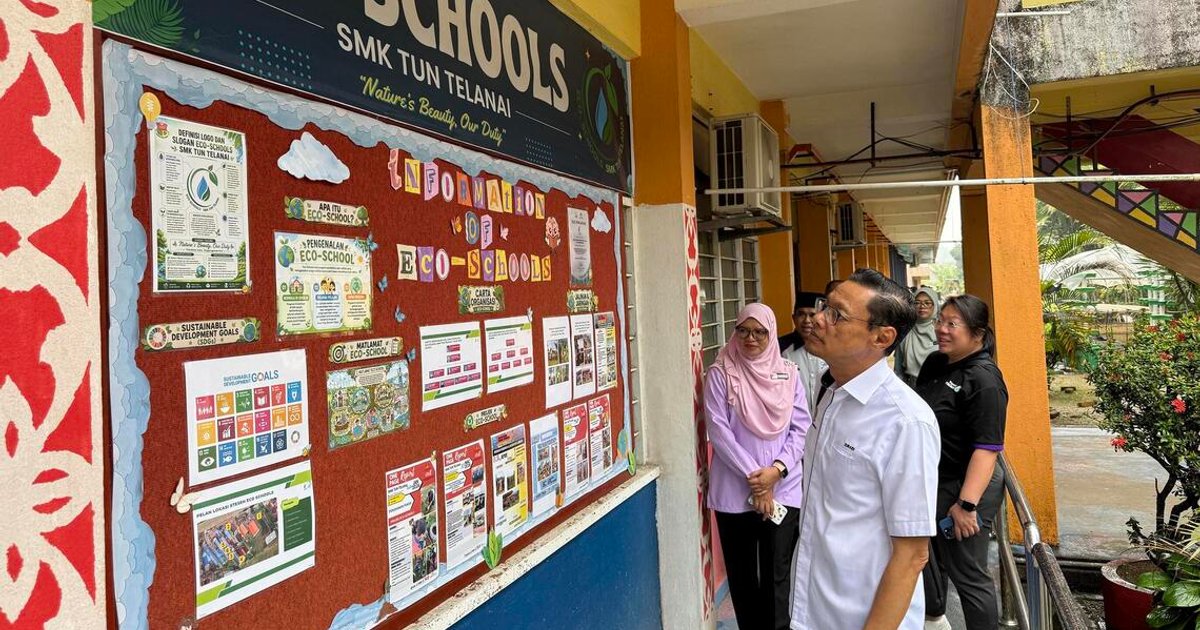
KUALA TERENGGANU – In the beachside town of Batu Rakit, conservationist and resort operator Alex Lee stares at the roaring waves pounding the edge of his latest project about half an hour’s drive north of Kuala Terengganu.Dubbed Terramalai, the site features traditional wooden houses from across Malaysia arranged around an open space for events, leading to an infinity pool overlooking the ocean. A traditional wooden ship was to be moored there as the centrepiece of the property.But those plans are now on hold.“The sea used to be 30m away,” Lee told The Straits Times.Among Malaysia’s 13 states, Terengganu is one of the hardest hit by environmental change such as floods and coastal erosion.The north-east monsoons consistently leave the east coast state with tens of thousands of evacuees and several deaths, and along with neighbouring Kelantan, the most economic damage, reaching into the hundreds of millions of ringgit annually.While the monsoon – which batters Terengganu’s exposed shores every year from November to March – is also the biggest natural driver of coastal erosion, human activity has exacerbated the problem.Home to the longest uninterrupted coastline in Peninsular Malaysia facing the powerful South China Sea, a 2015 national coastal erosion survey found a third of its 443km shoreline eroding between 2m and a whopping 30m annually.Due to rapid development – more than a third of Terengganu’s coast has undergone urbanisation, increasing tenfold since 2000 – natural green cover, which would slow down flooding and coastal erosion, was nearly halved from 46.5% to 26.6% between 2000 and 2017.Research has linked erosion in parts of the state to the expansion of Sultan Mahmud Airport’s runway, land reclamation and modifications to the Terengganu river mouth. A 2021 study found that the airport extension altered wave behaviour, shifting sediment away from one area while causing it to accumulate elsewhere at a rate of more than 9m a year.Seeding eco-friendly habitsThus, national oil giant Petronas, via its charitable foundation, is hoping to seed environmental awareness and ecologically friendly habits among the next generation by funding 50 “Eco-Schools” statewide.The Eco-Schools programme originated in Denmark in 1994 and has since brought environmental education to 54,000 schools across more than 100 countries. The concept was introduced in Terengganu in 2024.“We want our schools to have elements of environmental education because children aren’t aware of things like waste separation. We don’t practise these things as part of our culture,” state deputy education director Wan Zuraidi Wan Zaid told ST during a visit to one such Eco-School, Tun Telanai Secondary in the capital Kuala Terengganu. “So we have to start at school. If not, we will run out of landfills one day.”The projects that each Eco-School undertakes are simple and easily replicated. These include rainwater harvesting, waste separation and upcycling, composting and permaculture or hydroponic gardens.“The students can see the results with their own eyes, especially what they planted and how it grew,” said state assistant education director for science and maths Wan Nor Suharda Wan Ahmad Yasen, who directly oversees Terengganu’s Eco-Schools programme.Tun Telanai Secondary’s regenerative planting project is natural enough to attract some grazing fauna from nearby villages. ST PHOTO: SHANNON TEOHThese projects are tracked and students get to see the tangible effects of their eco-friendly actions through real-time data, such as the amount of water saved.Yayasan Petronas’ implementation partner is Green Growth Asia Foundation (GGAF), a non-profit organisation established specifically to run Eco-Schools in Malaysia when the Melaka state government was seeking an international environmental education programme in 2016.A decade after its launch in Malaysia, Eco-Schools are now running in seven states but the 50 schools in Terengganu are the largest cluster.Although these Eco-Schools are just a tenth of the 500 schools in Terengganu, GGAF chief programme officer Sri Themudu Bully Baboo told ST that there is “impact replication” because youth are “change agents”.“What is unique about Terengganu is that the schools are very competitive. We selected 50 Eco-Schools strategically in all the different districts, proportionately distributed, as benchmarks for all the schools in the area,” he said.In fact, unlike other states where GGAF advocated for youth environmental education, it was local teachers from Terengganu who approached GGAF to bring Eco-Schools into the state back in 2019, before a Covid-delayed launch in 2024.Getting schools to plant treesYayasan Petronas has also run a parallel programme called Environmental Education at School (EE@School) since 2025 with 25 selected schools nationwide, of which four are in Terengganu – the highest number per capita in Peninsular Malaysia.EE@School empowers secondary school teachers who have undergone a two-year training programme to implement “Living Labs”, a regenerative tree-planting project. Teachers and students develop planting sites within their schools, using them as outdoor learning spaces to learn about environmental stewardship, biodiversity, soil health, water retention and climate. Tun Telanai is one of the selected schools. As it is one of the schools in Terengganu most susceptible to flooding, participating students have been able to learn hands-on about how edible and flood-resistant crops, supported by a forest ecosystem, are critical for climate resilience, especially in dealing with floods.Tun Telanai Secondary's hydroponic garden is a hit among students as well as teachers who quickly buy up the harvest. ST PHOTO: SHANNON TEOHOver time, as the plants grow, students will be able to see how regenerative planting can help reduce surface runoff and help communities better withstand floods, especially after green cover has been decimated by rapid development.“The results were unexpected,” said Yusrina Mohammad, the teacher who runs EE@School in Tun Telanai, on the enthusiasm of the students. “The students actually enjoy their time in the garden.”Yusrina Mohammad, Tun Telanai Secondary's teacher heading its environmental education programmes, says that students have learnt more sustainable habits from recycling waste as well as rainwater. ST PHOTO: SHANNON TEOHShe added: “People comment that it looks like a jungle rather than a garden but that gives us a chance to talk about exactly what we are trying to do. Many of the students take plant cuttings home to try and plant them with their family and neighbours.”The hope is that education, coupled with infrastructural efforts to mitigate flooding and coastal erosion – over RM2 billion (S$600 million) has been allocated by the federal government – can help Terengganu reverse the tide.Additional reporting by Hadi AzmiSign up for our weekly Asian Insider Malaysia Edition newsletter to make sense of the big stories in Malaysia.
Terengganu’s fight against climate change begins in the classroom
Full Article
Original Source
Read the full article at Straitstimes →KhanList aggregates and links to publicly available news content. We do not host full articles from third-party sources. Always verify important information with original sources.