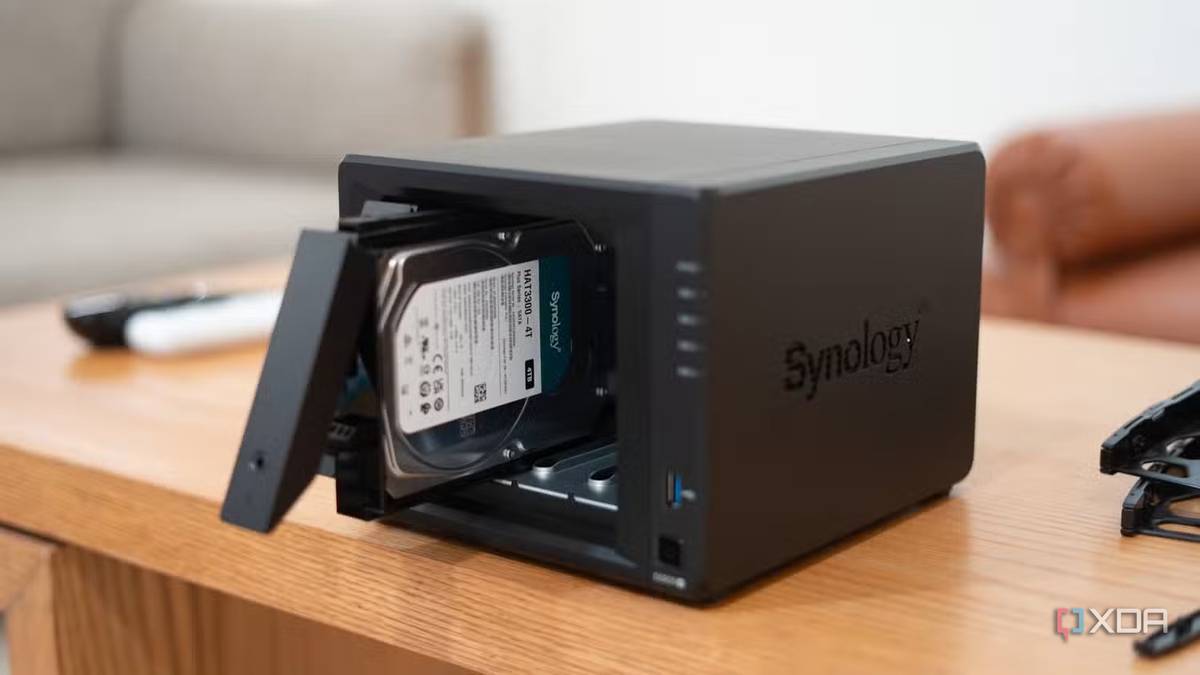
Published Aug 8, 2026, 1:00 PM EDT Dhruv Bhutani has been writing about consumer technology since 2008, offering deep insights into the personal technology landscape through features and opinion pieces. He writes for XDA-Developers, where he focuses on topics like productivity, networking, self-hosting, and more. Over the years, his work has also appeared in leading publications such as Android Police, Android Authority, CNET, PCMag, and more. Outside of his professional work, Dhruv is an avid fan of horror media spanning films and literature, enjoys fitness activities, collects vinyl records, and plays the guitar. I've been using NAS boxes for a decade and a half, and for the entirety of this period, Synology has been my go-to. There was good reason for that. The company gave me enough control by letting me pick a ready-to-go enclosure, allowing me to choose the hard drives I needed and expand on them when I outgrew them. It's an enthusiast product, and that freedom is something that's expected when you're spending hundreds of dollars. Let's be real, we're mostly just paying for the software here. That's why Synology's push towards restricting the hard drives you can use with a box you've already purchased rubs me and every other enthusiast the wrong way. A NAS is supposed to give you freedom from vendor lock-in and cloud-based subscriptions. Synology's move towards favoring its own hard drives and a select few third-party drives upends that dynamic completely. I'm aware that Synology has loosened up those restrictions a bit, but the message is clear, and trust is hard to restore. Synology sees itself as a closed ecosystem, and it's hard to move away from that. A NAS isn't a finished product Upgrades are part of owning and operating a NAS My Synology NAS is way more than just a centralized file server. My home runs on it. Sitting at the center of my home network, both literally and figuratively, it's the server that hosts all my Docker containers for self-hosted software, serves up media via Plex, music via Navidrome, images via Immich, and acts as a backup destination for half a dozen phones and laptops. It's an indispensable part of my life. And yet, despite its somewhat solidified place in my home and network, the NAS itself doesn't stay all that static. Every few months or so, I find myself cycling hard drives, adding more storage for my ever-increasing photo archive, or ripping a few more Criterion Collection Blu-rays to the NAS. I've even upgraded SSDs, increased RAM, and added faster network cards to some of my NAS boxes. When buying a hard drive, I'm not locked into a single vendor. I make a conscious call based on current hard drive prices. Leaving aside the fact that it's a bad idea to have all hard drives from the same vendor and same batch, I like to mix it up between Seagate, Western Digital, and even Toshiba. Lately, fresh hard drives have reached an unfathomable price point, so I'm even considering refurbished drives from ServerPartDeals. It's good to have options, and that flexibility is why I went all in on network storage instead of relying on the cloud. And now Synology's moves are trying to snatch that freedom away. Synology's argument might make sense from a business perspective. Supporting a limited pool of hardware reduces customer support overhead. But that's not the customer's problem, nor is it the trade-off I signed up for. Moreover, given that Synology's latest NAS boxes still use sixth-generation-old hardware while charging nosebleed prices, the margins should be sufficient to ramp up support. Why I'm thinking twice about my next NAS The uncertainty makes me hesitate The problem as I see it isn't that I can't use my existing NAS. Unless Synology decides to shoot itself in the foot, my current NAS box should continue to work just fine. But it's made me hit pause on upgrading my hardware. A NAS is an appliance much like a refrigerator. You don't replace it unless it's broken or no longer serves its purpose. My first NAS from 15 years ago is still serving files. During the lifecycle of any NAS I buy, I'll certainly upgrade the hard disks and increase storage capacity. So far, my only consideration has been price. Now, I need to validate if the drive will even work. Moreover, I'm in a country where most supported hard drives, including Synology's first-party models, aren't available. What am I expected to do in that case? By kneecapping hard drive support, Synology might have artificially region-limited its own NAS boxes. But more than that, Synology has shown that it can change policies on a dime, and while today's policies might no longer be as restrictive, there's no guarantee that won't be the case tomorrow. Trust is one of the hardest things a company can earn. It takes years of consistent pro-consumer decisions. Synology built that trust by giving people a reliable operating system without trying to dictate every hardware decision related to it. Look, much as I want to stick to Synology for my next upgrade, I can't lie that I'm not looking at other options. Between QNAP, UGREEN, or just a custom-built TrueNAS setup, there are alternatives even though they might not be as simple to set up as a Synology. The beginning of a slippery slope for Synology Synology's DSM remains my favorite NAS operating system. I sign in multiple times a day, and as I mentioned, it sits at the center of my digital life. Moving on from Synology is a decision I won't take lightly. But there's no denying that Synology's recent moves have shaken my confidence that the platform will continue to put user choice first. I still hope the company changes course. But after spending years earning my trust, it’s disappointing to watch Synology risk that goodwill over something as fundamental as hard drive choice. Synology DS925+ 7/10 CPU AMD Ryzen V1500B Memory 4 GB DDR4 ECC SODIMM Drive Bays 4 x HDD, 2 x NVMe Expansion 1 x USB Type C The Synology DS925 Plus is a compact and efficient 4 bay NAS built for home users and small businesses. It delivers excellent performance, runs DSM 7.2 with a polished and feature rich interface, offers great mobile app support, and works well as a media server. However, it is limited by its strict drive compatibility requirements and forced automatic updates on newer models.
Synology spent years earning your trust and cashed it in on hard drive compatibility
Full Article
Original Source
Read the full article at Xda-developers →KhanList aggregates and links to publicly available news content. We do not host full articles from third-party sources. Always verify important information with original sources.