
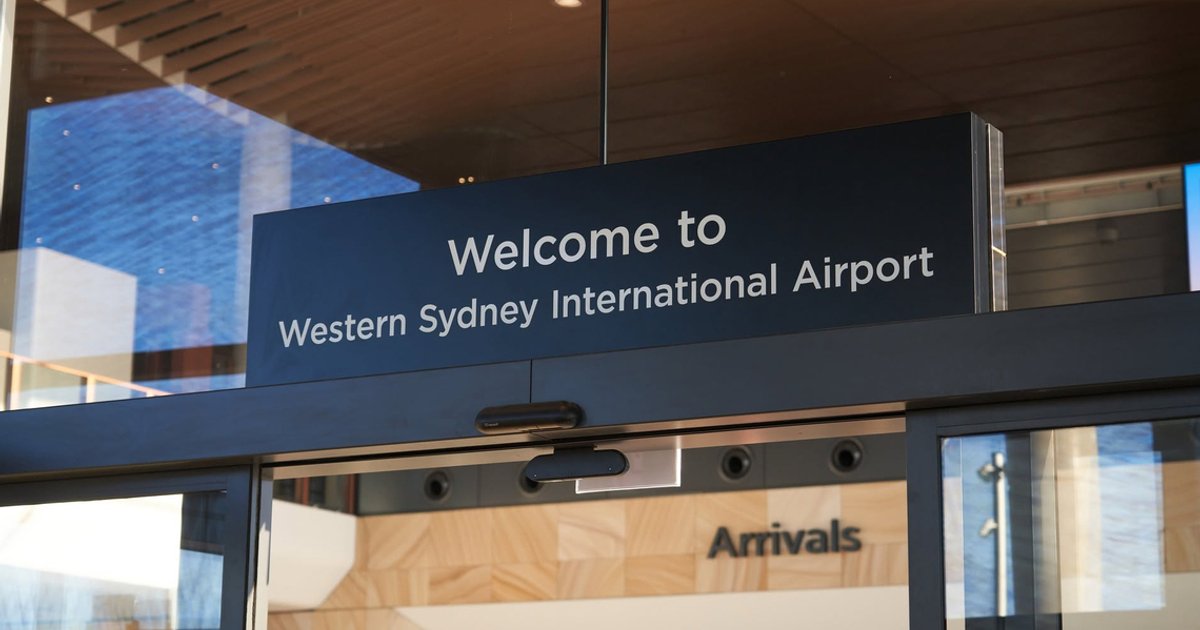
After more than half a century of political procrastination, environmental protests and funding shortfalls, Sydney finally has a second airport. But the new A$5.6 billion (S$5 billion) site’s commercial prospects are already in question.Western Sydney International, 50km inland from the city centre, will handle its first passenger flight on Oct 25 – a Jetstar service to the Gold Coast. But the facility has attracted only a handful of airlines and has half-a-dozen or fewer scheduled flights a day for the next 12 months, according to aviation data company Cirium.Australia’s biggest aviation infrastructure development in decades is opening just as the global travel industry endures its toughest period since the pandemic. Around the world, airlines are sounding the alarm on rising fuel costs and fares as the Iran War drags on.Many, including dominant Australian carrier Qantas Airways, are cutting back on domestic capacity rather than laying on more flights. Airlines are also struggling to get their hands on new jets, leaving few spare aircraft to send to startups like Western Sydney International where passenger demand is unproven.Compounding the government-owned airport’s challenges, a planned rail link won’t open until 2027 at the earliest, while a shuttle bus to the centre of Sydney costs A$55 and takes about one hour. That means Sydney Kingsford Smith, 20 minutes by taxi or train from the central business district and Australia’s primary gateway, remains a more practical option for most people.“The main airport is much more convenient to almost all travellers,” said David Levinson, a professor of transport at the University of Sydney. Western Sydney International’s passenger forecasts, look “a bit optimistic,” he said.Named for pioneering Australian aviator Nancy Bird Walton, the new airport expects to handle 8.4 million passengers a year by the end of the decade, and almost 20 million annually by 2045, according to its master plan. Both figures are fractions of the numbers handled by the city’s main airport. Western Sydney International is built on old farmland at Badgerys Creek. The government settled on the site in 2014, ending a debate about the need and location for a second airport that stretches back to 1946. Construction started in 2018 and the airport opened for cargo flights in July.The surrounding population is key to the facility’s commercial fate.By 2030, half of Sydney’s 6.1 million people will live in the city’s west, according to the airport’s master plan. Some 40% of Greater Western Sydney’s population was born overseas, which should generate demand for flights to countries such as India, China and Vietnam, the document says. Yet Qantas plans to operate little more than one domestic flight a day, on average, from March 2027, according to Cirium data through September 2027.Virgin Australia Holdings, the country’s second-largest carrier, has no flights scheduled. The new airport’s main customer is Jetstar, the leisure-focused, low-cost carrier owned by Qantas. “We are looking closely at the Western Sydney opportunity and assessing whether it would fit into a network and schedule that best serves the needs of our customers,” Virgin Australia said in a statement. Qantas referred to a speech by Chief Executive Officer Vanessa Hudson in June, when she described Western Sydney as “such an important market,” specifically highlighting its relevance to Jetstar. “We expect demand will grow, and when we see that, we’ll put more frequency in,” she said at the time.Other airlines that will use the new airport are Air New Zealand, Vietjet Aviation, Fiji Airways and Singapore Airlines. In an interview, Western Sydney International Chief Executive Officer Simon Hickey said more airlines will use the airport in time, and talks are taking place with several other carriers. “Right now, I’m really happy with where we’re sitting,” he said.But Hickey also needs the local population to give the airport a chance, which would help him persuade other carriers that there’s demand to capture. “It’s use it or lose it,” he said. “That will mean that we continue to grow and other airlines will come and join the pack.”To be sure, long-term appetite for air travel is relentless. Worldwide passenger demand is expected to more than double by 2050, according to the International Air Transport Association. And while it may be off to a slow start, Western Sydney International has some advantages over Sydney’s main airport. Most importantly, it has no overnight curfew like at Kingsford Smith, allowing international airlines to schedule departures that connect with other flights at their own hubs.The new airport expects to handle 82 million passengers a year by 2063 and ultimately become Sydney’s primary air-travel hub. It takes time for a new airport to establish itself, said Stephen Beckett, CEO of Airlines for Australia & New Zealand, which represents Qantas, Jetstar, Air New Zealand and Virgin Australia.“Some airlines will sit back and make their own commercial assessments based on passenger demand,” he said.For now, Western Sydney International is already drawing unfavourable comparisons with airports elsewhere that ultimately failed to live up to expectations. Levinson, the transport professor at the University of Sydney, compared Western Sydney International to Mirabel airport outside Montreal.Mirabel opened in 1975 in time for the Montreal Olympics but handled its last commercial passenger flight in 2004. The airport now operates chiefly as a freight hub. Right now, Western Sydney International is trying to serve a market that doesn’t yet exist, Levinson said. The new airport’s opening is “early, given actual demand,” he said.There’s a risk Sydney’s secondary airport will end up with a similar status as Avalon Airport, which is more than 50km outside Melbourne, according to Peter Forsyth, an aviation economics consultant who’s a former professor at Monash University.Avalon, where Jetstar has operated flights since 2004, has never broken through as a genuine alternative airport to Melbourne’s main airport, he said.Growth at Sydney’s new airport will be a slow burn, said Forsyth. “There is a market there,” he said. “But exactly how big it is, I don’t know.” BLOOMBERG
Sydney’s new $5 billion airport opens with barely any flights
Full Article
Original Source
Read the full article at Straitstimes →KhanList aggregates and links to publicly available news content. We do not host full articles from third-party sources. Always verify important information with original sources.