
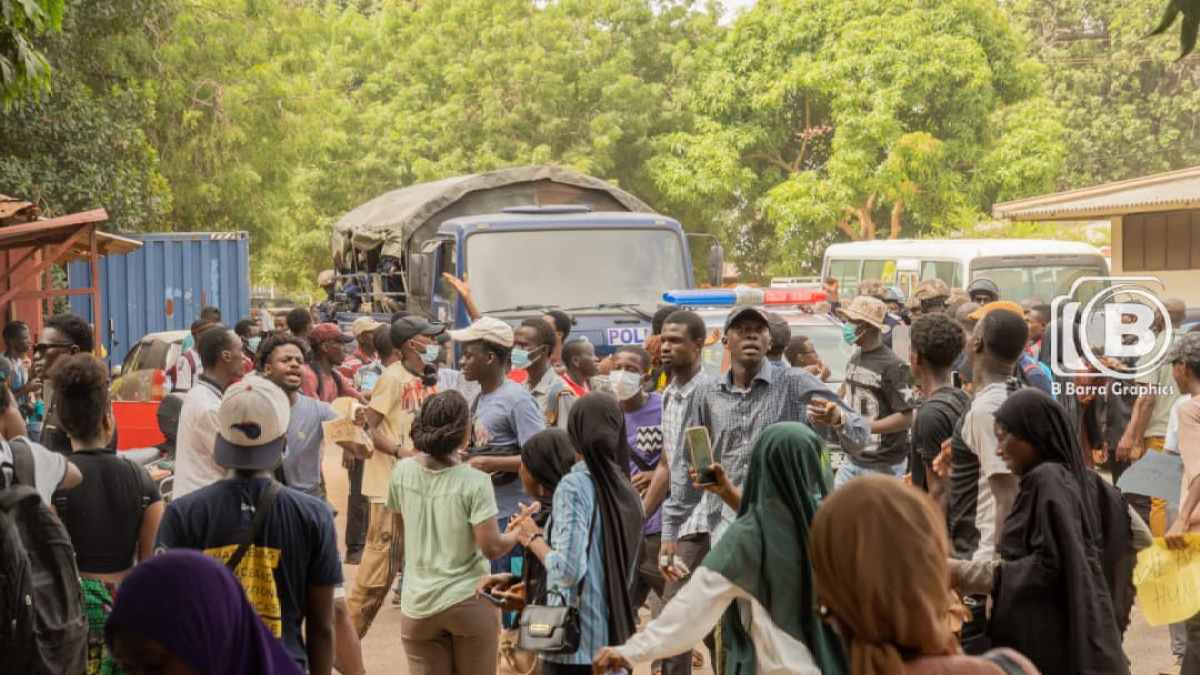
Faraba Banta, The Gambia – For Muhammed Lamin Jallow, a student at the University of The Gambia’s School of Arts and Sciences, getting to class has become a daily struggle.He travels about 40 km (25 miles) from home to the Faraba Banta campus, depending on university buses, to attend lectures.But securing a seat on the bus can be challenging.“Sometimes, it feels like survival of the fittest,” he told Al Jazeera. “We compete as to who gets in first, who gets to sit, who gets to stand and who goes to school and who does not.”Jallow was among hundreds of students who protested at the University of The Gambia (UTG) on Monday, taking their grievances over transportation, campus facilities and student welfare to the vice chancellor’s office.Lectures have since resumed after the government promised improvements to campus services.But the students have more demands. They want Vice Chancellor Herbert Robinson and the director of student affairs to resign, accusing both officials of failing to perform their duties.While the government has announced measures to address some of the concerns, the leadership dispute remains unresolved.Students at the University of The Gambia demand the resignation of university leaders [Barra Graphics]Transport and basic services remain concernsThe Students’ Union says its concerns affect more than 12,000 students, many of whom depend on university buses to reach campus.Following the protest, Higher Education Minister Professor Pierre Gomez visited the campus with university representatives and officials from the Ministry of Communications and Digital Economy.In a statement, the Ministry of Higher Education, Research, Science and Technology said the Gambia Transport Service Company had deployed 20 buses to support student transportation.Students have also complained of limited access to safe drinking water and affordable food, as well as unreliable internet connectivity.In response, the ministry promised that cafeterias across the university were ready to serve students and staff, but acknowledged that additional filtration was needed to make campus water safe for drinking. Water jars and dispensers have been installed at designated points, and the National Water and Electricity Company (NAWEC) had been consulted, it said.On internet access, the ministry said work was under way to extend connectivity to the newly constructed Schools of Agriculture and Law, with completion expected within a week.The proposals are intended to support student access to research materials and other educational resources. However, the statement did not confirm whether the work had been completed.The ministry said it would continue working with the university, the students’ union and other relevant stakeholders to monitor implementation.Cafeterias and practical training facilitiesThe reopening of cafeterias was another demand raised by students, who had complained that their closure made it difficult to find affordable meals on campus.Ismaila Fadera, the students’ union president, said he raised the issue with Robinson on October 20 .Fadera quoted the vice chancellor as saying: “Mister president, I have the student interest at heart, but we must balance this against administrative processes and compliance. You know I was a student too and many of us went through that. I used to carry my own water and food in my bag to university. The students should be told the reality. Having a cafeteria is a great addition to enhance the student experience but it is not right.”The ministry said the cafeterias were ready to serve students and staff, although it provided no details on meal prices or availability at individual facilities.Beyond food and water, students say inadequate learning facilities are affecting their education, particularly in programmes that require practical training.At the School of Medicine and Allied Health Sciences in Banjul, students face overcrowded classrooms, inadequate ventilation, malfunctioning electrical sockets and shortages of projectors and smartboards, according to Abubacarr Manneh, president of the University of The Gambia Medical Students Association. Manneh said medical, nursing and postgraduate nursing students share the available facilities, putting pressure on classroom space.He also worries about shortages of practical training equipment, including a promised simulation laboratory where students could develop clinical skills.“Practical sessions are crucial in our professional training and development for better care of our patients,” he told Al Jazeera.The university’s journalism students have similar concernsSukai Fatajo, a journalism student who participated in the protest, said the school needed radio and television studios to help students develop practical skills.“We deserve better, and our demands must be met,” she told Al Jazeera.The students’ union has also called for functional science laboratories, improvements to facilities at the medical school and adequate staffing.Students at the University of The Gambia say classrooms are overcrowded with limited facilities [Barra Graphics]The risks of getting to classFor Kumba Leigh, a journalism student, the struggle to reach the university has also become a question of personal safety.One morning in April, Leigh was attacked by a knife-wielding assailant in her hometown of Bakau as she walked to a bus stop. She was trying to leave home early enough to secure a seat.The attacker threatened to kill her if she did not hand over her bag. When she resisted, he struck her on the head and shoulder, cut her bag and dislocated her right arm. A nearby shopkeeper intervened, forcing the assailant to flee.Months later, Leigh still has pain in her arm and suffers from trauma.“No one should have to risk their life simply to travel to school,” she told Al Jazeera, calling for stronger security and increased police patrols.
‘Survival of the fittest’: The struggle to get to university in The Gambia
Full Article
Original Source
Read the full article at Aljazeera →KhanList aggregates and links to publicly available news content. We do not host full articles from third-party sources. Always verify important information with original sources.