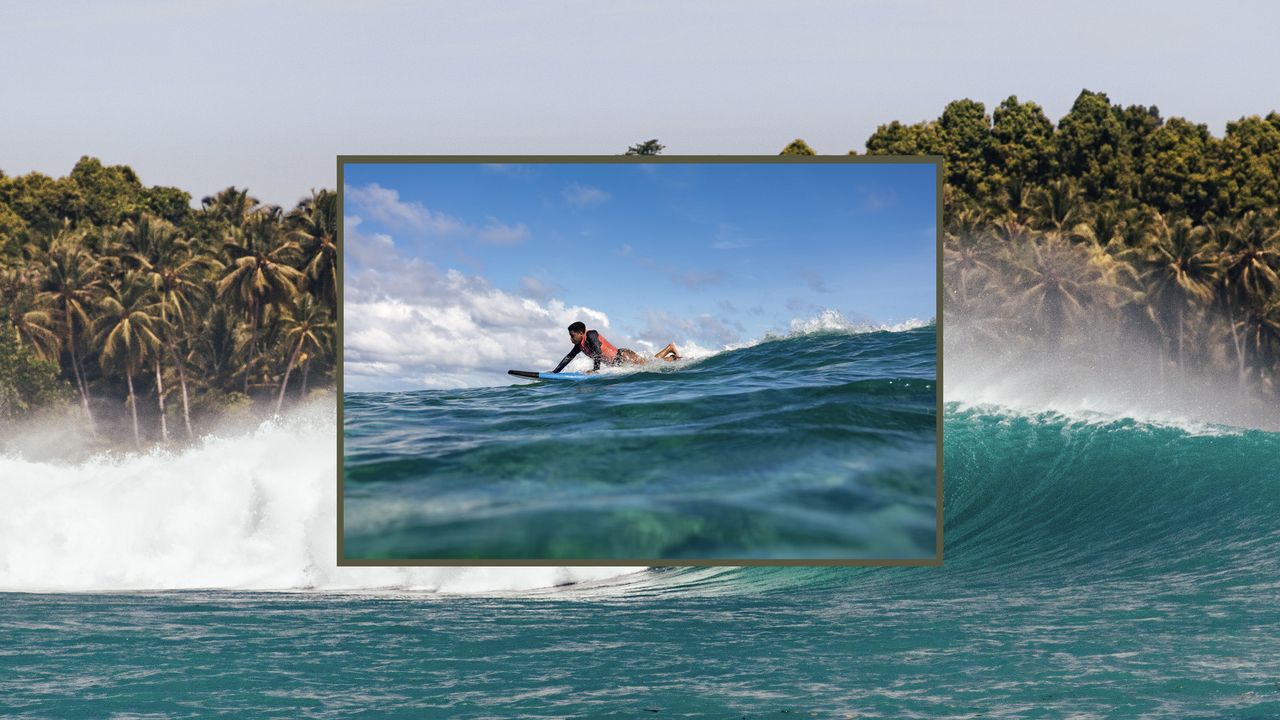
I have always had an overwhelming fear of the ocean—its power and depth, the creatures lurking in its gargantuan swells. It is a monster. Japanese artist Katsushika Hokusai got it right when creating his famous print, The Great Wave off Kanagawa, in which he depicts the sea as a cluster of claws grasping the air with merciless intent. Watching the movie Jaws as a kid didn’t help matters either. I, along with millions of 1980s kids, was shaken to the core by Steven Spielberg’s shark horror classic.It wasn’t until the summer after I graduated from university that I took my first dip in the sea. Standing waist-deep in the waters off Malaysia’s east coast, I freaked out when my friend emerged from beneath the surface and casually told me there were fish brushing past my legs. My aquaphobia wasn’t just psychological, though; it is rooted in a hard physical reality: I’m negatively buoyant, which means that treading water is nothing but a thrashing of sinking limbs. The only way I can stay afloat is to swim non-stop and exhaust myself, which is why I avoided the sea in my younger days, watching instead from the boat or shore as my friends cavorted like carefree otters.I wanted to enjoy the sea as much as they did, to see the marine life so mysterious and more fascinating than outer space. And I wanted to try surfing. The concept of gliding on the crest of a wave looked beautiful and liberating—I just needed to get over my unease in water. But this aversion reflected a broader psychological issue, a fear-based procrastination that has slowed my progress in life. I often shirk from bureaucratic tasks, preferring to pay late fees rather than fill out complex forms. Despite being a professional writer, the sight of a blank page on my computer screen has me reaching for the vacuum cleaner.The philosopher and author George Addair famously said that “everything you’ve ever wanted is sitting on the other side of fear.” He’s right. “What’s the worst that can happen?” is a question I often ask rhetorically, though actually answering it forced me to think more rationally about the risks of being in the ocean. Why had I spent 20 years missing out on the beauty of the coral reefs when I could just wear a life jacket? Eventually, curiosity trumped anxiety. My first full immersions in the sea began at age 40. Swallowing my phobia, I snorkeled in Palawan in the Philippines with a friend, sticking to her side like a whale calf to its mother. It was amazing. I tried it again in Antigua, Kenya, and the Maldives, where a giant manta ray glided past me. All good, but we’re talking about calm waters. Waves still freaked me out, even small ones like the six-footer that came at me in Santa Monica, California. I rose above it by clawing on my friend’s shoulders and almost drowning her in the process.Noo surfing in Indonesia’s remote Mentawai archipelago Grant DavisNonetheless, I dreamed of surfing. The prospect of wipeouts terrified me, yet the regret of never trying it was even scarier, so when an opportunity presented itself on a work assignment in Indonesia’s Mentawai archipelago, I grabbed it. Here, the Indian Ocean current flows uninterrupted, producing consistent waves that surfers love. For decades, hardcore board junkies were the only foreigners to venture to this remote region south of Sumatra, but family-run Aloita Resort caters to a broader crowd, including surf virgins. I couldn’t have picked a more beautiful spot to have my first lesson: warm turquoise sea, a beach backed by a forest of coconut palms, and professional photographer Grant Davis on hand to capture my moves. My Spanish instructor, Victoria Lvova, was the perfect teacher. Fun and reassuringly calm, she told me where to wait for the low-amplitude shoulder of the wave to arrive.At one point, I drifted too far left and watched in horror as a Hokkusai wall of water (a ripple by pro standards) rolled towards me. It pushed me downwards and sideways, snatching the board from my hands and flipping it upside down. When I broke the surface, Victoria was there to tell me, “It’s ok,” and help reposition the board. I had taken my first wipeout—my biggest concern—and emerged unscathed. A few more waves came along (I managed to stand up once), and I took a second wipeout without any drama. The biggest challenge, as is often the case in life, turned out to be something I hadn’t anticipated—the sheer exhaustion of paddling. Forget sharks or drowning; if anything was going to kill me, it was intense shoulder ache.So what was the worst that did happen? Well, an undignified photo of me riding my board on my hands and knees, wearing an uncool life vest. Not a strong look, but I felt like Superwoman (and would’ve given myself a pat on the back if my shoulders weren’t so sore). This surf experience felt like a massive cherry pop, a baptism into a new and less fearful realm. I’ve since transferred that confidence to the administrative and writing parts of my life, tackling the tsunami of tasks waiting for me back home, and knuckling down to write articles. I’m a million miles away from the Indonesian surf, but its lessons will stay with me forever.This article was originally published on Condé Nast Traveller UK.
Surfing in Indonesia Helped Me Conquer My Fear of the Ocean
Full Article
Original Source
Read the full article at Cntraveler →KhanList aggregates and links to publicly available news content. We do not host full articles from third-party sources. Always verify important information with original sources.