
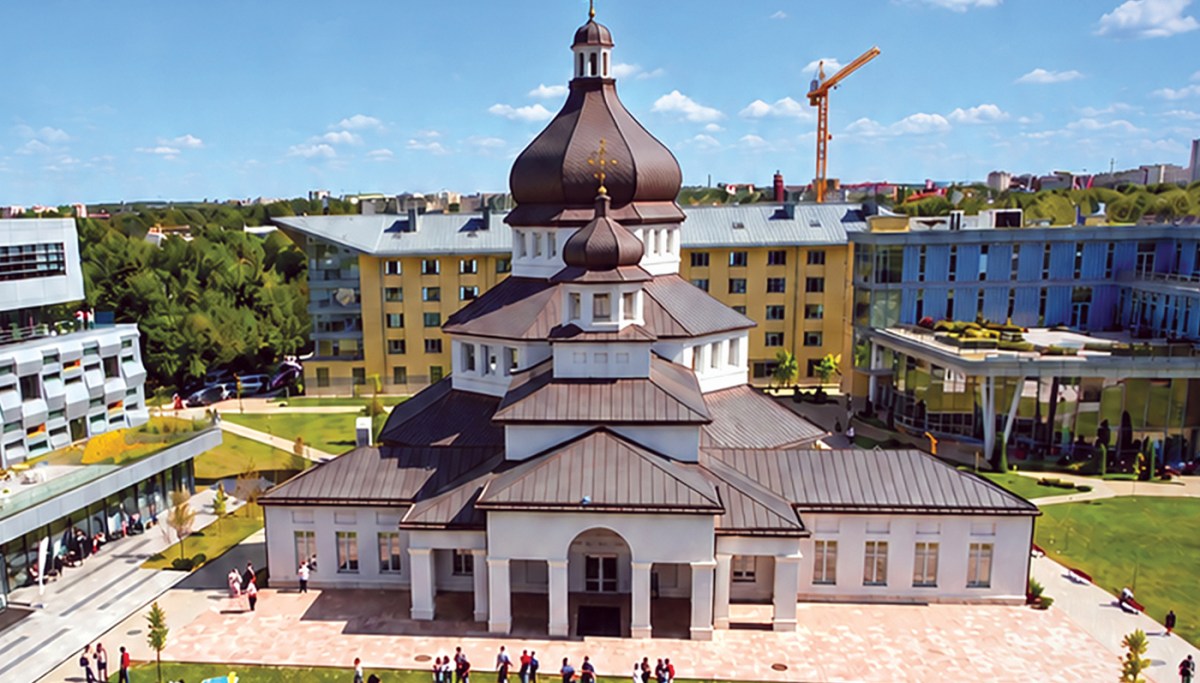
Pvt. Joker from Full Metal Jacket is coaxing his teammates to guess the correct word in a game of “Alias.” According to the rules of the game, Joker can only give his team members hints while the rest of the class watches and laughs at their stumbles. The setup is surely familiar to teachers of English as a second language all over the world, but the choice of vocabulary is a bit different from your typical classroom.“Like, when you stop the mission,” Joker says with a gesture of frustration. His team has been stuck on one particular word for about 20 seconds, and they’re quickly running short on time.“Abort!” shouts a teammate. With that hurdle overcome, the group starts to pick up steam. “Metallica has a song —” “Search and destroy!”“You do it with an axe, in the old days —”“Execute!”“You have an ice bucket —”“Challenge!”“You’re that old?” the instructor interjects laughingly. Joker’s team is out of time. They’ve managed to guess seven terms correctly in three minutes. They hold on for the win after the other two groups fall short of their mark.Ukrainian Catholic University. (ucufoundation.org) Joker’s real name is Julian, and he is an officer cadet, not a private. Despite his prominent forearm and calf tattoos, he bears a striking resemblance to Mathew Modine’s character from boot camp, complete with glasses, a shaved head, and a sly sense of humor. It’s roughly 9:30 a.m. at the campus of Ukrainian Catholic University in Lviv, and Julian is one of the oldest and most outspoken members of a group of cadets enrolled in English summer school. This is a bit of vacation from their typical military duties — the cadets are usually up at 7 a.m. for morning physical training, followed by grooming and personal hygiene inspections.On campus, the first lesson of the day starts at the civilized hour of 9 a.m. Even before we start the vocabulary game, however, it’s clear that these lessons are going to be different from your typical ESL fare. The day begins with a national moment of silence for fallen soldiers, which is observed every morning across Ukraine and is treated with near-religious reverence in these classrooms.The cadets are in civilian clothes, but they still stand out from the university summer crowd. For one, they’re the only overwhelmingly male group on campus, although there are a few female officer trainees in every classroom. The men all have buzz cuts and their “civilian” garb usually references their future trade, meaning logos with M-4 carbines, grinning skulls, naked women sporting sniper rifles and night-vision goggles, or tees denoting military specializations. Fanny packs and backpacks have an array of militaria, from unit patches to a “Donbasonia” knockoff of the ubiquitous Patagonia logo.Police and military cadets mark the National Anthem Day of Ukraine in front of Lviv City Hall on March 10, 2026, in Lviv, Ukraine. (Les Kasyanov/Global Images Ukraine/Getty Images) After the vocabulary game, it’s time to move on to a series of bizarre acronyms: OPORD, WARNO, and FRAGO. I’m scribbling furiously because I don’t know what any of these things mean, but the cadets are already familiar with the terminology and seem comfortable with the concepts. OPORD, it turns out, is shorthand for “Operation Order.”What is an “Operation Order?’” asks Solomiia, the jovial university instructor leading the class, in a slight but distinctly British accent.“Either do it or go to jail,” says Sasha, a tall second-year cadet at the front of the class who is almost as talkative as Julian. Solomiia laughs and brings up the proper definition on her slideshow. What happens if a commander forgets to write an OPORD?“It’s OK — nobody reads them anyway,” Julian says.After the chuckling subsides, Solomiia asks a follow-up question. Why are printed OPORDs useful in the field?“You can use them to start a fire,” Sasha suggests.The cadets laugh easily and continue the discussion. A few of them, including Julian and Sasha, were enlisted soldiers before they entered the academy and are already familiar with the yawning gap between military theory and practice.English proficiency is not a requirement for graduating cadets, but it is a useful skill in a military that relies on foreign equipment and is increasingly oriented toward NATO standards and practices. The cadets at this particular program are drawn from the military academies in Lviv and Odesa, and their typical English lessons are boring Zoom sessions with outdated teaching material. Adding insult to injury, the internet is unreliable because classes at both academies are dispersed across different, often remote locations as a security precaution. Summer English school at the university is meant to address this deficiency, Solomiia explains. She first started holding classes three years ago after consulting with friends from the military and Ukraine’s International Legion.The extra English lessons seem to be paying off. After last year’s summer session, several of the cadets went off for additional training in Romania. Solomiia was delighted afterward when they texted to tell her how much they used their classroom English. The cadets say they expect to use their English again when training abroad for amphibious and airborne operations.At lunch, I sit down with Sasha, the tall second-year cadet, and Dmytro and Yevhen — “Call me ‘Eugene’,” he says, after several mangled attempts at pronunciation — two cadets who have just finished up their first year. Sasha is from Odesa on the coast, Dmytro is from Kherson in the south, while Eugene is from Kryvyi Rih, a name I don’t immediately recognize. “It’s the president’s hometown,” Eugene explains helpfully. “It’s like our Detroit,” Sasha adds, a reference to the city’s reputation as an industrial rust bucket.Like Julian, Sasha was enlisted in the military before undergoing officer training. He served in Mykolaiv and Kherson and was then admitted to the Odesa Military Academy, where he, Dmytro, and Eugene are all training to go airborne. After we finish with introductions, I ask why anyone would volunteer to jump out of a plane.“The other choice was Marines,” says Sasha. “I don’t want to die in water.” Dmytro laughs and then starts showing off videos of his parachute jumps, which look about as terrifying as you might expect. In Ukraine, the cadets only do low-level helicopter jumps under carefully prescribed conditions. To practice jumping from an actual plane, they’ll have to travel abroad for additional training.At the academy, the cadets study everything from military theory to tactics and mathematics. Eugene looks incredulous when Sasha explains that they’re expected to take philosophy courses. The cadets seem to like their English lessons, but it’s clear that summer school in Lviv is also a nice break from their typical military routine.“We’re not supposed to go out for beers,” Sasha says as the other two laugh. “But we do it anyway.”It’s no wonder the cadets enjoy their time in Lviv, the rare Ukrainian city where it’s possible to forget there is a war on. Located in one of the country’s westernmost provinces, Lviv and nearby Krakow were once sister cities under the Habsburgs and interwar Poland. The post-World War II settlement interposed a border between the two cities, but Lviv still has a distinctly Mitteleuropa feel, complete with birthday-cake architecture, spectacular churches, and charming, cafe-lined avenues. The city has an air of shabby gentility brought on by decades of neglect, but if you squint down the right street — and ignore the crumbling facades, boarded-up church windows, and downed Russian drones on display — you can easily imagine yourself in Prague or Budapest.Lviv is more European than the rest of the country,” says Julian, who grew up here. “The east is fighting, and the west is sort of a shelter where people rest.” To other Ukrainians, Lvivians have a reputation for being passive-aggressive and perhaps a bit snobby, but it’s not hard to see why the locals are proud of their city.In a country roughly the size of Texas, Lviv is about as safe as you can get, but it is still on the receiving end of intermittent drone and missile strikes. In late March, a residential building was hit right next to the Bernardine Monastery downtown, a UNESCO World Heritage site.“I used to drink coffee with my wife there,” Julian says. “Now, not so much.”Despite the drone and missile attacks, Lviv has experienced a wartime property boom fueled by displaced Ukrainians moving from the east. Compared to other cities, the city’s curfew and air-raid rules are noticeably lax. A German university instructor laughingly tells me that Berlin under quarantine had tougher restrictions.A manicured university campus in Lviv is also a change of scenery for Capt. Paul, the academy instructor supervising the summer language program. Paul speaks perfect English — his father was from Houston, and he spent a year training at the Royal Military Academy Sandhurst in the United Kingdom — and, with his carefully trimmed mustache and military fatigues, looks to have stepped off one of the city’s ubiquitous recruiting posters. Before becoming an instructor at the Lviv academy, he was a forward artillery observer in Kharkiv and Donetsk. After a bit of prodding, he admits that he was with Ukraine’s 8th Special Operations Regiment, which is, in his words, “kind of like the Green Berets.”Paul’s accent is so good that a young woman interrupts our conversation to thank him for his service in English. His language skills also give him a unique insight into Ukraine’s relationship with its foreign volunteers. “When you meet a guy in the International Legion and they hear you speak English, their eyes kind of light up,” he says.The influx of foreign volunteers, while welcome, has also created problems for Ukraine’s military. Many are drawn to Ukraine for firsthand experience in what Paul calls “modern war,” meaning intensive drone operations. He says the Ukrainians have recently received an influx of volunteers from Colombia, believed to be working for the cartels, who sign up to learn about battlefield first-person view drones and then disappear after they’ve acquired the requisite expertise. On Russian-aligned social media, this is characterized as evidence of a Ukrainian “alliance” with the drug lords, but it points to the larger problem of vetting foreign volunteers under wartime conditions. Later, two instructors at UCU tell me they’ve noticed suspiciously large numbers of Spanish-speaking “tourists” in Lviv who are strangely reluctant to talk to locals.Like his young charges, Paul feels the disconnect between campus life and the fierce fighting to the East. “As a person who’s done combat, it’s kind of boring,” he says ruefully. But, he adds, it’s rewarding to see cadets improve as they progress through their academy classes.Day 2 of the English language program starts on a more subdued note. Many of the cadets from yesterday are not in class — they’ve been excused to attend a funeral for recent academy graduates. UCU is hosting a campus 5K to raise scholarship money, and university grounds are filled with runners, almost all girls, in compression socks, chunky-soled Hoka and Adidas sneakers, and fashionably tight workout gear. “What’s the big deal about running 5 kilometers?” one of the cadets asks irritably.The first lesson of the day is on radio communication and the NATO phonetic alphabet. The ideal transmission, according to the instructor, is concise and exact, something like, “Six, three-six. Contact east. Grid 447 652. Approx. 12 dismounts, moving south. Request immediate fire support. Casualties: none. Awaiting instructions. Over.” The alternative version of the above transmission, labeled “what not to do,” seems a model of clarity by comparison, but courtesy, proper articles, and superfluous adjectives are apparently frowned upon in military circles.After radio and communications etiquette, we move on to photographic reconnaissance. The instructor needs an extra participant for this activity, so I get paired with Roma, a studious, bespectacled cadet in a maroon airborne T-shirt and pink Asics. We’re supposed to analyze a reconnaissance photograph on the board and then compare notes. I see a line of trucks at a crossroads next to a lake. Roma has a different view of things.The lake is almost certainly man-made, he points out, because of its unnaturally square shape. The angle of the picture means the photo was probably taken from a low-flying drone. The trucks, Roma continues, are parked too close together, making them ideal targets for artillery fire. The photo was probably taken in the early days of the war, he says. Large convoys of military vehicles no longer move in daylight.During a smoke break, I get a chance to talk to Roma and Vlad, another talkative young cadet with a friendly face, about their training back at the academy. Both are from the Odesa group and have just finished their first year, though Roma is on the airborne track and Vlad will be serving in the Ukrainian Marines.“It’s a really strong brotherhood,” Vlad says, explaining why he chose the Marines. He expects to use his English skills later this year, when he goes to Romania for amphibious exercises.Ukrainian Marines, Vlad continues, also undergo jump training. “We jumped with old Soviet Union parachutes the first time, so landing was hard,” he says laughingly. Next time will be better because he’ll be using Polish equipment.There aren’t many girls in the cadet language program, but the smoke break brings together officers from different backgrounds, including a few women. Vlad introduces me to Lina and his friend, Alexander.“Not Sasha,” Alexander clarifies. “Like Alexander, you know, of Macedon,” Vlad says. “Alexander the Great?” I ask.“Yeah,” Alexander the Great says, grinning widely. “Like him.”Lina is wearing trendy, thick-soled shoes and baggy jean shorts that reach below her knees and has a red-and-black tattoo spiraling over her right forearm. She is from the Lviv academy, which has a broader range of training programs than Odesa, including psychological support, her chosen specialization. After the war is over, she hopes to help veterans readjust to civilian life.Vlad and Alexander the Great, who are both from the Odesa group, gently rib Lina for what they say is an easier program at the Lviv academy. In Odesa, all the cadets are training for airborne, Marines, or reconnaissance and special forces.Alexander the Great’s English is less fluid than Vlad or Lina’s, but he seems to revel in the physical strain of academy life. Despite a steady diet of 20 cigarettes a day and constant vaping, “he runs like a horse,” Vlad says. “He trained me because my running was not so good.”Alexander the Great grins again. “Like David Goggins, you know?”After two days at summer camp, I’m still hazy on the difference between an OPORD and a FRAGO, but I’ve learned a few home truths about life in the Ukrainian military. You’re never scared on your first jump — the fear comes later, after you know what’s coming. You’re not supposed to take your phone on the helicopter to film yourself, but everyone does it anyway. If your first chute fails, it’s immediately yanked upwards, which the recruits casually refer to as “a candle.” But don’t worry — you get extra pay if you have to use your emergency parachute.Behind the ubiquitous jokes and military memes is a grim reality. When the cadets finally graduate, they are going to command men older and more experienced than themselves. Paul says the average age of a front-line soldier is about 42.Perhaps most importantly, everyone at the summer camp, from Paul to the cadets to the civilian instructors, is convinced that the war is going to last a long time. “Optimism comes from destroying the fuel refineries in Russia,” Paul says, a reference to a spate of spectacular Ukrainian strikes on Russian energy infrastructure. “Some of the Russians are now waking up to the costs of war.” But he still expects heavy Russian offensives in the coming months, enabled by summer foliage cover and new conscript drafts.The cadets, meanwhile, will be taking academy classes for a few more years, but none expect the fighting to be over by the time they graduate. Vlad and Alexander the Great say they only signed up because of the war and expect to be fighting. “I am an art man,” Vlad says with an utter lack of guile. He enjoys playing guitar and wants to study history and philosophy when this is all over. But he doesn’t think that will happen by the time he graduates.“I wish military English wasn’t necessary,” says Solomiia, the program’s organizer. “But we’ll be here next year.”Sometimes this grim reality is hard to remember in Lviv, a city that is strangely distant from the fighting to the east. It may also be hard for the younger officer trainees to process. “It’s still fun and games to them,” says Julian, the older cadet with the easy jokes who has already seen combat.UKRAINE’S LONG WARAt lunch on the first day, I asked Sasha, Dmytro, and Eugene about the disconnect between Lviv’s peaceful, Old World atmosphere and the brutal fighting they expect to get thrown into after graduation. After thinking about the question for a few moments, Sasha had an unexpectedly poignant answer.“This is what we’re fighting for,” he said. “So people have normal lives.”Will Collins is a lecturer at Eotvos Lorand University in Budapest, Hungary.
Summer school for Ukraine’s future officers
Full Article
Original Source
Read the full article at Washingtonexaminer →KhanList aggregates and links to publicly available news content. We do not host full articles from third-party sources. Always verify important information with original sources.