
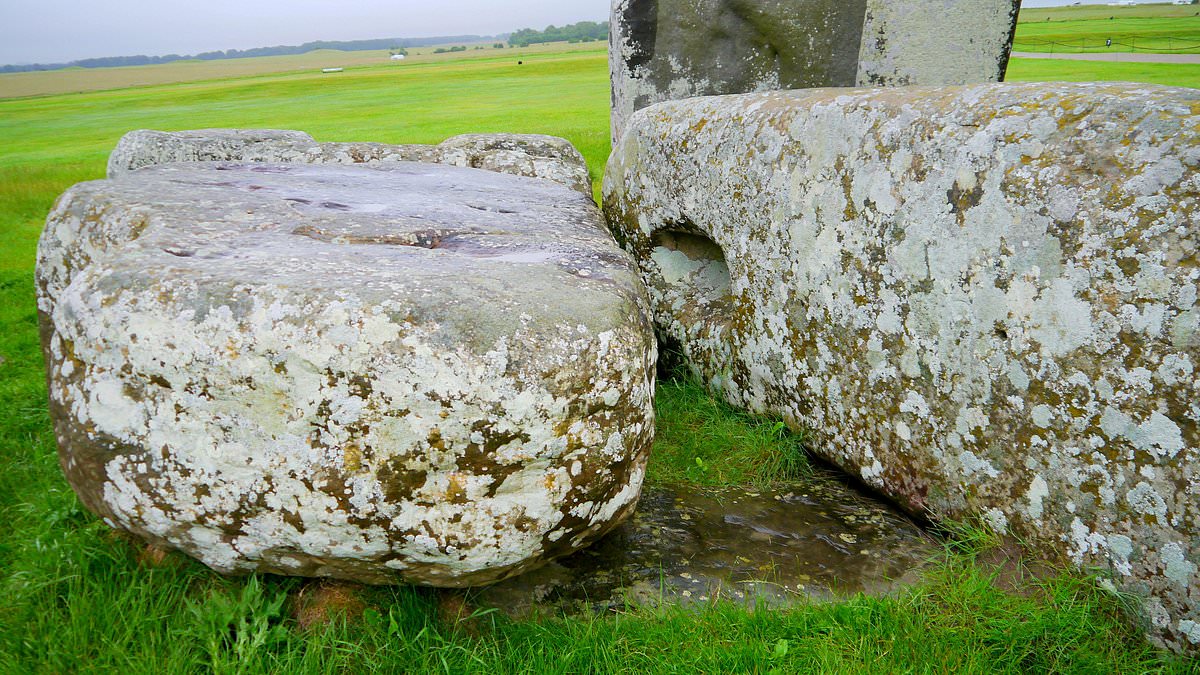
It's one of the biggest remaining mysteries surrounding Stonehenge – where did the altar stone come from?For years, researchers have been trying to determine where the huge six–tonne sandstone slab originated before it was transported to Salisbury Plain thousands of years ago.For much of the last century, experts believed the stone came from west Wales.That theory was then overturned by recent studies pointing instead to north–east Scotland.Now, a fresh investigation has cast doubt on Scotland as well, leaving northern England among the most promising remaining candidates.Lead author Professor Duncan Pirrie, from the University of South Wales, told the Daily Mail: 'Our search is focusing on rocks which form part of a geological unit called the 'Old Red Sandstone'.'Key areas for us to focus on now are in the Midland Valley of Scotland, Southern Scotland and northern England.' The monument's Altar Stone, weighing up to six tonnes, may come from northern England after all. Pictured: The stone underneath two bigger Sarsen stones Researchers have spent years trying to determine where the huge six–tonne sandstone slab originated before it was transported to Salisbury Plain thousands of years agoThe Altar Stone is a distinctive 16ft (4.9m) sandstone slab that lies at the heart of Stonehenge and is unique among the monument's stones. The international team carried out the most detailed geological analysis of the Altar Stone ever undertaken, examining its structure, minerals, chemistry and isotopic composition.Their findings, published in the Journal of the Geological Society, suggest the stone did not come from the Orcadian Basin in north–east Scotland, one of the leading suspected source regions.Instead, the hunt for its true birthplace has narrowed to a broad swathe of southern Scotland and northern England.Professor Pirrie explained: 'The two main groups of rocks at Stonehenge are the larger 'Sarsen' stones which are broadly speaking relatively locally derived.'There are then the smaller bluestones which are dominantly a range of igneous rock types which can be linked back to the Preseli Hills of Pembrokeshire.'According to the researchers, the Altar Stone stands apart because it is composed of sandstone containing distinctive calcite cement and the mineral baryte. Researchers believe Stonehenge is made of three types of stone. Here, the Altar Stone is highlighted in green Lead author Professor Duncan Pirrie said key areas of focus are now the Midland Valley of Scotland, Southern Scotland and northern EnglandWhile sandstone is common throughout Britain, scientists have yet to find a perfect geological match.'Our work has suggested that we can rule out Wales,' Professor Pirrie added.'There are still some areas in the far north–east of Scotland that we need to check, so perhaps we cannot entirely rule out this area, although we haven't found anywhere yet in this region.'So we are focusing on southern Scotland and northern England.'Researchers believe identifying the source could reveal new details about the abilities of the Neolithic people who built the monument.'I think that we have perhaps rather lost sight of just how capable Neolithic people were,' Professor Pirrie added.'Clearly moving a six–tonne stone significant distances is a testament to their engineering and organisational ability.' The Altar Stone contains distinctive white mineral bands and ripple–like patterns formed millions of years ago. These geological features act like a fingerprint, helping scientists trace its origins Microscopic images of the Altar Stone reveal its unique mix of minerals and cement, providing scientists with a detailed geological fingerprintProfessor Pirrie notes that while the bluestones were transported around 140 miles (225km), bringing the Altar Stone from Scotland would have involved an even greater journey.'Our latest study provides the most detailed description of the Altar Stone ever compiled, and we are very hopeful that we can answer this challenge soon,' he added.According to Professor Richard Bevins of Aberystwyth University, the latest work has significantly narrowed the search area.He said: 'For almost a century, the prevailing view was that the Altar Stone came from west Wales.'Our previous research overturned that assumption and pointed instead to Scotland as the most likely source.'This latest study significantly refines the search by identifying the specific geological characteristics we need to look for, allowing future investigations to be targeted more effectively.'With each new piece of evidence, we move closer to solving one of Stonehenge's most enduring mysteries.' Stonehenge's sarsen stones are the larger megaliths than form an outer circle and central horseshoe. Then there are the smaller bluestones, and the Altar Stone in the middle It's possible the stones were transported by being placed on logs, with a team of people pulling them along via ropes. Pictured: A replica of a stone being transported at StonehengeProfessor Nick Pearce, also of Aberystwyth University, said eliminating possible source regions was just as important as discovering new ones.'Every location eliminated narrows the search and brings us closer to discovering where the Altar Stone originated,' he said.Earlier this year, an expert suggested Stonehenge's famous sarsen stones may have been transported there as part of a Neolithic race.Win Scutt, curator of properties at Stonehenge, said there may have been an element of competition in lugging the 30–tonne stones from up to 20 miles away.The prehistoric monument on Salisbury Plain features dozens of massive, iconic megaliths that form an outer circle and central horseshoe.While there are countless theories as to why the monument, which is around 5,000 years old, was built, Mr Scutt suggests humanity's primal urge to compete may have played a role.'I think there might have been a sport in getting these stones here,' he said. 'Teams of people, a bit of competition, a challenge.'The Stonehenge monument standing today was the final stage of a four part building project that ended 3,500 years agoStonehenge is one of the most prominent prehistoric monuments in Britain. The Stonehenge that can be seen today is the final stage that was completed about 3,500 years ago. According to the monument's website, Stonehenge was built in four stages: First stage: The first version of Stonehenge was a large earthwork or Henge, comprising a ditch, bank and the Aubrey holes, all probably built around 3100 BC. The Aubrey holes are round pits in the chalk, about one metre (3.3 feet) wide and deep, with steep sides and flat bottoms. Stonehenge (pictured) is one of the most prominent prehistoric monuments in BritainThey form a circle about 86.6 metres (284 feet) in diameter. Excavations revealed cremated human bones in some of the chalk filling, but the holes themselves were likely not made to be used as graves, but as part of a religious ceremony.After this first stage, Stonehenge was abandoned and left untouched for more than 1,000 years. Second stage: The second and most dramatic stage of Stonehenge started around 2150 years BC, when about 82 bluestones from the Preseli mountains in south-west Wales were transported to the site. It's thought that the stones, some of which weigh four tonnes each, were dragged on rollers and sledges to the waters at Milford Haven, where they were loaded onto rafts.They were carried on water along the south coast of Wales and up the rivers Avon and Frome, before being dragged overland again near Warminster and Wiltshire.The final stage of the journey was mainly by water, down the river Wylye to Salisbury, then the Salisbury Avon to west Amesbury. The journey spanned nearly 240 miles, and once at the site, the stones were set up in the centre to form an incomplete double circle. During the same period, the original entrance was widened and a pair of Heel Stones were erected. The nearer part of the Avenue, connecting Stonehenge with the River Avon, was built aligned with the midsummer sunrise. Third stage: The third stage of Stonehenge, which took place about 2000 years BC, saw the arrival of the sarsen stones (a type of sandstone), which were larger than the bluestones.They were likely brought from the Marlborough Downs (40 kilometres, or 25 miles, north of Stonehenge). The largest of the sarsen stones transported to Stonehenge weighs 50 tonnes, and transportation by water would not have been possible, so it's suspected that they were transported using sledges and ropes. Calculations have shown that it would have taken 500 men using leather ropes to pull one stone, with an extra 100 men needed to lay the rollers in front of the sledge.These stones were arranged in an outer circle with a continuous run of lintels - horizontal supports. Inside the circle, five trilithons - structures consisting of two upright stones and a third across the top as a lintel - were placed in a horseshoe arrangement, which can still be seen today. Final stage: The fourth and final stage took place just after 1500 years BC, when the smaller bluestones were rearranged in the horseshoe and circle that can be seen today.The original number of stones in the bluestone circle was probably around 60, but these have since been removed or broken up. Some remain as stumps below ground level. Source: Stonehenge.co.uk
Stonehenge mystery deepens: Scientists say the altar stone may come from northern ENGLAND after all - and not Scotland or Wales as previously thought
Full Article
Original Source
Read the full article at Dailymail →KhanList aggregates and links to publicly available news content. We do not host full articles from third-party sources. Always verify important information with original sources.