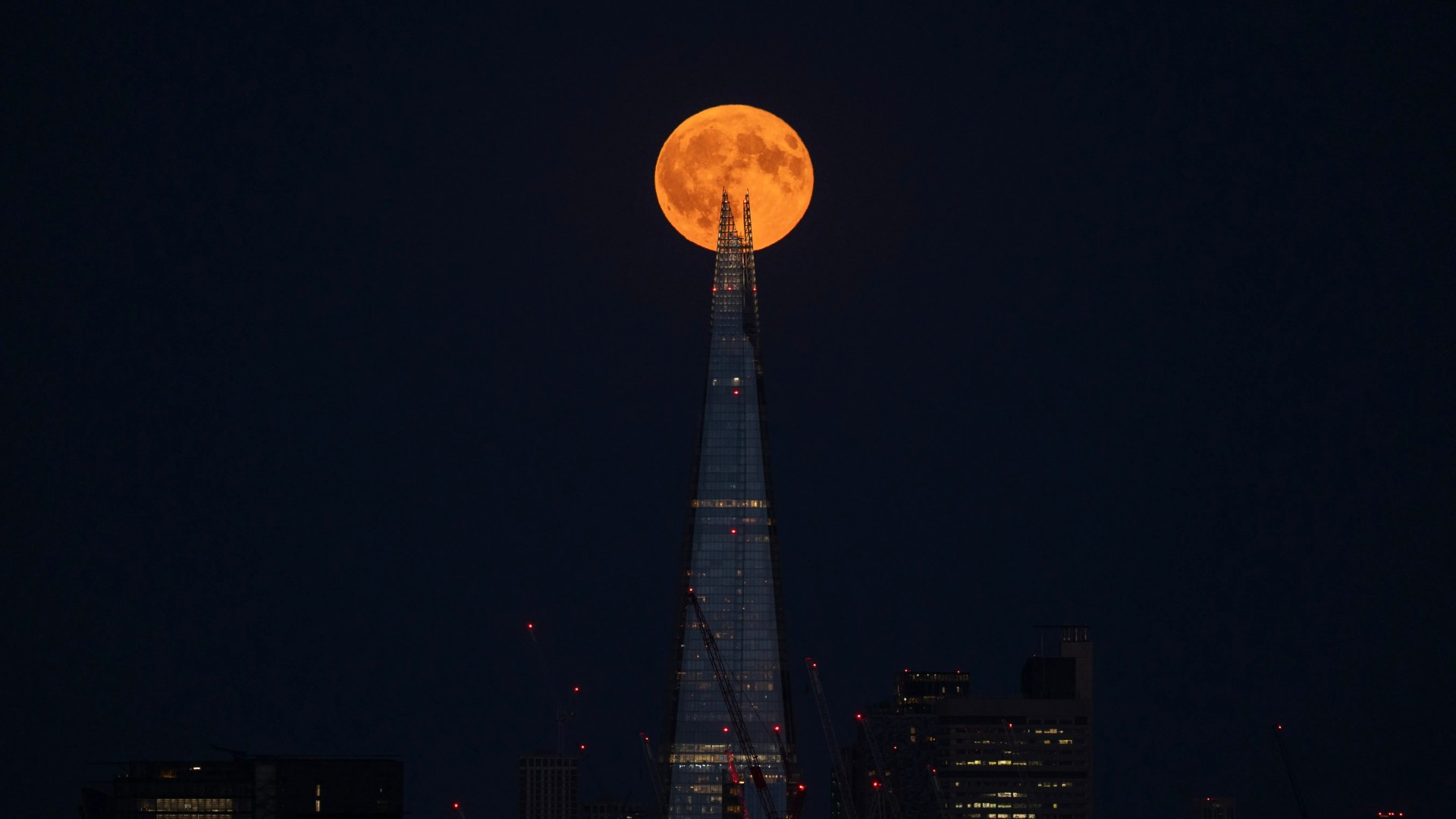
STARGAZERS were treated to incredible views across the globe as the rare Buck Moon lit up famous landmarks. Lucky sky-watchers have snapped incredible pictures of the giant golden orb hovering over them. The Buck Moon rising behind a mosque in Cairo, Egypt Credit: Reuters The Temple of Poseidon at Cape Sounion near Athens, Greece Credit: Getty The Buck Moon is July’s full moon, getting its name from the fact that male deers’ antlers are in full growth this time of year. The astronomical treat requires zero specialist kit, meaning anyone looking out of their window gets a front-row seat to the show. Sign up for the Tech newsletter Thank you! In the UK, people in Devon, Cornwall, and Kent were lucky enough to marvel at the bright yellow light emanating off the huge moon. Meanwhile, in London, the big orange ball rose above The Shard. The red moon shining glowing over Canary Wharf Credit: Alamy The Buck Moon lit up fields in Warwickshire Credit: PA In Athens, Greece, the full moon hovered over the Temple of Poseidon at Cape Sounion, and in Cairo, Egypt it beautifully lit up the tower of a mosque. The Buck Moon has a striking warm orange and yellow glow thanks to a scientific trick known as Rayleigh scattering. When the moon hangs low in the sky, its light has to push through a much thicker layer of Earth’s atmosphere. The air scatters away the shorter blue light waves, letting only the lush, warm red and orange tones reach our eyes. Most read in Tech The Shard in London appeared to pierce the moon Credit: PA In Hungary, the moon rose behind an antenna tower Credit: Getty The Buck Moon was also turning heads because of how massive it appeared peeking over the horizon. The mind-boggling size is a brain trick known as the Moon Illusion. When the Moon is in low orbit, the brain automatically compares it to familiar landmarks on the ground like trees, houses, and tall buildings. This tricks the brain into thinking it’s much bigger than when it’s floating high in the empty night sky. The Buck Moon is also called the Thunder Moon Credit: Getty The moon appears big due to its low orbit Credit: Alamy The name Buck Moon originates from Native American traditions, marking when male white-tailed deer grow new antlers encased in velvet. The timing is less tidy than the name suggests – while it fits North American white-tailed deer, whose antlers can start hardening from mid-July, British deer run to different schedules. Roe deer have generally stripped their velvet by late July, while red, fallow and sika deer typically do so during August and September. July’s full moon also has plenty of other traditional names from other cultures around the world: Thunder Moon, Hay Moon, Salmon Moon, and Berry Moon. The Buck Moon is the middle of three summer full moons, sitting between June 30’s Strawberry Moon, and August 28’s Sturgeon Moon. So if you missed this phenomenon, August’s full moon should also delight. Comment now
Stargazers watch in amazement as rare Buck Moon lights up landmarks across the world
Full Article
Original Source
Read the full article at Thesun →KhanList aggregates and links to publicly available news content. We do not host full articles from third-party sources. Always verify important information with original sources.