
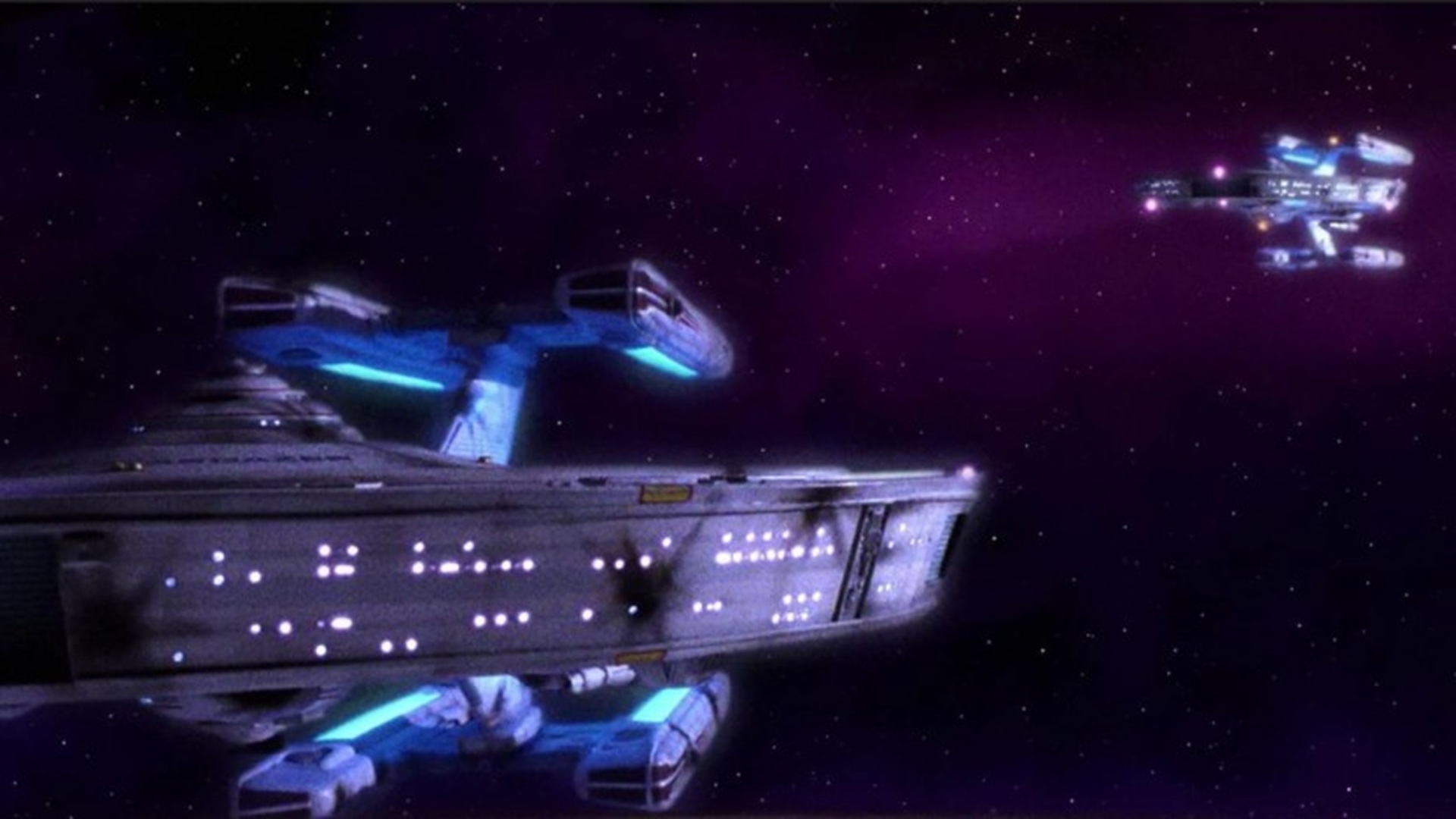
A Brazilian physicist has discovered that a famous battle tactic from American sci-fi TV series “Star Trek: The Next Generation,” is not only scientifically plausible but even more effective than depicted on screen. As part of his research, Níckolas de Aguiar Alves, a PhD candidate at the Federal University of ABC in Santo André, studied the show’s so-called Picard Maneuver.” In the series, the combat tactic was devised by Starfleet Captain Jean-Luc Picard while commanding the USS Stargazer during the Battle of Maxia. The tactic saw the starship jump to warp speed toward its enemy, suddenly stop at close range, and then open fire before light or sensor signals from its former position arrived. The effect created the illusion of two ships, leaving the enemy unsure which one to target. De Aguiar Alves’ calculations now suggest that the strategy would produce three apparent images of the spacecraft, rather than the two portrayed in the TV show. “You get a lot of intuition very quickly, and pretty much for free, by just doodling,” he said. The illusion triples The maneuver first appeared in the 1987 episode called “The Battle,” where Picard recalls a battle from his time as captain of the USS Stargazer. After the ship came under attack and lost its shields, Picard was urged to find a way to close in on the enemy vessel without taking further fire. The captain then ordered the ship to accelerate to warp speed, travel toward the enemy faster than light, and then abruptly stop before firing. Since it was moving at such a high speed, the enemy would briefly see two versions of the ship: an older image at its previous position and the real one at its new location. In the episode, the enemy therefore risked firing at the wrong target. However, de Aguiar Alves discovered that the scenario becomes more complicated once the spacecraft’s changes in velocity are considered. As per the physicist, the ship does not simply travel at a constant faster-than-light speed. It first accelerates to warp speed, and later decelerates to a stop near the enemy. Those two changes mean an observer could actually see three apparent images of the spacecraft at certain moments. The findings propose that Picard’s strategy was more effective than the episode’s 50/50 gamble. From sci-fi to physics De Aguiar Alves reportedly noticed the connection while working on an unrelated particle-physics problem involving a medium in which light travels more slowly. After sketching diagrams to better understand the problem, he realized the setup resembled the trick he had seen years earlier in Star Trek, during his postgraduate studies. “And after I drew one or two diagrams, I started noticing, ‘Hey, I think I’ve thought about something like this before,” he added. Faster-than-light spacecraft still remain science fiction, as current physics prevents objects with mass from accelerating beyond light speed. But, similar mathematics becomes relevant when particles move through materials where light travels more slowly than it does in a vacuum. A charged particle can move through water faster than light propagates through that water. When this happens it generates Cherenkov radiation, the characteristic blue glow associated with nuclear reactors. De Aguiar Alves was studying another phenomenon, called the “memory effect,” in which a passing wave can leave a lasting change in a particle’s motion. Theory suggests the effect could be stronger in materials where light travels mor slowly. He, however, praised the show’s underlying idea, even though it underestimated the number of apparent spacecraft. “The main thing they got perfectly, and I think it is a great illustration,” he concluded.The study, named “The unexpected effectiveness of the Picard maneuver: Seeing three images of the same superluminal spaceship,” is published as a preprint on arXiv. It is set to appear in the American Journal of Physics. Get the latest in engineering, tech, space & science - delivered daily to your inbox.Based in Skopje, North Macedonia. Her work has appeared in Daily Mail, Mirror, Daily Star, Yahoo, NationalWorld, Newsweek, Press Gazette and others. She covers stories on batteries, wind energy, sustainable shipping and new discoveries. When she's not chasing the next big science story, she's traveling, exploring new cultures, or enjoying good food with even better wine.
Star Trek’s iconic warp speed combat Picard Maneuver would work, physicist proves
Full Article
Original Source
Read the full article at Interestingengineering →KhanList aggregates and links to publicly available news content. We do not host full articles from third-party sources. Always verify important information with original sources.