
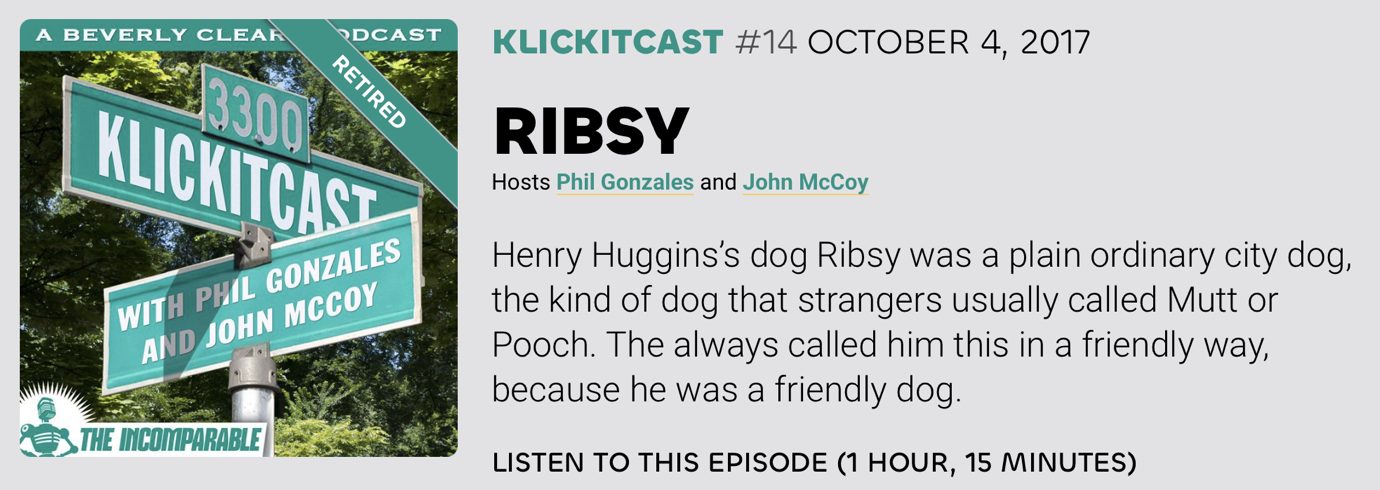
Late last month I got several emails from Spotify, all pretty much the same: Hello, Our automatic review tools determined that this podcast may contain content that infringes the rights of a third party. Due to this, we’ve removed: Title: 14: Ribsy Detected Content: “Ribsy” by Beverly Cleary Why did this happen? Spotify for Creators supports the distribution of audio and video podcasts. Our automated review process may remove any content that appears to be distributing third-party literary material. What’s next? If you think your episode does not infringe the intellectual property rights of a third party, or is subject to a copyright exception (such as fair use), you may submit an appeal. We’ll review your appeal and notify you of our decision. Please note: Abusing the appeals process may result in restrictions on submitting future appeals. Under our repeat infringer policy, shows or users with multiple strikes will be removed from Spotify, and their accounts terminated. However, if your content is reinstated—either through a successful appeal or because the claim is withdrawn—we’ll update your records and remove the strike. Klickitcast was a podcast by John McCoy and Phil Gonzales that covered every book by Beverly Cleary. Episodes were usually an hour long, and generally started with the hosts reading the first paragraph about the book to kick off their discussion. I measured a few of them. An hour or more of critical content, and maybe 30 or 45 seconds of quoting from the work being discussed. This is the very definition of “fair use,” in which excerpts from works may be used specifically for the purpose of making editorial points about those works. It’s very obvious what happened. Not being satisfied by its endless patrolling of podcast episodes for music that appears in Spotify’s own music libraries, the company had moved on to either: Lazily scanning the titles of podcasts to see if they matched books. or Lazily transcribing podcasts and matching them to some book text, possibly even only the first portion of the book. Either way, if a match was found, Spotify would immediately remove the podcast episode from its service and send one of those emails that I received. On the one hand, I was offended because anyone could see that these were not pirate podcast episodes that were illegally creating audiobooks out of copyrighted works. When I use the word “lazily,” what I’m saying is that there is clearly a way to build a tool that analyzed the transcripts of podcast episodes and compared it to book text and intelligently determined whether the episode was pirating books. But Spotify didn’t bother with that. It just hoovered up anything and everything, including an episode where book text took up a grand total of 0.008% of its runtime. On the other hand, I was also offended because this is just another example of the ruination of the legal concept of fair use. Fair use is not a copout or a loophole, it’s a fundamental understanding that copyright law has limits, and quoting a work to criticize it can’t be stifled by authors demanding that their copyright entitles them to prevent critics from quoting their work. The problem is that fair use on the internet has been stifled by content-detection algorithms that don’t care about your fair use. It just notices that you used something that belongs to someone else. On YouTube, this can lead to account deactivation, loss of ad revenue, and even the hijacking of your ad revenue and the diversion of it to someone else who claims they own the rights to the thing you are using legally. Let me give you an example of how this chilling effect works. Next week we’re posting the first episode of the new series of Designed in California, which is about the creation of the iPod. To set the scene, there’s an episode about the origins of the MP3 audio format, which includes an amazing story about a particular pop song that was used by one of the creators of the MP3 to fine-tune the format. I thought it would be great to play a few seconds of the song in the podcast, when illustrating just how difficult it was to encode an a capella voice performance and explaining that the father of the MP3 estimates that he had to listen to the song a thousand times before he felt he had gotten it right. We aren’t playing the song, though, because I’m sure it would run afoul of YouTube and Spotify’s content algorithms, and we’d need to risk the argument that it’s fair use—and potentially threaten the distribution and revenue generation of our brand-new podcast. Nothing like having episode one of a five-part series disappear from the internet because we ran afoul of content scanning. (Yes, you can appeal these sorts of rulings. In fact, Spotify did reply the next day to my response to its rejection notices and agreed that it was in the wrong and restored the episodes. But as a content creator, you are throwing yourself on the mercy of the organization, and if they decide you’re in violation, you are out of luck.) After all this, I decided to delete my Spotify account and sever The Incomparable’s relationship with that company. To be honest, I had only put my network’s podcasts up on Spotify because I had heard from a few Spotify users who were interested in listening to them there. But for shows like mine, the truth is that we rarely had double-digit listeners of any given episode. And more broadly, I believe Spotify is bad for podcasting. It’s not really podcasting, of course, because it ingests the files and re-serves them. It’s not interested in the broader podcast ecosystem (hence its original plan to buy a bunch of popular shows and limit their distribution to Spotify). It’s a massive company that has decided to feed the growth beast by consuming as many adjacent pieces of content as it possibly can. And that includes podcasts and audiobooks. (Yes! Is it a coincidence that just as Spotify began its lazy inspection of podcasts for violations of literary content, it’s also ramped up its own audiobook offerings, including AI-generated audiobooks? I assume not, while also assuming that there probably is a plague of AI-generated audiobooks out there that really do violate copyright. It’s not wrong—but it’s conveniently self-serving.) If you listen to podcasts on Spotify, I encourage you to stop. Your iPhone comes with a free podcast app that’s pretty good, and many others are available. We all have better options. If you appreciate articles like this one, support us by becoming a Six Colors subscriber. Subscribers get access to an exclusive podcast, members-only stories, and a special community.
Spotify opens new front in war on fair use
Full Article
Original Source
Read the full article at Sixcolors →KhanList aggregates and links to publicly available news content. We do not host full articles from third-party sources. Always verify important information with original sources.