
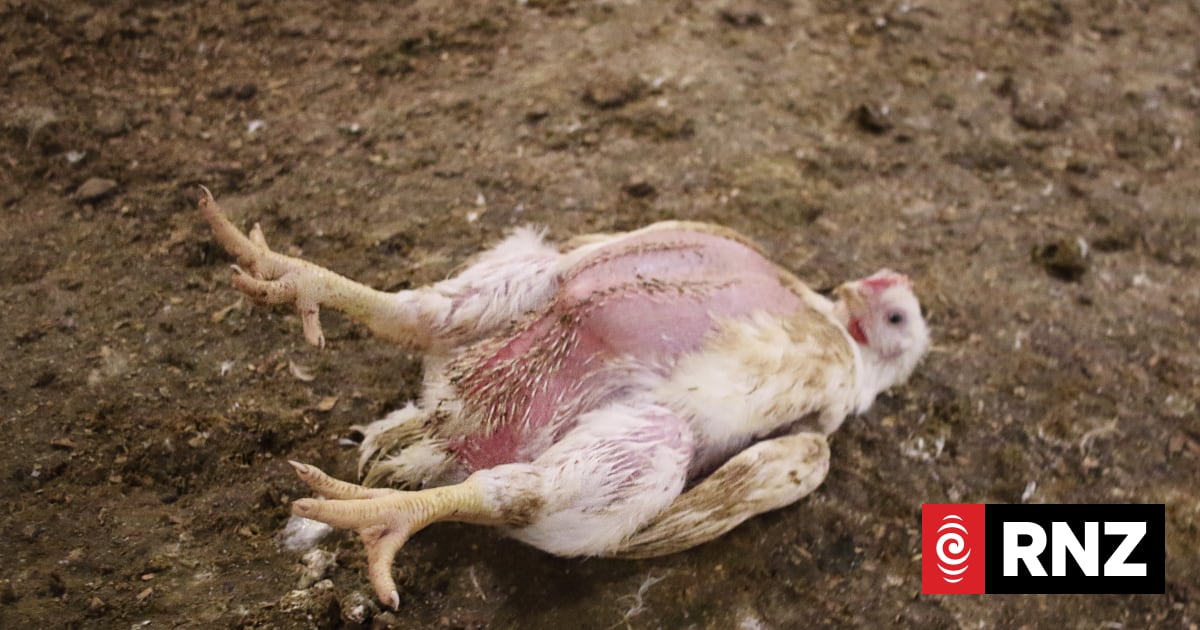
The SPCA has issued a new voluntary standard for chicken welfare after questions from RNZ about fast-growing "frankenchickens".Currently, the SPCA's welfare standards for chicken farms have no rules on fast-growing breeds. This has sparked concern that the chickens bred for meat on New Zealand farms grow so fast they can have difficulty walking or get stuck on their backs."These guys get bigger and bigger and bigger and bigger in a very fast time frame, and if they tip over, it can be a little bit like a turtle being on its back," says avian veterinarian Jodi Salinsky.RNZ referred footage from two farms taken in 2024 by activists to the SPCA. The footage shows some birds apparently stricken on their backs. Both farms go above and beyond what's legally required and are SPCA certified. This tells buyers "they are helping raise standards of care well beyond legal requirements as well as providing a good life for New Zealand's animals" according to the SPCA.SPCA chief scientific officer Arnja Dale says it has not required slower growing breeds because they don't exist commercially here. Making it a requirement would risk producers leaving the voluntary SPCA certification scheme altogether."The fast-growing chickens would still be in those sheds, but SPCA certified's standards, oversight and auditing would not," Dale says.However, SPCA-commissioned research in 2025, which has not been previously released, found more than half (59 percent) of people surveyed wanted fast-growing chickens phased out, and only 11 percent were opposed.One quarter of respondents wouldn't be prepared to pay more, but 28 percent indicated they would pay 10 percent more for slow-growing breeds. A further 17 percent said they would pay five percent more. The SPCA has developed a new "enhanced" standard, which calls for a transition to slower-growing chickens.The new Welfare Plus+ standard was published this week in response to the questions raised by RNZ. There is no timeline to make the new standard part of the baseline SPCA certification."SPCA will always take a stand. We work with industry to improve animals' lives today. This does not stop us challenging industry to do better tomorrow," Dale says.Animal welfare standards need to "progress on many fronts"."We cannot focus so exclusively on one goal that we turn our backs on the millions of chickens we can help today."The rise of the so-called 'frankenchicken'Since the 1950s the shape and size of commercial meat chickens has changed massively. Once svelte birds have ballooned to be barrel-like.Their rapid growth isn't a result of growth hormones. Chickens were selectively bred over decades to be bigger and eat less.One of the biggest changes has been in their main breast muscle, which one study says increased by approximately 80 percent between 1957 and 2005.Activists have nicknamed them "frankenchickens" and all of New Zealand's commercially-produced meat chickens, even organic chickens, are these fast-growing breeds.A meat chicken's life-span before slaughter is now 34 to 39 days. In the 1950s it took 16 weeks to reach roast-ready size.RNZ / Creative CommonsThis rapid growth can come at a cost. The same scientific paper that tracked the size changes over the decades noted there were unintended effects of the rapid growth including skeletal defects, metabolic disorders and altered immune function.Another issue common among fast-growing breeds is difficulty walking. A Ministry for Primary Industries (MPI) study found approximately 30 percent of birds' ability to move was affected.A study carried out in commercial sheds has compared the gaits and welfare of a slow-growing Hubbard Redbro bird against a Ross 308, a common fast-growing breed. It found the slower-growing birds had better leg health than their counterparts and fewer died before they were large enough to slaughter. The slower growing birds took an average of 5.5 days more to grow and were a lighter weight than the fast-growing birds.Poultry industry's responsePoultry Industry Association New Zealand (PIANZ) executive director Fiona MacMillan says there's no need to switch breeds."The birds that we farm have been bred, by a process of selective breeding, to be both healthy and fast growing."They grow fast but also have "strong bones, good overall resilience and health." Welfare flows from good flock management by ensuring food, conditions and stocking density are optimal, MacMillan says.Tegel told RNZ it's confident in the genetics of its chickens. The companies supplying the breeds have spent decades selecting for a range of characteristics, not simply growth rate."We therefore do not consider growth rate in isolation to be an appropriate measure of welfare."It says the "broad body shape" and "developed breast muscle" of its birds can affect the centre of balance, which could be why the birds in the video were unable to right themselves."Under normal circumstances, our growers conduct regular shed walks and would identify any bird in this position and return it to an upright position."Activist videosAnimals Aotearoa, a welfare lobby group, supplied footage to RNZ it says was taken in 2024 by "investigators" entering two different farms without permission in the dead of night.The group released the footage to advocate for a move to slower-growing breeds that are part of a Better Chicken Commitment it wants companies to adopt. It says these breeds would be less likely to get trapped on their backs or experience lameness.Tegel confirmed both farms identified by Animals Aotearoa were Tegel suppliers at the time the footage was taken, though it couldn't verify if the footage was taken at those locations. RNZ has verified the location of the farm where chickens were on their backs.The second farm was visited by the SPCA after being given the location by Animals Aotearoa, although it says it wasn't able to independently verify the footage was taken there, or even in New Zealand.Avian veterinarian Jodi Salinsky told RNZ, without being able to examine the birds, she couldn't diagnose the exact issue each was experiencing, but she thought the video raised welfare concerns.Jodi Salinsky.Sharon Brettkelly"A bird laying on its back is going to be in distress if they're there for a significant amount of time. They do not rest on their back in any way, shape, or form."She says it's likely the birds were stuck because of the large breasts and rapid growth rate, which are a feature of fast-growing chicken breeds. The footage did not show anything illegal, however.Farms are required to check chickens daily and treat or euthanise sick chickens. As a snapshot in time it's impossible to tell if this was being completed from the footage, Salinsky says.No birds were on their backs in footage from a second farm, but Salinsky observed some of the birds appeared to have fluid in their abdomens. She also noted the birds often only walked for a few steps, before stopping and sitting, a behaviour she says is common because their bodies grow so quickly."Pop holes" to the outdoors were visible in some of the footage and images, which means the chickens are considered free range."[Free range] just means they have access to outdoors. But how many chickens can even walk that far to get there?"PIANZ's MacMillan says the activists recording the footage were intruders, which can distress birds."The birds would have been really disturbed by the presence of strangers in the shed, appearing out of the dark and shining lights on them."Vets have told her that birds prone on their backs are occasionally seen in farms in small numbers."If any birds should end up like this, farmers will spot this and correct the situation on their regular visits to the sheds. But again, it needs to be stressed, it is not common," she says.Tegel's spokesperson says birds trapped on their backs is an "unacceptable welfare outcome" but it agrees the birds in the video could have been startled by the activists in the shed causing them to "tumble" over each other in fright as they moved away from strangers.It is irresponsible for people to enter sheds without permission, Tegel says."It creates a serious biosecurity risk and can significantly stress the birds. Poultry farms operate under strict biosecurity requirements to prevent disease and protect bird health, and anyone entering a shed must follow strict biosecurity procedures."Salinsky says it's plausible some birds may have been knocked over when people entered the shed but noted some appeared to have a large amount of poo next to them and thought it likely to have been in the same position for some time. "I don't think a bird would have pooped that much if they just got scared and fell over."Activists entered two SPCA approved chicken farms to collect footage in 2024Supplied / Animals AotearoaAnimals Aotearoa executive director Marianne Macdonald says the investigators take precautions to avoid spreading disease. Boots were cleaned before entry and disposable boot covers and gloves were worn. They don't travel between farms and don't have contact with any birds for at least a week before they enter a farm.She says investigators pause after entering a shed and wait until the chickens are used to their presence before moving around to film.Most people would be surprised that the chickens in the footage are considered to be free-range and living a "good life," Macdonald says.Improving conditions in sheds by adding perch space or doors to the outside is no use if the birds aren't physically capable of using them, she says."We've got to transition away from these birds that have suffering coded in their genetics."Macdonald welcomes the new SPCA welfare standard, but says it doesn't go far enough."What's critical now is a firm deadline to phase out their current SPCA Certified standard. Right now, they're still certifying preventable suffering. They need to commit to real change."The current welfare standardSPCA certified farms are visited four times a year by a third party auditing company. One visit is announced and the other three are surprise visits. In addition, farms must meet other criteria including providing perches, reduced stocking in sheds and a limit on hours of light.Marcelo Rodriguez Ferrere is an associate professor at the University of Auckland and the president of the New Zealand Animal Law Association. He says the Animal Welfare Act and a code of welfare for meat chickens has minimum standards, but there are no rules that expressly stop fast-growing breeds from being farmed.The current 2018 code recommends that the selection of genetics "should be encouraged to promote physical traits that support the expression of normal behaviours in meat chickens". It does note concerns around trends in the industry, "particularly in relation to rapid growth rates" and says the industry should take steps to ensure welfare problems don't become "ethically unacceptable" to New Zealanders.This code of welfare is due to be reviewed."We have remarkably little visibility about what happens behind closed doors on farms in New Zealand," Rodriguez Ferrere says. This is why people enter farms without permission and take footage to show people what's happening."I don't think people would go to Kentucky Fried Chicken and think that that's the way that chickens are farmed in this country, but it's entirely the way that chickens are farmed in this country, and so perhaps there's a broader systemic problem at issue here."Animals Aotearoa has been agitating for change since 2021 when it championed a voluntary welfare code called the Better Chicken Commitment, which includes a move to slower-growing breeds.It has rattled the doors of food meal services, fast-food chains and supermarkets aiming to create demand for slow-growing breeds in hatcheries.Macdonald claims progress getting food brands on board with slower-growing breeds has been stymied by the SPCA's existing certification."Food businesses come back to us and say, 'Well, we're using free-range SPCA-certified chickens, and the SPCA said this is okay, so we're not going to do anything else'."The blue badge of certification provides a "shield" for the chicken industry, she says.The role of supermarkets and takeaway storesThe adoption of slower-growing breeds has been mixed around the world. In the Netherlands, all free-range chicken meat sold in supermarkets comes from slower-growing breeds.In New Zealand, Woolworths says it has no plans to transition to slow-growing breeds."We remain committed to continuously improving animal welfare across our supply chain - as reflected in our 2030 Sustainability Strategy and the fact that 100% of Woolworths brand fresh chicken is SPCA certified," a spokesperson told RNZ.Foodstuffs, which owns New World, says chicken producers are better placed to comment on breed selection than they are.In the United Kingdom, KFC and other takeaway brands committed to moving to slower-growing breeds by 2026. The plan was abandoned, however, in favour of a new industry standard that permits fast-growing chickens, which they say create less greenhouse gas.In New Zealand, Domino's has previously committed to using slow-growing chickens by 2026. It wouldn't comment on whether it has been able to meet its deadline, or challenges it has faced trying to meet the goal.Another pizza brand, HELL, has committed to switching to slower-growing breeds.There are very few companies in New Zealand that supply chicks to chicken producers. Aviagen didn't respond to RNZ's queries about the availability of slow growing breeds.Bromley Park Hatcheries general manager Brent Williams says in 2018 the company did bring in a slower-growing breed, but it didn't sell well. It has since sold part of the company to Inghams, and focuses on egg-laying chickens.He says he would consider bringing slow-growing breeds into the country if there was enough demand and would need contracts in place ordering enough chicks to make it commercially viable. If this was in place, he says it would take a bit over a year to establish a supply.
SPCA issues new welfare standard after RNZ questions about so-called 'frankenchicken'
Full Article
Original Source
Read the full article at Rnz →KhanList aggregates and links to publicly available news content. We do not host full articles from third-party sources. Always verify important information with original sources.