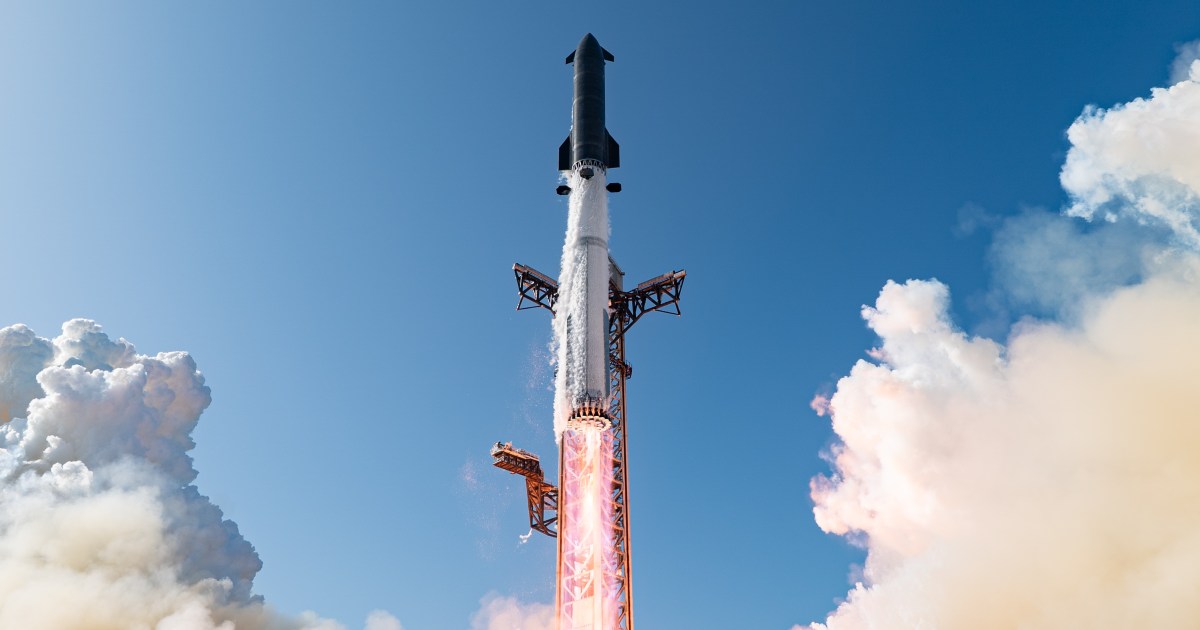
After a scrubbed attempt earlier this month, Starship's upper stage survived intact for the first time. Now Elon Musk says the next flight could try catching the ship itself. | Published: July 29, 2026 Starship's V3 booster roars off the pad with its 33 Raptor 3 engines, climbing over Starbase, Texas, on July 24, 2026. All 33 engines ignited normally on this flight — the vehicle's 13th test — before the booster separated and came down hard in the Gulf of Mexico. Credit: SpaceX via X SpaceX launched its Starship for the 13th time on July 24, sending a V3 Starship and Super Heavy booster through nearly every milestone the company had planned — deploying the first batch of next-generation Starlink satellites, relighting an engine in space, and bringing the upper stage down to the gentlest ocean splashdown SpaceX has ever managed. Just moments after the upper stage splashed down, SpaceX spokesperson Dan Huot captured the excitement on the SpaceX livestream, remarking, “Lucky number 13. Hell of a flight for Starship.” Hours after Flight 13 wrapped, SpaceX founder Elon Musk said the company is ready to try catching the upper stage with the launch tower’s mechanical arms on the very next flight — assuming the data holds up. “Unless we discover problems after mission data review, SpaceX will attempt to catch the ship with the tower on next flight,” Musk wrote on X after the launch. Starship is SpaceX’s fully reusable, two-stage rocket — a 408-foot-tall (124 meters) stack pairing the Super Heavy booster with the Starship upper stage, both powered by Raptor engines burning methane and liquid oxygen. V3, which debuted in May, features upgrades to stronger Raptor 3 engines, and is the version of the vehicle SpaceX intends to fly for NASA’s Artemis moon landings. A flight of firsts During the first launch of V3, Flight 12 in May, the Super Heavy booster lost an engine on ascent, then failed to relight enough engines for its boostback burn, ending in a hard, uncontrolled fall into the Gulf of Mexico. The Starship upper stage reached its planned trajectory despite losing one of its six engines along the way. The FAA opened a mishap investigation before clearing SpaceX to fly again. Flight 13 didn’t come easy, either. A July 16 launch attempt ended in an automatic, computer-triggered abort right before launch after four Raptors failed to ignite. SpaceX traced and fixed the issue, then lost another day to weather, before finally lifting off July 24. All 33 of the Super Heavy’s Raptor engines ignited normally this time, and the booster’s ascent and separation went as planned. During Super Heavy’s landing however, only a subset of the 13 engines meant to fire for splashdown relit, leaving the booster to hit the Gulf hard. For the first time, the upper stage deployed 20 Starlink V3 satellites — the constellation’s newest design — through its PEZ-dispenser-shaped payload door, with two of the departing satellites turning their cameras back for a parting look at their ride. The upper stage also completed a successful in-space relight of one Raptor engine. During reentry, Starship relit all three of its landing engines, flipped upright, throttled down from three engines to two to one, and settled onto the water intact — the first Starship to survive splashdown without breaking apart or catching fire, and the first clear look at a heat shield that made it through a flight in one piece. “This is the first time we’ve put an intact Starship in the water,” Huot said during the launch livestream. The spacecraft continued to send telemetry and video even as it bobbed on the waves — another first, and one that let SpaceX engineers watch their heat shield live just moments after landing. “This is a dream scenario,” Huot said. “Normally you’re working with a slightly charred Starship in the water, and now we have one intact.” The heat shield is one of the biggest hurdles SpaceX faces on the road to full reusability. Built from roughly 18,000 individual tiles, it has to hold up flight after flight without requiring extensive rework or inspection between flights. The data from Flight 13 is no doubt invaluable as SpaceX continues to improve the design, and the fact that the heat shield survived intact is a step in the right direction, but it also underscored the scale of the problem. The heat shield didn’t come through in a condition that points to rapid reuse. In a story for Ars Technica, Eric Berger noted that footage of Starship after splashdown showed “notable white streaks across the heat shield” coming from the tile boundaries, indicating that hot gas may have penetrated the seams during reentry. Berger reported that outside experts, including former NASA heat shield researcher Dan Rasky, remain skeptical that the current tile-based design can ever support the rapid, low-cost reuse SpaceX is aiming for. What’s next for Starship If SpaceX is going to attempt a tower catch of Starship with the Mechazilla arms on Flight 14, that also means the ship will have to reach orbit, fly around Earth, and return to Starbase, Texas — a feat Starship has yet to achieve, as all previous flights have been suborbital. It would represent a huge step for a rocket that NASA is counting on as the lander for Artemis 3 and 4. Although the Artemis program is also counting on another milestone SpaceX hasn’t attempted yet: transferring propellant between two Starships in orbit. Brooks Mendenhall is a staff writer for Astronomy magazine and is based in Chattanooga, Tennessee.
SpaceX launches Starship test flight ‘lucky number 13’
Full Article
Original Source
Read the full article at Astronomy →KhanList aggregates and links to publicly available news content. We do not host full articles from third-party sources. Always verify important information with original sources.