
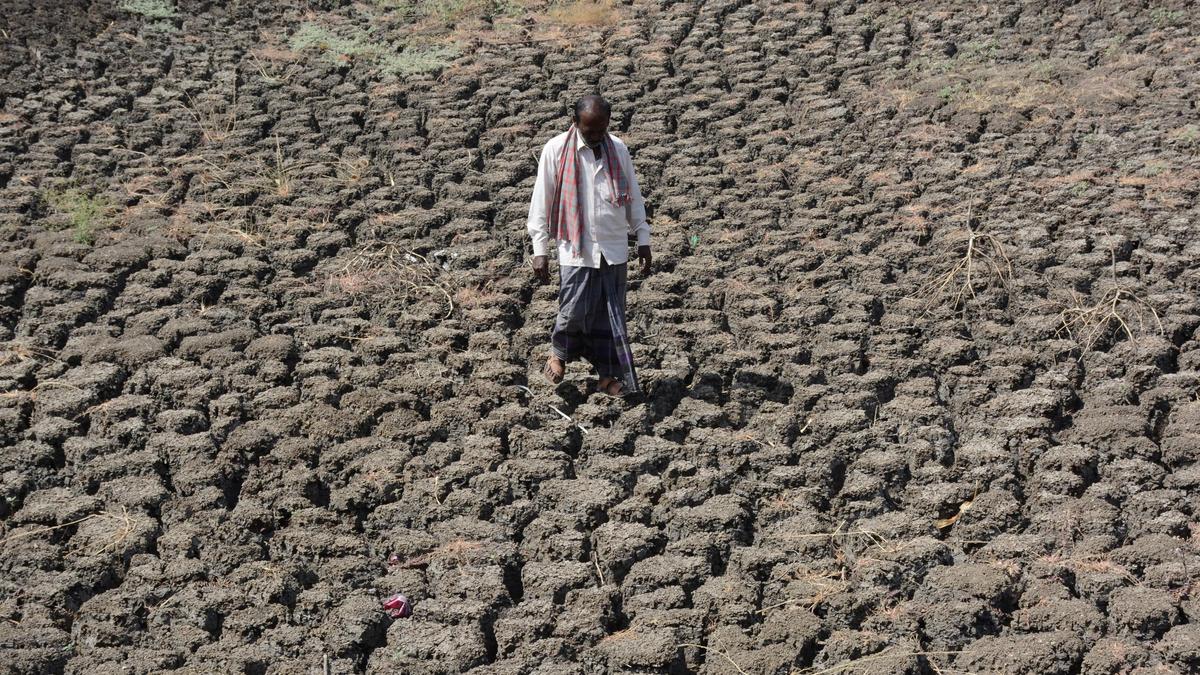
As against the normal rainfall of 852 mm for the SWM period from June to September, Karnataka received only 551 mm, reporting a shortage of 35%. | Photo Credit: file photo The rainfall received by Karnataka during the southwest monsoon (SWM) is the second lowest in the last 70 years (after 1956) and the seventh lowest in the last 125 years (after 1901), shows data, pointing to the severity of the drought. The year 2002, which had the lowest SWM rainfall since 1956, had received just 10 mm less than 2026.As against the normal rainfall of 852 mm for the SWM period from June to September, the State received only 551 mm, reporting a shortage of 35%.What has caused concern is that while the overall rainfall deficit is 35%, the actual shortage is even higher in some regions. The cumulative rainfall deficit during the southwest monsoon stands at 41% for South Interior Karnataka, 42% for North Interior Karnataka, 38% for Malnad region, and 28% for coastal region. SWM has been either deficit or largely deficit in 209 taluks of the total 240 in the State.The State has already declared 217 taluks as drought hit as per the Centre’s drought manual’s norms. This number is likely to increase as the ground-truthing exercise is on in the remaining 23 taluks.Repeated droughtsDrought is not a new phenomenon for Karnataka, which stands next only to Rajasthan in terms of drought-prone areas, as 80% of its geographical area is prone to drought. Since 2001, the State has faced drought for 16 years. But the present drought stands out for its severity and impact on lives of people, particularly agriculture sector.Unlike a few other States, including Tamil Nadu, that can rely on the northeast monsoon (NEM), Karnataka depends prominently on SWM, which is the mainstay of the State’s weather system, accounting for about 74% of the calendar year rainfall. NEM accounts for a just 16%. This means that the impact of the drought is bound to grow when the shortage of water is expected to increase.Already, the agriculture sector has taken a serious hit during the kharif season. While the sowing coverage for the season, which marks the main agricultural season for the State, took a hit owing to poor rains, most of those who took up sowing had to face losses since crops wilted because of prolonged dry spells.Huge crop lossesAs against the target of 84.1 lakh hectares, sowing was undertaken only on 69.57 lakh hectares in the State during kharif, accounting for a coverage of 83%. Foodgrains in general and cereals in particular are the crops that saw lesser coverage in terms of sowing. As against a target of 37.6 lakh hectares, cereals were sown only on 27.27 lakh hectares, accounting for 73% coverage. The total coverage of foodgrains accounted for 76% as they were sown on 46.21 lakh hectares as against a target of 60.45 lakh hectares.Worse, a sizeable extent of crops that were sown dried up. The assessment in 101 taluks alone has shown that standing crops on a total of 19.52 lakh hectares worth around ₹18,748.23 crore have been lost. The total crop losses in 201 taluks has been estimated to be around ₹46,000 crore. These figures are likely to increase when crop losses in other taluks are also considered.While the State has already submitted two memoranda to the Centre seeking assistance to overcome the crisis, agricultural experts and policy makers fear that the food production may take a severe hit this year. Published - October 07, 2026 08:59 pm IST
Southwest monsoon rainfall in Karnataka is second lowest in 70 years and seventh lowest in 125 years
Full Article
Original Source
Read the full article at Thehindu →KhanList aggregates and links to publicly available news content. We do not host full articles from third-party sources. Always verify important information with original sources.