
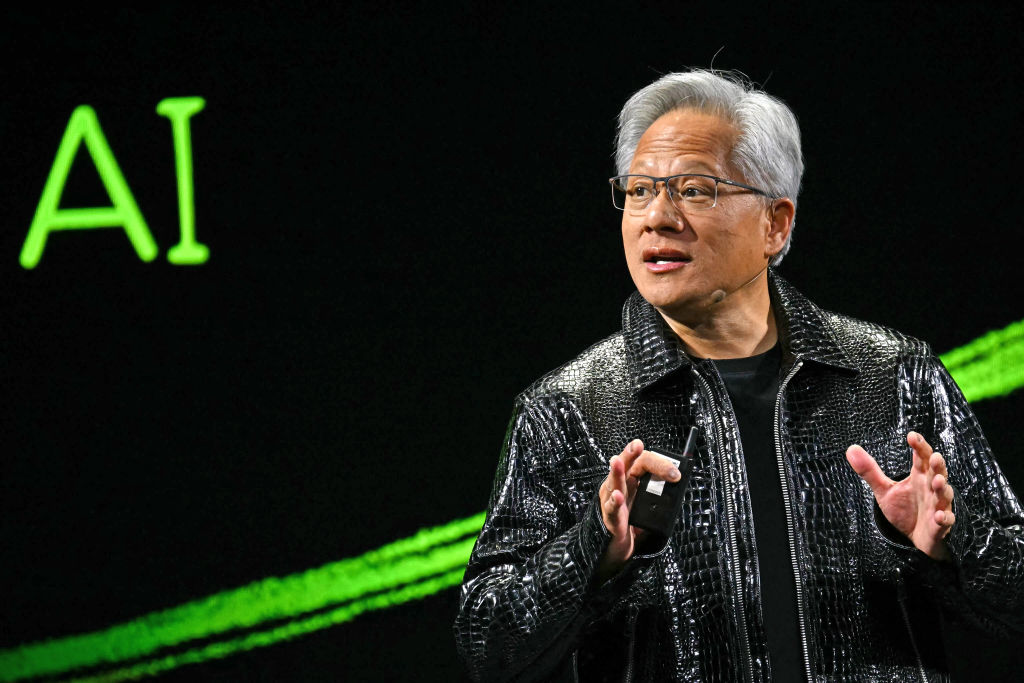
“There’s no question that in four or five years’ time, we’re going to use a lot more fossil fuel,” Nvidia CEO Jensen Huang told Ezra Klein of The New York Times. “But also, in the next decade in front of us, at no time in history are we better prepared to move to sustainable energy,” he added. “If you want to turn a corner on climate change, if you want a future that’s sustainable, lean into AI.”It is perhaps surprising, given the tone of much mainstream discussion of artificial intelligence, that the man at the helm of the world’s most valuable company, which produces chips essential to the new technology, was agnostic about whether AI would stop climate change. “It could be solar, it could be nuclear, it could be fission, fusion, hydro, you name it,” Huang said in his hour-long interview with Klein. The future would be great, but he was uncertain about how. His rhetoric is a prime example of how the language of climate politics, and of climate obstruction, has changed since the emergence of powerful AI models.In a way, Huang’s rather vague promises are a return to the rhetoric of the early days of climate politics, when economists like Nobel Prize winner William Nordhaus won renown for models that heavily discounted the future compared to today. By this thinking, spending lots of money now to avoid climate damages later was not worth it because future humans would be so rich that they could afford the climate costs. The model was called “DICE”; humans should roll one.Why try to predict what exactly human ingenuity would deliver? In 2013, Nordhaus simply assumed a “backstop technology . . . that can replace all fossil fuels.” More recent Intergovernmental Panel on Climate Change models explicitly expect carbon removal to do much of the cleanup work, somehow growing a thousandfold in two or three decades even though deploying this public good doesn’t make anyone any money.Sometimes tech oligarchs are more specific. DeepMind CEO Demis Hassabis highlights the promise of advancements in material design, wondering if AI might deliver the “perfect battery.” Anthropic chief Dario Amodei pins his hopes on “atmospheric carbon removal and clean energy technology [and] lab-grown meat,” while the investor Reid Hoffman says AI “could help the people building fusion power.” Google Brain cofounder Andrew Ng believes AI could improve the science on the “possibility of cooling Earth via stratospheric aerosol injection,” this solar geoengineering technology being, along with carbon removal, the favored tool of the overshoot ideology that asserts humans can break the climate now and put it back together later.To be fair, it would be unreasonable to expect a full explanation of a technology that has yet to be invented, especially in the waning minutes of a podcast that Huang spent flailing, blithely dismissing fears about models that are already hacking governments and businesses and deceiving the firms that built them. If AI became superintelligent, human intelligence, dwarfed by that of the machine it had created, would struggle to predict what it might achieve. Could a dog fathom the existence of antibiotics, or a deer the purpose of a wildlife crossing?It is not impossible that AI achieves or helps humans make unbelievable technological breakthroughs well before the mid-century climate targets that occupy policymakers’ attention. The technology is already capable of predicting the structure of proteins and outperforming people on humanity’s hardest tests. Economists without conflicts of interest, like a team led by Nicholas Stern at the London School of Economics, underline AI’s potential to improve weather forecasting, make solar and wind power more efficient, and make alternative proteins more competitive. AI boosters like Huang are not necessarily dishonest; rather, their subject is inherently uncertain.Still, it seems that the people busy building world-changing technology have not thought about the links between technology and political economy in a capitalist system, where even well-meaning AI firms may not be able to risk slowing down research for fear that their competitors in Silicon Valley, or in China, won’t. Amodei thinks his product is so strong that “ideology will not survive” it! Plus, fossil fuel firms have access to ChatGPT too: indeed, a recent study in Nature found that AI-driven productivity gains in the gas and oil sector, such as cheaper and more accurate drilling, would outweigh improvements in the renewables sector.Technological progress does change political and business incentives, and the development of a truly impressive energy-storage technology would indeed make it easier to run the world’s grids on renewables. But it wouldn’t necessarily get the owner of a gas power plant or pipeline to shut down their assets before they’re amortized. Some industries, like carmakers, are decarbonizable. Others, like coal mining, are not — for them, the existential risk is not the rising seas but the changing of the guard. Big fossil fuel firms pursue profitable energy investments for their shareholders, which is not always the same thing as pursuing low-cost technologies.This word, uncertainty, is essential. It has played a key role in the rhetoric of climate reaction and in the key argument thereof, climate denial. For years, the reactionary tactic was to muddy the waters so that humans may continue to muddy the atmosphere. As long as it seemed even halfway plausible, reactionaries cast doubt on whether humans were changing the climate at all.As the evidence has mounted that anthropogenic climate change is real and dangerous, these claims have fallen out of fashion, with the noteworthy exception of the man at the top of the US government, Donald Trump. “The people that say AI is going to destroy the World, and that Data Centers are bad for your neighborhood, are the same people that said, just a short time ago, that the World would be extinguished by ‘Climate Change,’” Trump posted on Truth Social in September, days before making a similar point at the United Nations. “That HOAX never worked out for them, and now they’re on to the next one.”There are other parallels between the discourses on AI and climate risk. The warnings from inside frontier labs — the lead of Alignment Science at Anthropic cheerfully admitted “we really do earnestly believe AI could kill all humans” — resemble the warnings from the Exxon scientists who discovered in the 1980s that their product might overheat the planet. The oil firm’s executives responded to the sound of the whistle by launching a decades-long disinformation campaign about the risk. Nvidia’s Huang, the man making the marvelous chips and increasingly providing the financial backstop for AI data centers, now wants everyone to calm down: “All the alarmism, all the doomerism, all of the predictions — they’re scaring people.”Playing on uncertainty is not the only option available to climate obstructionists. Most rhetoric by those who oppose climate action is in line with reactionary rhetoric throughout history. In 1991, the year governments formally began negotiating the UN’s climate treaty, the scholar Albert O. Hirschman published a treatise on the subject, titled The Rhetoric of Reaction. Drawing on examples going back to Edmund Burke’s denunciation of the French Revolution, Hirschman identified three types of rhetoric deployed against efforts to change the world: progressive plans could be depicted as “perverse” if they would allegedly aggravate the problem they were meant to solve, “futile” if they would achieve nothing, and as a source of “jeopardy” if their implementation would endanger some other value.A climate example springs to mind for each. Don’t stop burning gas in Louisiana, as it would be perverse: China would simply burn even dirtier coal in response. It would be futile to steer humanity from energy-dense fossil fuels to effete renewables — and our country is only responsible for a tiny share of emissions anyway. To restrict fossil fuels would be to jeopardize economic growth and freedom. Hirschman’s classic schema has held up quite well for the subsequent thirty-five years of climate rhetoric, as evidenced by how well more recent scholarship on climate obstruction comports with it.What’s so interesting about the AI uncertainty is that it goes in both directions. Superintelligence could help solve the climate crisis — the term deus ex machina feels a bit on the nose, given that Elon Musk speaks of a “digital God” and Sam Altman speaks of “magic intelligence in the sky.” Or it could destroy human civilization! If either outcome is likely, there’s not much use subsidizing the production of wind turbines today or worrying about how many people might die of extreme heat in fifty years. In other words, the likelier you believe AI is to achieve superintelligence, the less urgent climate change seems, whether the superintelligence is aligned or malign.Perhaps this helps explain why some on the Left are quick to dismiss the potentially dangerous or salutary effects of AI. Noam Chomsky was an early and prominent skeptic of the idea that models could truly reason. The left-wing writer Cory Doctorow says spreading fears about AI, a business he calls “hooking up statistical engines to money-furnaces,” just helps hyperscalers raise capital.This is why the historian Rutger Bregman even argues that “AI denial” is a problem of the Left, just as climate denial has been one of the Right. As Hirschman’s book notes, reactionaries have “no monopoly on simplistic, peremptory, and intransigent rhetoric.” Perhaps the AI companies do want to show their product is powerful in order to attract investment, or to demonstrate that it’s dangerous so the US government will build a moat to protect their gigantic data center investments. But just because their warnings may be self-interested doesn’t mean they’re wrong about the power of the technology. The failure of a few overextended players in the AI economy — Oracle, anybody? — would not prevent the technology from changing the world. Since when is the Left so blasé about what damage giant high-tech businesses might wreak in the pursuit of profit?For the climate-minded left, it may feel as if the wrong crisis has suddenly seized the world’s attention, even as climate impacts keep worsening. (In the week that Anthropic warned of “existential risks to humanity” in its IPO prospectus, Bangkok was underwater.) There is some history here. When environmental concerns were first raised in in the 1960s and ’70s, some dismissed them as distractions from more important issues. But the world is, unfortunately, not limited to one existential risk at a time. Those who have worked to stop nuclear war have seen many other risks come and go since the United States bombed Hiroshima and Nagasaki in August 1945.Artificial intelligence is clearly a powerful technology: no one should dismiss this because they prefer to mock the tech elites building it. The primary concern at present should be that this technology is emerging into a global economic system dominated by profit seekers, largely unconcerned with the climate crisis, whom governments are for the most part allowing to regulate themselves. While some have compared the current AI build-out to the Manhattan Project, nuclear technology was never allowed to remain in private hands.If AI is to help solve the climate crisis without causing great damage of its own, governments will have to take more control of the firms building it and rewrite economic rules to channel this new power in the right direction.
Could AI Fix Climate Change? Probably Not Under Capitalism.
Full Article
Original Source
Read the full article at Jacobin →KhanList aggregates and links to publicly available news content. We do not host full articles from third-party sources. Always verify important information with original sources.