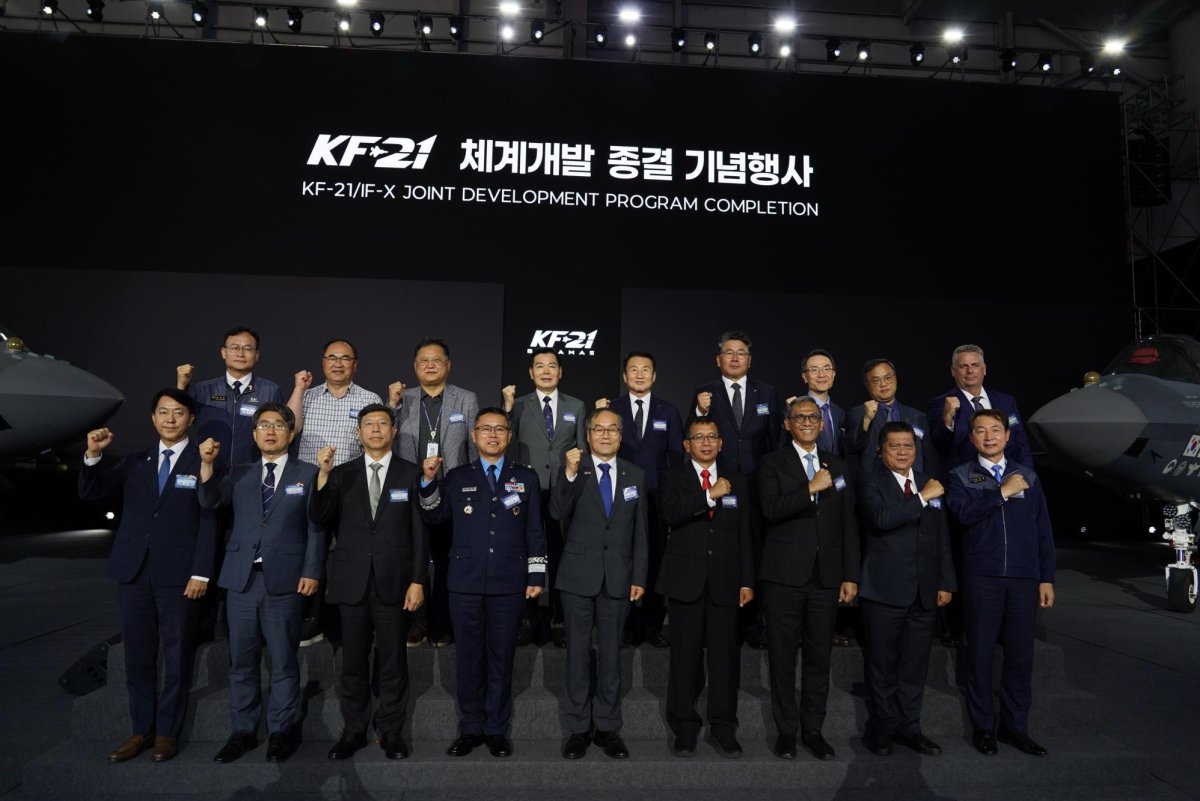
Defense Acquisition Program Administration Commissioner Lee Yong-chul, center, joins South Korean and international participants at a ceremony marking the completion of KF-21 development Wednesday at Korea Aerospace Industries’ headquarters in Sacheon. Photo courtesy of KAI July 30 (Asia Today) -- South Korea has formally completed development of the KF-21 Boramae, its first domestically developed supersonic fighter jet, clearing the way for full-scale production and deployment. The Defense Acquisition Program Administration held a ceremony Wednesday at the headquarters of Korea Aerospace Industries in Sacheon, about 185 miles southeast of Seoul. About 300 people attended, including DAPA Commissioner Lee Yong-chul, military officials, representatives of about 500 South Korean suppliers and officials from Indonesia, an international development partner. Representatives of Indonesian aerospace company PT Dirgantara Indonesia and U.S. defense contractor Lockheed Martin also attended. The KF-21 project began in December 2015 and proceeded through preliminary and critical design reviews, prototype production, ground testing and flight testing. The program also included the development of logistics support and training systems needed to operate and maintain the aircraft. The completion of system development moves the program into mass production and operational deployment. The first production aircraft was rolled out in March. South Korea describes itself as the eighth country to have independently developed a supersonic fighter jet. "The KF-21's success was made possible by the dedication of project officials and engineers as well as public support for our technology," Lee said. "We will again demonstrate South Korea's capabilities through technological independence and self-reliant national defense." KAI quarterly sales rise 41% KAI reported second-quarter consolidated sales of 1.17 trillion won, or about $771 million, up 41% from a year earlier. First-half sales increased 48% to 2.26 trillion won, or about $1.49 billion. The company attributed the growth to KF-21 production, domestic helicopter and surveillance programs and increased exports of completed aircraft. Operating profit was affected by changes to delivery schedules for some domestic programs, including the Light Armed Helicopter, and higher costs associated with exchange-rate movements. KAI said profitability is expected to improve in the second half as production of the KF-21 increases and deliveries of FA-50 light combat aircraft to Malaysia begin. Deliveries of Light Armed Helicopters are also expected to accelerate. KAI reported 2025 sales of 3.7 trillion won, or about $2.44 billion, operating profit of 269.2 billion won, or about $178 million, and net profit of 187.3 billion won, or about $124 million. The company has set 2026 targets of 5.73 trillion won, or about $3.78 billion, in sales and 10.44 trillion won, or about $6.89 billion, in new orders. FA-50 exports support order backlog KAI's order backlog stood at 27.34 trillion won, or about $18.05 billion, at the end of 2025, up more than 10% from the previous year. The company is targeting an order backlog of 31.7 trillion won, or about $20.92 billion, this year. The FA-50 remains one of KAI's main export products. KAI is supplying Poland with 48 FA-50 aircraft, including a customized FA-50PL version, and Malaysia with 18 FA-50M aircraft. The Malaysian agreement includes an option for 18 additional jets. In June, KAI signed a 975.3 billion won, or about $644 million, contract to supply 12 additional FA-50PH aircraft to the Philippines. The Philippines previously purchased 12 FA-50 aircraft, making the latest order a repeat purchase based on its operation of the jets. KAI expects FA-50 production for Poland and Malaysia to contribute more strongly to sales during the second half of the year. KAI expands unmanned and space programs Jong Chool Kim, who became KAI's president and chief executive officer in March, has reorganized the company around three major divisions and 13 headquarters-level units. KAI said the restructuring was intended to strengthen accountability and expertise within each business area. Kim has identified innovation, expansion of profitable businesses, cooperation with suppliers and an integrated company culture as his main management priorities. "The successful development of the KF-21 is a historic achievement that demonstrates South Korea's ability to develop an advanced fighter with domestic technology," Kim said. He said KAI would focus on stable production and deployment of the aircraft as well as the integration of South Korean weapons and future performance upgrades. The company is also working on artificial intelligence-based pilot systems, unmanned aircraft, manned-unmanned teaming technology and space and satellite programs. Manned-unmanned teaming refers to operations in which crewed aircraft work with autonomous or remotely operated aircraft. KAI said the KF-21 program has also strengthened South Korea's aerospace supply chain by involving about 500 domestic companies and expanding local production of major components. -- Reported by Asia Today; translated by UPI © Asia Today. Unauthorized reproduction or redistribution prohibited. Original Korean report: https://www.asiatoday.co.kr/kn/view.php?key=20260730010011268 Read More South Korea's KF-21 fighter receives type certification South Korea's KF-21 clears combat certification milestone Hanwha expands from defense into space with 'Korean SpaceX' vision Two institutions emerge as backbone of South Korea's defense exports
South Korea completes development of KF-21 fighter
Full Article
Original Source
Read the full article at Upi →KhanList aggregates and links to publicly available news content. We do not host full articles from third-party sources. Always verify important information with original sources.