
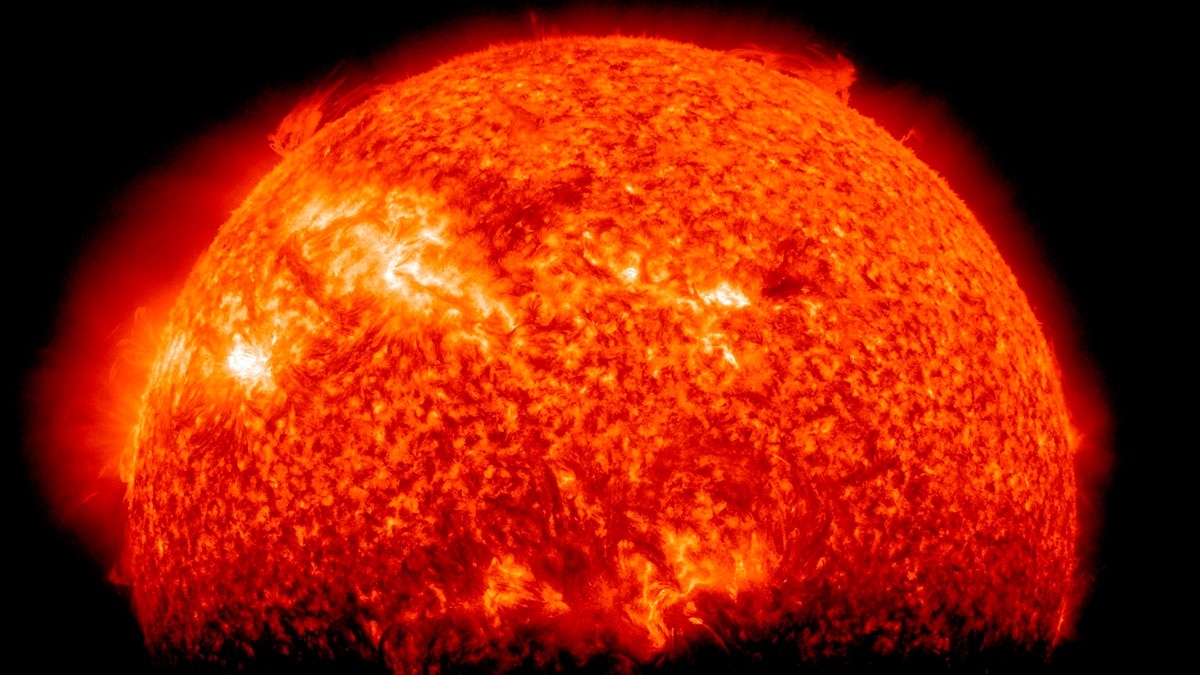
A fresh eruption from Sunspot 4549 has sent a Moreton wave and a coronal mass ejection into space. Forecasters say the incoming solar material could trigger geomagnetic storms, brighter auroras and some disruption to satellites and radio links.The expected impacts could produce geomagnetic storms ranging from G1, or minor, to G3, classified as strong. (Photo: Nasa)New Delhi,Oct 9, 2026 11:21 ISTEarth is bracing for a series of solar storms as the Sun unleashes powerful eruptions, including a massive wave of superheated plasma known as a solar tsunami.The incoming space weather could trigger geomagnetic storms ranging from minor to strong, potentially creating spectacular auroras over the weekend.According to space weather forecasts, Earth's magnetic field could be struck by as many as three coronal mass ejections (CMEs) on October 9 and October 11. These eruptions carry billions of tonnes of charged particles and magnetic fields into space, and their interaction with Earth's magnetic field can trigger geomagnetic storms.The expected impacts could produce geomagnetic storms ranging from G1, or minor, to G3, classified as strong. The strongest storms could increase the chances of auroras appearing across regions that do not usually experience the colourful displays, although their visibility will depend on the strength and orientation of the incoming magnetic fields.SUN UNLEASHES A SOLAR TSUNAMI The latest activity began when Sunspot 4549 erupted again on October 8, producing an M6.7-class solar flare. M-class flares are considered medium-strength eruptions, with the potential to disrupt radio communications and intensify other space weather effects.The explosion also unleashed a solar tsunami, formally known as a Moreton wave, across the Sun's atmosphere. These enormous waves of hot plasma and magnetic energy race through the solar atmosphere following powerful eruptions.The shock front can tower above Earth in scale and travel at speeds exceeding one million miles per hour.The October 8 event was described as a near-global disturbance, meaning the wave swept across a substantial portion of the Sun's visible surface.As the wave expanded, a coronal mass ejection lifted off from the Sun. Forecasts indicate that this CME could graze Earth on October 11, adding to the effects of two other incoming eruptions.COULD EARTH SEE GEOMAGNETIC STORMS?CMEs can take anywhere from hours to several days to reach Earth, depending on their speed. When they arrive, their magnetic fields can disturb Earth's magnetosphere, producing geomagnetic storms.These disturbances can generate auroras when charged particles interact with gases in Earth's upper atmosphere. Stronger storms can push auroral displays farther from the polar regions, although sightings are never guaranteed.Geomagnetic storms can also affect satellites, navigation systems, high-frequency radio communications and, in severe cases, power grids.The forecast period could offer favourable conditions for aurora photography, as the nearly new Moon is expected to leave the night sky relatively dark.However, the actual intensity of the storms will depend on the incoming CMEs' speed, density and magnetic orientation. Scientists will continue monitoring the Sun and the approaching solar material to determine how strongly Earth's magnetic field will be affected.- Ends
Solar tsunami headed to Earth as Sun explodes with mega storm
Full Article
Original Source
Read the full article at Indiatoday →KhanList aggregates and links to publicly available news content. We do not host full articles from third-party sources. Always verify important information with original sources.