
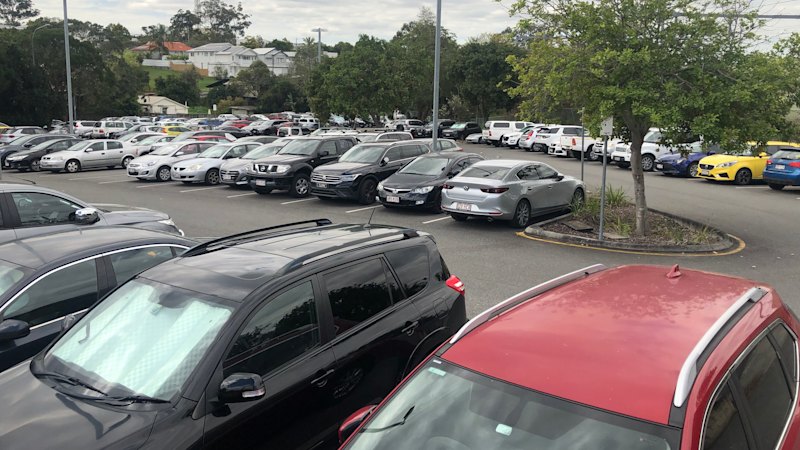
November 4, 2026 — 12:23pmMore than 100 commuter and shopping centre car parks in Brisbane are primed to become solar-powered charging stations for electric vehicles.Researchers from the Queensland University of Technology identified 156 parking locations in Brisbane where solar canopies above EV charging stations would be suitable, studying 10 high-turnover car parking locations such as shopping centres and public transport park ‘n’ ride sites in more depth.They found solar canopies at the 10 sites could generate 1.93 gigawatt-hours annually, serving more than 31,000 vehicles a year.Car parking at train stations in Brisbane could be transformed to include solar canopies to allow people to charge their electric vehicles. But not all sites are suitable.Travis BassettBut it’s not as simple as installing solar panels over a car park.Researchers looked at solar potential, travel patterns, charging access, and electricity network capacity – and developed a model to help planners consider those factors together.Sites were excluded if they would be shaded by trees or the layout would make it difficult to install a canopy or chargers.A graphic included in a Queensland University of Technology study shows the most suitable zones for solar (photovoltaic, or PV) charging stations for electric vehicles.The most suitable sites had large parking areas, strong charging demand, extra capacity in the local electrical substation, and good transport infrastructure, for example, Mount Gravatt Shopping Centre, which was close to the M1 and rapid bus transit.DFO at the airport, while not one of the 10 sites studied in more depth, had “huge solar potential” and considerable charging potential due to visitors’ extended shopping time, the researcher said.The lead author, PhD candidate Niklas Tilly, said the framework combined spatial data on solar potential, land use, transport accessibility and socio-economic characteristics to identify locations.“We then screened electricity network capacity to assess potential constraints,” he said.“A car park may look suitable on a map, but we also need to understand how it is used and whether the local electricity network can accommodate charging.”It is often useful for solar chargers to be connected to the grid, so people can charge during poor weather, but that places pressure on local electricity networks if poorly located or managed.Electric vehicles expanded their share of the new car market in Australia from 10 per cent last year to more than 25 per cent, with cheaper models becoming available and diesel costs surging because of war in the Middle East.But Australia has one of the worst ratios for EVs to public charging sites in the world, with just one charging point for every 52.7 EVs.The 10 parking sites studied in more depth were a mix of sports or shopping centres and park ‘n’ ridesBunnings Cannon HillWestfield Mt GravattSleeman Sports Complex, ChandlerBanyo Retail CentreWynnum PlazaZillmere station park ‘n’ rideBoondall station park ‘n’ rideMitchelton station park ‘n’ rideBanoon station park ‘n’ ride, SunnybankCannon Hill station park ‘n’ rideTilly said that was not always an issue, as Australian cities were less dense than Europe, and many owners preferred to charge at home due to convenience and cost-effectiveness.But for apartment dwellers, particularly people without access to a parking spot, buying an EV was constrained by not having anywhere to charge it.Tilly said EV charging sat at the intersection of transport and energy, but planning was largely developed in parallel.“Bringing them together means considering where people park, how long their cars stay there and how charging can make use of locally generated solar electricity,” he said.Tilly said commuter park ‘n’ rides were ideal for solar charging because vehicles parked for several daylight hours, while solar canopies provided shade and reduced heat.Encouraging people not to drive all the way to work, but instead use a park ‘n’ ride and catch public transport, was another benefit, he said.Start the day with a summary of the day’s most important and interesting stories, analysis and insights. Sign up for our Morning Edition newsletter.More:Electric vehiclesBrisbaneFor subscribersRoadsPublic TransportQUTFrom our partners
Solar roofs at train stations could solve EV charging woes. Here’s where they should be
Full Article
Original Source
Read the full article at Smh →KhanList aggregates and links to publicly available news content. We do not host full articles from third-party sources. Always verify important information with original sources.