
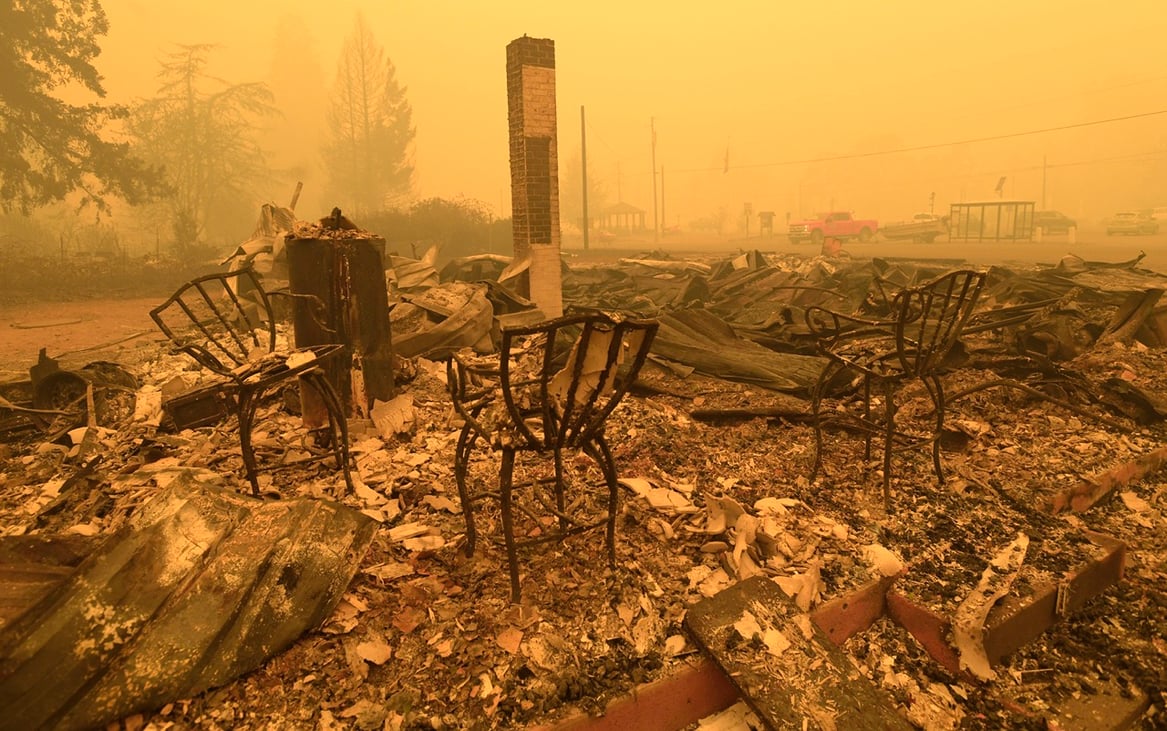
The fires over Labor Day weekend in 2020 displaced thousands of Oregon residents.PORTLAND, Ore. (CN) — Victims of the destructive series of wildfires that ravaged Oregon over Labor Day weekend in 2020 implored the state Supreme Court on Tuesday to revive a jury verdict in their favor.In one of the state’s largest disasters, fires blazed across Oregon during a historic windstorm in September 2020. PacifiCorp and Pacific Power had left their power lines energized, and those energy lines ignited the flames.Thousands of survivors of four fires — the 242 Fire, the Echo Mountain Complex Fire, the South Obenchain Fire, and the Santiam Canyon Fire — sued the power companies, accusing them of failing to reasonably maintain the power lines, clear vegetation surrounding the lines and protect against fire. They also claimed the companies negligently failed to shut down power to the lines despite warnings.The trial court certified a class of fire survivors harmed by the four fires and structured the trial so the jury would determine liability and causation for each fire. After an eight-week trial, the jury found PacifiCorp caused the fires and harmed class members. Nineteen damages-only trials then produced verdicts and judgments exceeding $1 billion.However, PacifiCorp appealed, challenging an instruction that told the jury the class representatives brought evidence on behalf of absent class members and jurors could “assume that the evidence at trial applies to all class members.”The Oregon Court of Appeals sided with PacifiCorp, holding that common evidence didn’t prove causation and the jury may have assumed evidence of liability for one fire meant liability for the others.Before the Supreme Court Tuesday, the fire survivors — a class of over 2,400 individuals — argued the appeals court made a mistake.“At the end of the day, what they really don’t like is the jury verdict in this case,” said Nicholas Rosinia, attorney representing the class of wildfire survivors said, referring to the power companies. “They bet the company on a class action wildfire trial, and they lost.”“Here, the jury decided the case on a fire area by fire area basis," Rosinia continued. “That’s not to say the evidence was not common across the class as a whole, but it permitted, in this case, PacifiCorp to make fire-specific defenses to the extent it had fire-specific defenses.”The fire survivors argue the jury simply needed to determine that PacifiCorp’s fires were a substantial factor in the resulting harm.“The PacifiCorp’s conflagration of fires was the common evidence that proved the ultimate harm, and that’s why all of the class members relied on that same body of evidence with respect to the conflagration to prove their case,” Rosinia said.The wildfire survivors said there was no dispute that there was harm across the class area.“The only dispute was whether PacifiCorp’s conflagration of fires was a substantial factor, and the evidence that everybody relied on was common as to that question,” Rosinia said.PacifiCorp disagreed, arguing the class action was unprecedented, that the class should not have been certified, and that the instruction invited the jury to assume the evidence presented at trial applied to every single class member.“For the jury, class actions are hard enough, but they’re told this is one big class. This wasn’t subclasses by fire areas — one big class, 17 class representatives, they widely differ among them, and the jury is told, ‘You can consider all of the evidence as applying to all the class members,’" said Theodore Boutrous, attorney for PacifiCorp. “I’ve never seen anything like it.”Oregon Supreme Court Justice Christopher Garrett questioned PacifiCorp’s theory.“It appears just from reading the briefs and the verdict form that the case was pretty clearly tried on a fire-by-fire basis and the verdict form reflects that,” Garrett remarked. ”So how real is the worry that the jury would have transposed causation from fire number one to fire number three?”PacifiCorp argued the worry is quite real, given the sheer size of the class and varying circumstances.“Do we really think the jury would think that a fire burning a hundred miles away proved a different fire?” questioned Oregon Supreme Court Justice Meagan Flynn.PacifiCorp contended that yes, the jury very well could have thought so. It also argued the trial court should not have certified such a large class.“There hasn’t been a class action certified anywhere in the country with one wildfire. Here, we’ve got four fire areas, and there were dozens of fires within those fires,” Boutrous said. “It was just a fundamental error to certify one big class with 17 representatives who themselves couldn’t have been in a class just alone because they were in completely different places.”The Oregon Supreme Court did not indicate when it would rule.Categories / Appeals, RegionalSubscribe to our free newslettersOur weekly newsletter Closing Arguments offers the latest about ongoing trials, major litigation and rulings in courthouses around the U.S. and the world, while the monthly Under the Lights dishes the legal dirt from Hollywood, sports, Big Tech and the arts.Additional Reads
Oregon wildfire victims defend jury instruction in billion-dollar PacifiCorp suit
Full Article
Original Source
Read the full article at Courthousenews →KhanList aggregates and links to publicly available news content. We do not host full articles from third-party sources. Always verify important information with original sources.