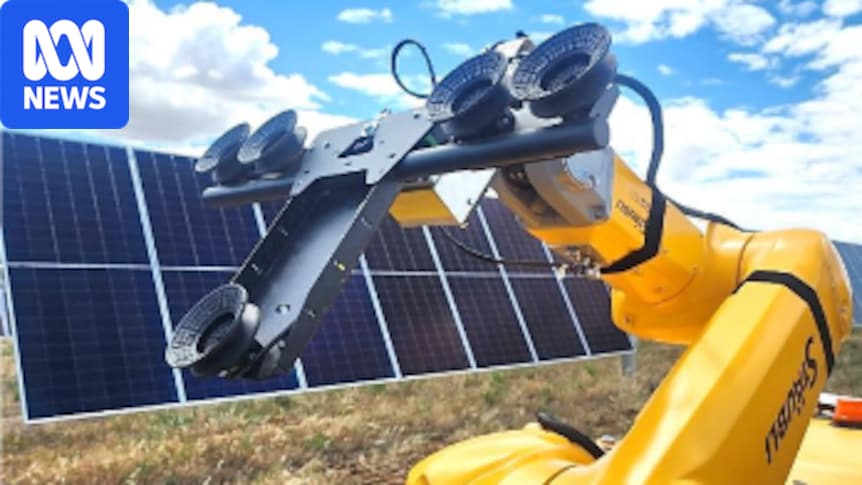
When it comes to domestic solar and battery installations, Australia is a trendsetter.More than four million homes now have rooftop solar, and in the past year more than 450,000 household batteries were installed. At times during the day, there is so much solar energy in the grid that in some states power is being offered for free during a midday window.But to truly transform our economy requires solar energy to be installed cheaply and at an industrial scale, according to a new white paper by the Australian Renewable Energy Agency (ARENA)."Work is well underway to make sure that we achieve our goals in cell and module efficiency, which is a critical thing to unlock," ARENA CEO Darren Miller said."What's been harder is getting momentum in the deployment of solar at scale at very low costs."ARENA has set an aspirational goal known as 30-30-30 — solar panels with 30 per cent efficiency, installed at 30 cents per watt, by 2030. Even if Australia doesn't hit every part of that target, Mr Miller said it helped focus attention on the scale and speed of deployment needed to make solar cheap enough for new industries.Solar panels themselves are now a relatively small part of the overall cost of building a solar farm."The large majority of the cost structure is those heavy civil works, the pouring of concrete, the drilling of holes for pilings, the steel, the cables, and obviously the manual labour involved," Mr Miller said.To help, ARENA has been investing in technologies and companies designed to automate construction, such as robotic solar panel installers, automated piling systems, and modular solar arrays that can be deployed quickly.Drones are another technology ARENA is investing in, helping to automate monitoring of large solar projects. (Supplied: ARENA)Putting a dozen solar panels on a suburban roof is a world away from installing millions more across the vast expanses of the Pilbara.Until now, these projects have been largely carried out by teams of itinerant workers, if they can be found.But a company called Luminous Robotics is trying to streamline the process, according to Mr Miller."They have these autonomous robots called Lumis that can move around a solar field and place modules in the right positions and then ultimately place those modules onto the racks without human intervention," he said."We have a shortage of skilled workers that we can deploy in remote areas."So the more robots we can use as part of skilled labour, the better."Lumi robots helping to lift and install solar panels. (Supplied: Luminous Robotics)That is not to mention the more than 30-kilogram weight of each solar panel a person might have to lift over and over again in 40-plus temperatures."Robots can do a much better job in a much safer way at picking and placing modules on racks, with humans being quality control, control of the robots, and ultimately doing those fine-grained bits of work that robots can't yet do," Mr Miller said.There is also an Australian company ARENA has backed called 5B, which trucks in prefabricated concertina-style solar arrays to site and unfolds them with a forklift, bypassing the need to build foundational infrastructure.Alice Lang, 5B's chief of staff and a solar photovoltaic engineer herself, said traditional solar farms were often built by taking "all of the sticks and bits and pieces and nuts and bolts to site" and assembling them there.The company is based in Adelaide, where the arrays are prefabricated and loaded into shipping containers.The 5B Maverick is an accordion-style prefabricated solar array that can be deployed in under an hour. (Supplied: 5B)Ms Lang said once logistics were organised and a site had been prepared, some companies using the technology had been able to install about one megawatt of solar in a day with a team of just four people. That is four people installing enough capacity to supply the annual electricity use of roughly 300 homes."Rather than hundreds of people lifting modules above their heads and putting them onto an array, you would see someone in a forklift unrolling a solar array," Ms Lang said.She pointed to the Bellevue Gold project in Western Australia, where 5B's technology has been used as part of a hybrid energy system with solar, wind and storage to help decarbonise its mining operations.The Bellvue gold mine in Western Australia runs on 80-90 per cent renewable energy, and uses 5B solar arrays. (Supplied: ARENA)While solar panels have become cheaper globally, Australia has struggled to match China's rapid decline in project costs. Utility-scale solar installations in Australia still cost around one-and-a-half times as much as they do in China.Ms Lang said Australia's role was not to copy China's manufacturing scale, but to play to its strengths."Australia still has is these incredibly strong research institutions and these connections between research institutions like UNSW and other universities and industry to find ways to make use of the technologies that we are developing in building the economy that we all want," she said.A renewable global economyThe vision of the ARENA white paper is more than just decarbonising Australia's electricity system. It argues ultra-low-cost solar could help underpin future industries like green iron, hydrogen production and critical minerals processing.That would require enormous amounts of low-cost renewable electricity, but Climate Energy Finance director Tim Buckley said Australia was well placed to become what he described as a renewable energy superpower."We've got some of the best wind and solar resources in the world," he said."We have huge capital reserves in the superannuation system, and we are a trusted export partner to North Asia in particular."Mr Buckley said cheaper renewable energy could do more than generate electricity, potentially supporting more processing and manufacturing onshore instead of simply exporting raw resources."Rather than just aluminium, we export green aluminium," he said."Rather than iron ore, we export green iron, and rather than lithium spodumene, we export lithium hydroxide powered by firmed renewables."Australia currently has about 12 GW of utility-scale solar connected to the National Electricity Market (NEM).The average daily electricity demand across the NEM, which excludes Western Australia and the Northern Territory, is a fraction of what would be needed to power those new export industries.In the future, ARENA's Darren Miller envisages something closer to a parallel energy system, with thousands of gigawatts of solar built in remote areas to support mining and manufacturing.Due to the abundance of unused landmass and sunshine, Mr Miller sees a unique opportunity for Australia."The opportunity set here around ultra-low-cost solar and the opportunity to play a global role in commodity markets towards net zero is an order of magnitude bigger than the opportunity to decarbonise our grid," Mr Miller said."We see an opportunity for 1,000 gigawatts of solar to be deployed in remote areas of Australia making these green commodities."'Vested interests' stall progressWhile the ideas are inspiring, Australia is not China, and the democratic process can be slow and bureaucratic."Planning, coordination, social licence for transmission lines, the time it takes to get environmental approval, those are the barriers and the challenges around the speed of deployment of solar," Mr Miller said.But for Tim Buckley, a former banking analyst, the challenge is less about engineering and more about investor confidence."We're not a communist state, we don't have a dictator, but what we do have is a messy democracy, and we have vested interests," he said."We're a major fossil fuel producer and vested interests are getting in the way of the science, and they're getting in the way of investor confidence."Renewable energy now contributes to roughly 50 per cent of electricity demand in Australia, transforming the grid. Now Darren Miller wants to transform the economy."There will be nothing more important to Australia's economic advantage going forward towards 2050 than very, very cheap electrons made at scale in Australia."
Solar is cheap, but building enough of it can be difficult
Full Article
Original Source
Read the full article at Abc →KhanList aggregates and links to publicly available news content. We do not host full articles from third-party sources. Always verify important information with original sources.