
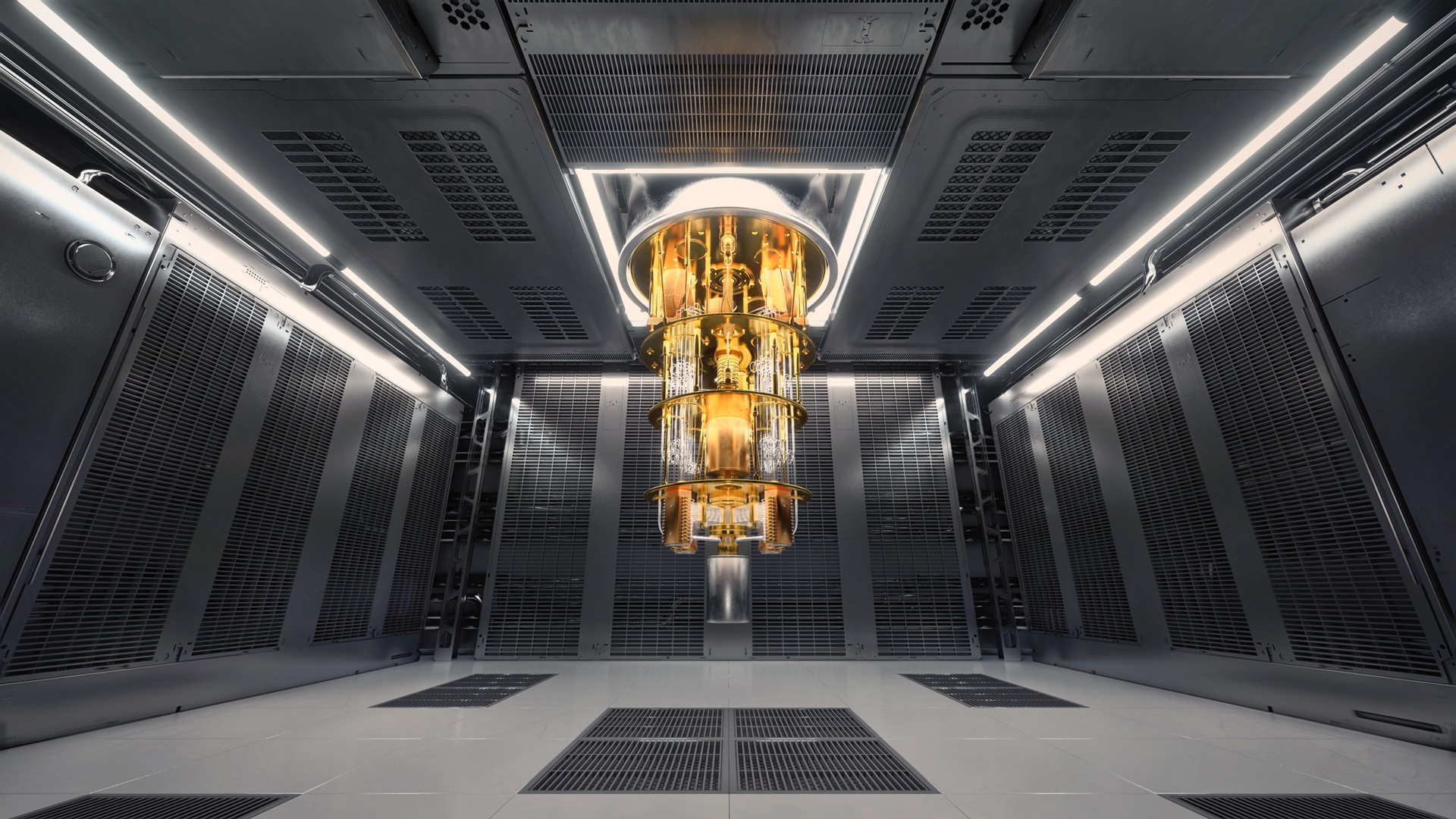
Scientists in the US have been developing a smart agent that could automatically tune sensitive quantum devices and accelerate quantum computing and the hunt for elusive dark matter. The artificial intelligence (AI) system is currently being tested by researchers at the Pacific Northwest National Laboratory (PNNL) in Richland, Washington. The agent could reportedly control quantum-noise-limited parametric amplifiers. These ultra-low-noise microwave devices are used to strengthen extremely weak signals set by quantum mechanics and introduce almost no additional noise. In addition, they’re used in experiments searching for dark matter and in systems that read information from superconducting quantum bits, or qubits. However, operating them can require skilled physicists to adjust settings and test the results for hours. To tackle that issue, the PNNL team led by Christian Boutan, PhD, came up with an AI system to automate the task. The project, called AQUA-WOLF (or Autonomous Quantum Amplifier Workflow Optimization and Learning Framework), is supported by the US Department of Energy’s Genesis Mission. AI fine-tunes amplifiers The novel technology could support the Axion Dark Matter eXperiment (ADMX), which searches for hypothetical particles called axions. The experiment is rather unusual for a dark matter detector, as it is not located deep underground. ADMX uses a microwave cavity placed inside a large and powerful magnetic field to search for cold dark matter axions in the local galactic dark matter halo. If they are present, the team hopes they will convert into microwave photons that can be picked up with highly sensitive quantum electronics. A quantum-noise-limited parametric amplifier ready for testing.Credit: Andrea Starr / Pacific Northwest National Laboratory The experiment must scan across a range of possible axion masses, which makes the amount of time the equipment spends collecting data particularly important. According to Boutan, tuning the amplifiers is the “dominant source of waste of time” during the search. But he believes that AQUA-WOLF could automate the process with reinforcement learning. Instead of relying on a physicist to repeatedly adjust the amplifier, the AI agent would change the settings itself and learn from the results. Initially, the researchers would reward the system based on gain, which measures how much an amplifier strengthens an incoming signal in decibels. They then aim to expand the process to account for other factors, including noise and stability. Training the agent The scientists will also test several algorithms against one another to identify the most effective approach. Meanwhile, automating the entire process could also be beneficial for quantum computing. That’s because the amplifiers read information from qubits. However, tuning them could become difficult as quantum computers grow to contain thousands of qubits. They also plan to teach the agent the physics behind the equipment and encode the system’s Hamiltonian, a mathematical description of its energy, in the agent. This way it could make decisions based on physical principles rather than simply exploring different settings through trial and error. Christian Boutan, PhD, working on a dilution refrigerator that can cool quantum devices to a temperature near absolute zero. Quantum amplifiers must be tuned to operate in these extreme conditions.Credit: Andrea Starr / Pacific Northwest National Laboratory Erik Lentz, PhD, a PNNL physicist, teaches the AI agent to use physics principles in its reasoning and decision-making, saying conventional algorithms can explore the available parameter space “in a kind of inefficient way.” Because parametric amplifiers work on similar physics, the AI could learn to tune new devices with less training. The team plans to test it on real hardware, such as an amplifier from NIST, and adapt it to other amplifiers that could eventually be used in experiments such as ADMX. Once validated, PNNL plans to release the AI agent as open-source software. Its datasets will also back the Genesis Mission’s shared scientific infrastructure. “The goal isn’t to remove scientists from the lab,” the researchers concluded in a press release. “It’s to stop them from spending their hours on a tedious chore so that they can spend more time discovering what holds the universe together.” Get the latest in engineering, tech, space & science - delivered daily to your inbox.Based in Skopje, North Macedonia. Her work has appeared in Daily Mail, Mirror, Daily Star, Yahoo, NationalWorld, Newsweek, Press Gazette and others. She covers stories on batteries, wind energy, sustainable shipping and new discoveries. When she's not chasing the next big science story, she's traveling, exploring new cultures, or enjoying good food with even better wine.
Smart US tool could cut quantum device tuning time in hunt for elusive dark matter
Full Article
Original Source
Read the full article at Interestingengineering →KhanList aggregates and links to publicly available news content. We do not host full articles from third-party sources. Always verify important information with original sources.