
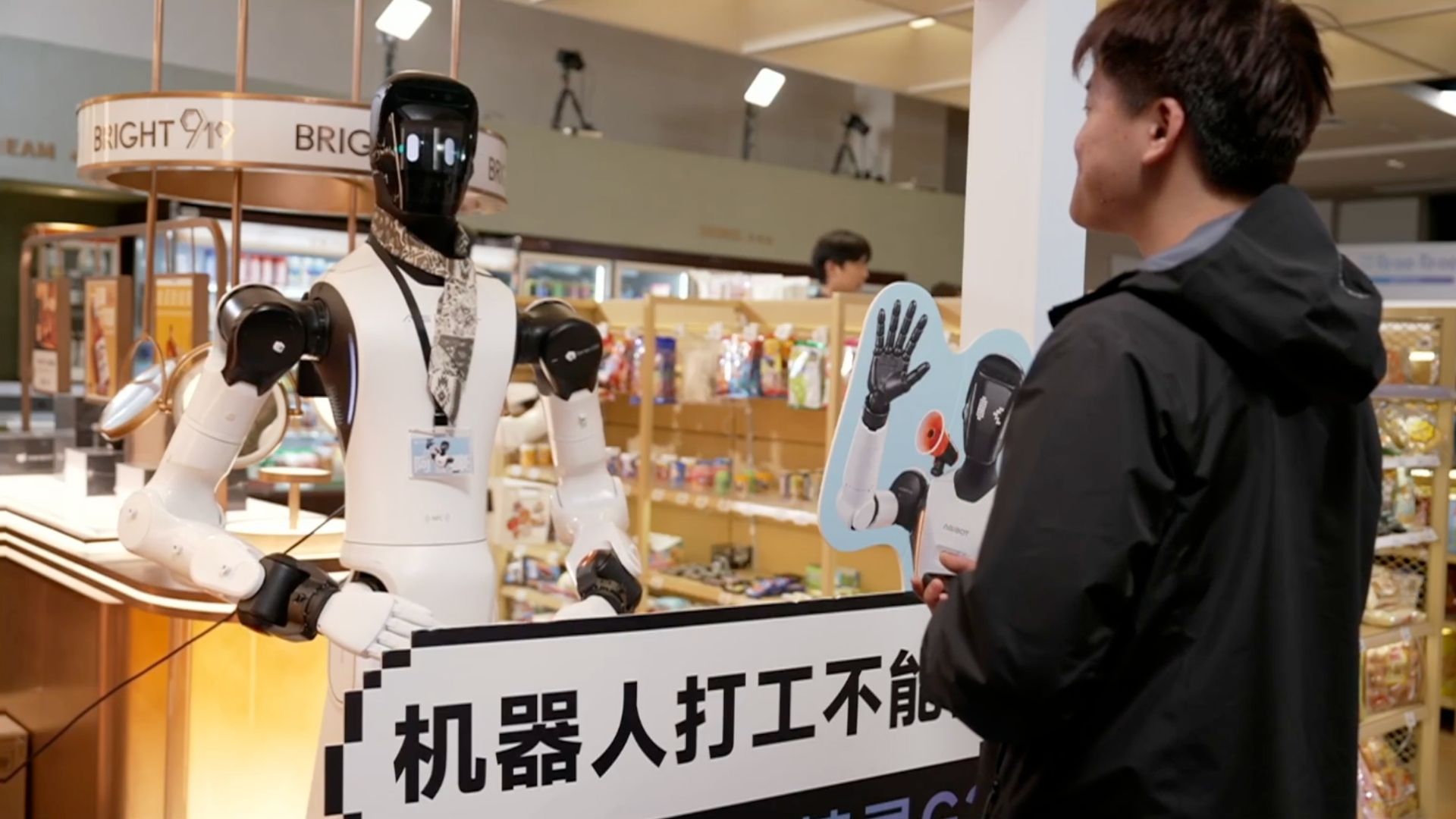
Six humanoid robots have spent 24 hours working in a Shanghai convenience store, greeting customers, preparing coffee, serving food, and restocking shelves. But when the shift ended, only four of the machines passed their performance assessments, highlighting the difficulties robots still face when handling unpredictable everyday tasks. The experiment, called “Robots Never Clock Out,” was organized by Chinese robotics company AGIBOT and ran from 10 a.m. on November 2 to 10 a.m. on November 3 at an operating convenience store in Shanghai’s Xuhui district. The company deployed six G2 wheeled humanoid robots and livestreamed the challenge, attracting more than two million viewers across online platforms. According to AGIBOT, the machines collectively completed 1,730 tasks during the trial. However, two robots assigned to cleaning and shelf inspection, and restocking did not meet the company’s performance criteria. 1,730 tasks across four shifts The six robots were assigned different retail responsibilities, covering customer assistance, product handling, coffee preparation, hot-food service, and cleaning. AGIBOT reported that the machines completed 683 customer-service interactions, 369 product pickups and deliveries, 147 coffee orders and 126 breakfast servings. They also performed 277 shelf-inspection and restocking tasks and 128 table-cleaning assignments. The trial covered four operating periods: the lunchtime rush, evening peak hours, overnight operations, and the following morning’s breakfast rush. This exposed the robots to different levels of customer activity and changing store conditions rather than limiting the demonstration to a short, controlled task. Robots Never Clock Out | AGIBOT G2’s 24-Hour Convenience Store Challenge Six AGIBOT G2 take on a 24-hour shift as convenience store trainees. From rush-hour crowds to late-night solo duty and the morning breakfast sprint, can they keep up with nonstop customers and…— AGIBOT (@AGIBOTofficial) November 2, 2026 The company assessed the machines based on time on duty, task completion, customer feedback, response times, and their ability to handle unexpected situations. Four robots passed the final assessment, while two were placed in an observation group for further improvement. Why two robots failed The cleaning and shelf-management assignments proved particularly challenging. According to TechSpot, citing the Chinese outlet ITHome, the cleaning robot encountered a full trash bin that blocked its planned route. Rather than resolving the obstacle, it deviated from its assigned path, left the store, and failed to return to its position. The robot responsible for shelf inspections and restocking also struggled to keep pace with the store’s requirements. It reportedly lacked the initiative to identify and replenish products consistently as merchandise was sold. These problems highlight a difficult distinction in robotics. Performing a task under predictable conditions is not the same as completing it reliably in a changing environment. A robot can be programmed to follow a cleaning route, but an overflowing bin introduces a situation it may not know how to resolve. Similarly, restocking requires more than identifying a space. A machine must recognize products, locate misplaced items, manipulate packaging, and decide when shelves need attention. AGIBOT also subjected the robots to deliberately difficult tests during the challenge. Evaluators asked robots to distinguish between regular and sugar-free Coca-Cola, rearranged chewing gum on shelves for them to put back, and blocked an aisle with a person and a box to test obstacle detection and navigation. Testing embodied AI beyond the laboratory The trial also demonstrated AGIBOT’s Genie Master embodied AI agent framework, which connects task planning, execution and feedback across the robots. Using its Embodied Execution Protocol, the system coordinates assigned work and collects execution results for analysis. AGIBOT says it can retain successful and unsuccessful experiences, use them to troubleshoot problems, and convert effective adjustments into training data for improving future robot behavior. This approach is important because humanoid robots need to combine perception, decision-making, and physical manipulation to operate outside controlled environments. A machine must not only recognize an object but also determine how to approach, grasp and move it without damaging nearby items or putting people at risk. The convenience-store experiment offers a useful look at that challenge. Although the robots completed more than 1,700 reported activities, the two failed assessments show that seemingly routine retail work can still expose gaps in autonomy and adaptability.For AGIBOT, the next step is to improve performance through operational feedback and test its robots in additional real-world environments. The results suggest that humanoid machines are becoming increasingly capable of handling specific retail duties, but reliably managing an entire shift remains a much harder job.Get the latest in engineering, tech, space & science - delivered daily to your inbox.Kaif Shaikh is a journalist and writer passionate about turning complex information into clear, impactful stories. His writing covers technology, sustainability, geopolitics, and occasionally fiction. A graduate in Journalism and Mass Communication, his work has appeared in the Times of India and beyond. After a near-fatal experience, Kaif began seeing both stories and silences differently. Outside work, he juggles far too many projects and passions, but always makes time to read, reflect, and hold onto the thread of wonder.
Six humanoid robots in China work 24-hour shift in a store, two fail assessment
Full Article
Original Source
Read the full article at Interestingengineering →KhanList aggregates and links to publicly available news content. We do not host full articles from third-party sources. Always verify important information with original sources.