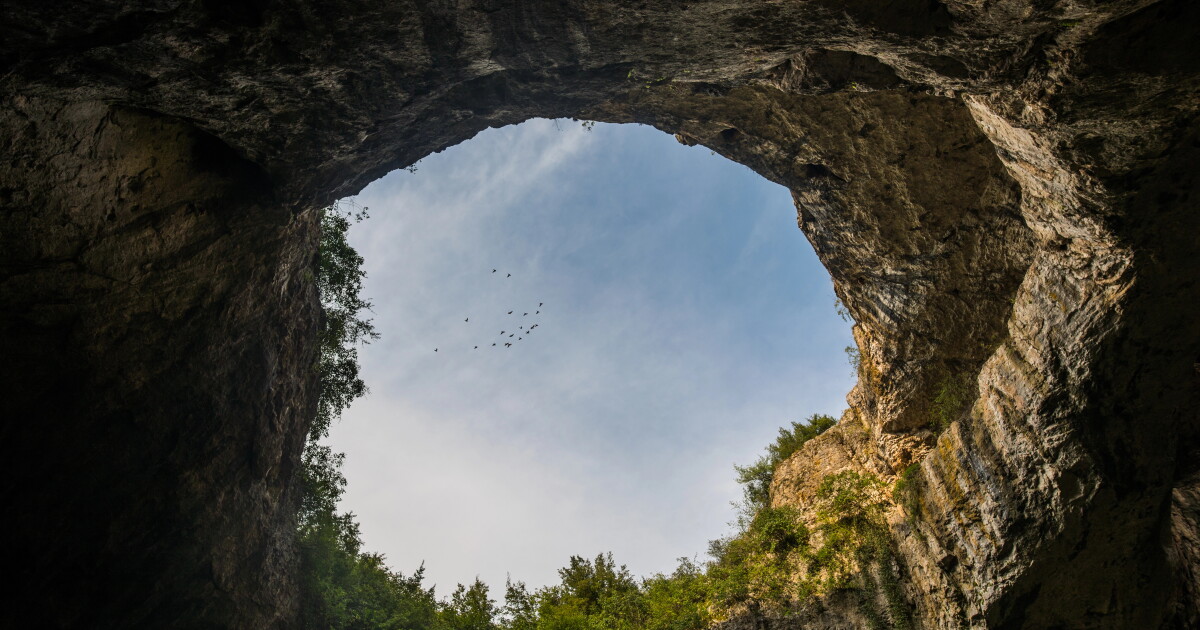
Large sinkholes in nature have traditionally been viewed as a win for biodiversity, protecting plants that would be exposed to environmental stress above ground. However, a new genetic study indicates they are an evolutionary death trap.Researchers from the South China Botanical Garden (SCBG), part of the Chinese Academy of Sciences (CAS) and the CAS Guangxi Institute of Botany, found that massive sinkholes – known as karst tiankengs – are both a haven and a dead end for species. The team made this discovery, published in Current Biology, by looking at the long-term survival chances of the endangered Manglietia aromatica tree found in southwest China. The tree can be found growing inside of karsts in this region, like Guangxi, which is famous for these massive natural sinkhole formations.Using a detailed reference genome for the tree, the scientists re-sequenced 112 plants from 26 populations spread across its Chinese habitats. Importantly, they looked at the genetic makeup of individuals from both inside the sinkholes and those growing above the ground.What they found was that plants near sinkholes had retained enough genetic diversity and had low rates of mutations. Essentially, the trees that could be associated with sinkholes still had reasonable diversity.So despite these populations becoming fragmented – disconnected from others overall – the sinkholes appear to have played a role as natural refuges. This kind of "safe haven" could, in theory, help protect the species in times of climatic upheaval.However, when the researchers zoomed in further, they found a darker side to the pit of safety that, on paper, seems to benefit a species' short-term survival."Sinkholes are not simply safe havens," says Kang Ming, a SCBG researcher and corresponding author of the study. "They provide a buffered microenvironment that helps endangered plants persist, but their enclosed geography can also isolate populations and gradually wear away the genetic variation needed for future adaptation."Further analysis found that the genomes of individuals growing inside sinkholes had significantly lower genetic diversity and more undesirable mutations, compared with the trees sampled from nearby and further away from the subterranean structures.This goes against current understanding of sinkholes being a natural reservoir of preservation.Some of the mutations the scientists found are obvious adaptations to the sinkhole environment. Seedlings from sinkholes died quickly when grown in normal above-ground settings, because they'd become highly light-sensitive.When light exposure was halved, they grew well. But it wasn't until they had very little light – just 10% of the sun that trees growing above ground received – that they really thrived. Further testing found that sinkhole trees had selected for genes that boosted photosynthesis and carbon fixation, showing how the populations had adapted for their low-light habitat. "This helps explain why Magnolia aromatica can thrive in the dim, humid forests at the bottom of sinkholes," says Zhu Xianliang from the SCBG, first author of the study. "The species appears to be strongly dependent on shaded environments, especially during early seedling establishment."This on its own is not necessarily bad; in fact, it shows remarkable adaptivity that's led to the success of these isolated sinkhole populations.However, using climate-change models, the researchers found that tree populations around the sinkholes are likely to shrink during this century. Because these populations help maintain gene flow between isolated sinkhole trees and those further afield, their loss would break the already reduced genetic bridge that currently exists. Ultimately, it would lead to the sinkhole trees becoming even further isolated and unable to exist outside of their very niche environment."Forecasts combining species distribution models, genomic offset, and mutation-load prediction identified future risk hotspots near barriers and suggested that genomic erosion may compound climate vulnerability in parts of the range," the researchers write.So while the sinkholes may have helped the species survive so far, the long-term future of M. aromatica may depend on how well protected the "edge" populations are."Our results suggest that conservation should protect both the shelter and the connections around it," says Kang. "For endangered karst plants, maintaining gene flow among populations may be just as important as preserving the special habitats where they survive."As well as being a fascinating look at how plants adapt to challenging environments, the study offers important insight into how critical gene flow is for long-term survival of a species.Sinkholes remain an important short-term refuge for threatened species, but may ultimately come at the cost of neighboring populations above the ground if gene flow isn't prioritized in conservation.The study was published in the journal Current Biology.Source: South China Botanical Garden via XinhuaFact-checked by Mike McRae
Sinkholes saved these endangered trees – then trapped them there
Full Article
Original Source
Read the full article at Newatlas →KhanList aggregates and links to publicly available news content. We do not host full articles from third-party sources. Always verify important information with original sources.