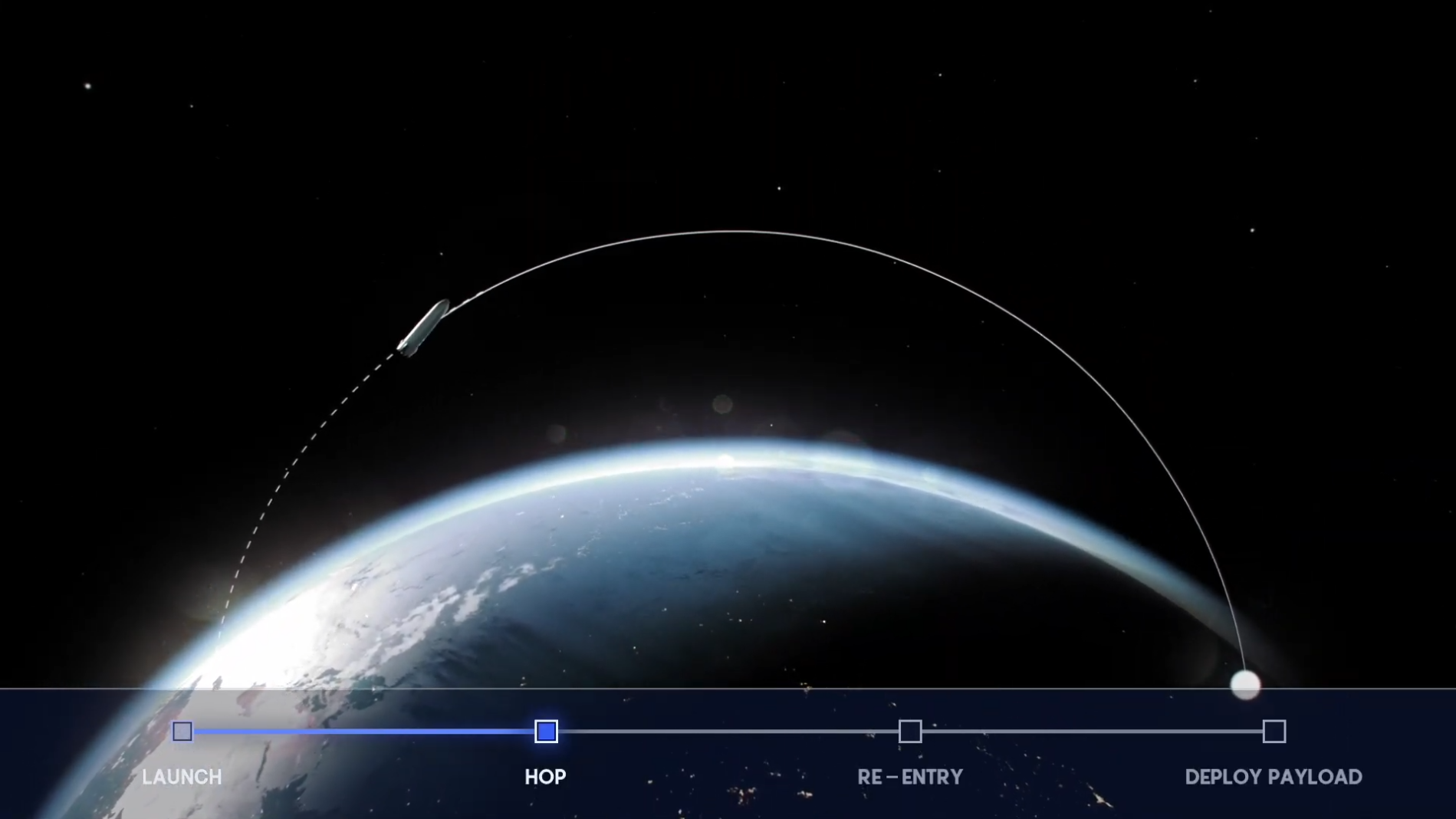
(Image credit: Hop Aero) Hop Aero, a six-person Y Combinator startup based in Orange, California, has published the first public details of what it calls ‘Rook,’ an autonomous rocket the company says will carry 550 pounds (250 kg) of cargo up to 750 km in about 15 minutes, launch from a standard 40-foot shipping container, and land on unprepared ground with no runway or fixed infrastructure. The company's Y Combinator listing gives Okinawa to Taiwan as the reference mission for that 15-minute flight and pitches Rook as a way to put swarms of autonomous unmanned systems on a battlefield. However, Rook hasn’t flown yet, and Hop Aero's only government funding is a single $1.25 million Air Force contract that expires in October.Introducing Rook by @Hop_Aero (YC S26): an autonomous hypersonic cargo rocket that delivers 550 lbs up to 450 miles in ~15 minutes.It launches from a standard 40-foot shipping container and lands on unprepared surfaces—no runways or fixed infrastructure required. pic.twitter.com/GDtnZtPYYkJuly 28, 2026A minimum-energy ballistic arc covering 750 km needs roughly 2.64 km/s at burnout and peaks near 181 km, by some quick napkin math, which puts Rook well above the 100 km Kármán line into space. The ballistic coast alone accounts for about six-to-seven minutes, leaving around eight of the claimed 15 minutes for boost, reentry, and landing. A 40-foot ISO container offers about 12.03 m of internal length and 2.35 m of width, capping the vehicle's dimensions. Rocket Lab's Electron stands 18 m tall and delivers about 300 kg to low Earth orbit.The Air Force Research Laboratory made Rocket Cargo a Vanguard program in June 2021 and awarded SpaceX $102 million in January 2022 to work on the concept with Starship. Starship flew its 13th test on July 24, with the upper stage later splashing down in the Indian Ocean.The Air Force renamed the effort Point-to-Point Delivery in its fiscal year 2025 budget request and asked for $4 million. A Johnston Atoll environmental review covering up to 10 reentry vehicle landings a year was suspended in July 2025, and Rocket Lab's AFRL reentry demonstration on Neutron hasn't flown yet. The Navy's answer to the same forward-supply problem is 3D printing spare parts at the deployment site.Co-founder Jacob Balaj previously worked at Masten Space Systems, which ran more than 600 vertical takeoff and landing flights over 18 years and was developing its Xogdor vehicle for point-to-point payload transport when it filed for Chapter 11 in July 2022. Astrobotic bought the assets for $4.5 million that September.Inversion Space, another Y Combinator company, raised a $44 million in Series A funding and employs around 60 staff, but its subscale Ray demonstrator failed to leave orbit in January last year after a short circuit stopped the deorbit engine from igniting. Hop Aero says it has completed one tethered test of a small-scale prototype at the Oklahoma spaceport. At the time of writing, no company has yet flown a licensed commercial point-to-point cargo delivery. Follow Tom's Hardware on Google News, or add us as a preferred source, to get our latest news, analysis, & reviews in your feeds.Get Tom's Hardware's best news and in-depth reviews, straight to your inbox. Luke James is a freelance writer and journalist. Although his background is in legal, he has a personal interest in all things tech, especially hardware and microelectronics, and anything regulatory.
Shipping container-launched cargo rocket promises 550-pound deliveries 750 km away in 15 minutes — $1.25M Air Force contract backs 'Rook' cargo rocket that flies into space to speed deliveries
Full Article
Original Source
Read the full article at Tomshardware →KhanList aggregates and links to publicly available news content. We do not host full articles from third-party sources. Always verify important information with original sources.