
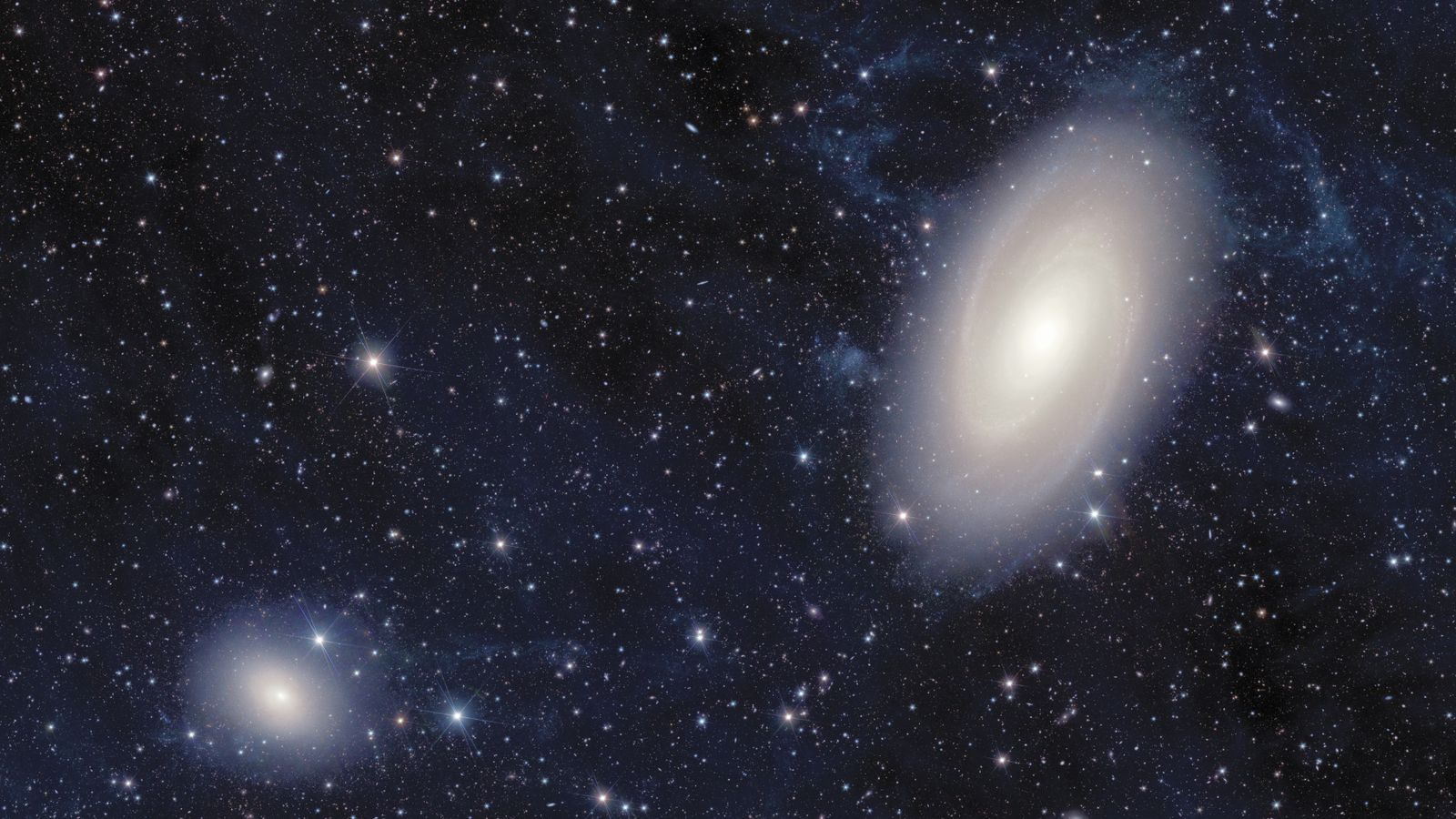
The 1.7 million gigabytes of data include more than 900 million galaxies, more than 60 million potential quasars and about 15,000 candidates of an elusive cosmic phenomenon that can help scientists understand dark matter and dark energy November 18, 2026 11:32 a.m. An image from Euclid's recent data drop featuring the Messier 81 galaxy group ESA / Euclid / Euclid Consortium / NASA, image processing by J.-C. Cuillandre and E. Bertin After roughly 13 months of scientific observations, the Euclid space telescope—built by the European Space Agency (ESA)—has released its first big batch of data. The observations cover an area of the sky roughly equal to 9,500 full moons as viewed from Earth, and that’s just a tiny portion of what the observatory will capture as it builds the largest-ever 3D map of the cosmos. The contents of the 1.7-million-gigabyte data drop, unveiled on November 12, are astounding. They include more than 900 million galaxies; more than 60 million potential quasars, the bright cores of faraway galaxies; and about 15,000 candidates of an elusive phenomenon called strong gravitational lensing, which can help shed light on a cosmic mystery: the dark universe. Zoom into Euclid's 500 gigapixel mosaic of the Universe Euclid launched in July 2023 to journey to a spot nearly one million miles from Earth called Lagrange Point 2, joining NASA’s James Webb Space Telescope. ESA’s instrument aims to investigate two mysterious, invisible things: dark matter, which acts as cosmic glue, and dark energy, thought to be behind the universe’s accelerating expansion. Scientists suspect that together, they make up 95 percent of the universe, but neither can be measured directly. That’s why scientists are excited about the thousands of strong gravitational lensing candidates in this batch of data. Did you know? Another Lagrange Point 2 buddy NASA’s Nancy Grace Roman Space Telescope is currently en route to the second Lagrange point, where it will search for exoplanets and help unravel the mysteries of dark matter and dark energy. Gravitational lensing occurs when light from a distant galaxy gets distorted by a galaxy between it and the light detector—in this case, Euclid. The way the light gets warped around the obstacle allows researchers to indirectly investigate the dark universe. “How strongly the light is bent tells us how much matter a galaxy contains, including invisible components like dark matter. With thousands of lenses, we can study how dark matter is spread through galaxies and understand how galaxies form and evolve over cosmic time,” Natalie Lines, an astrophysicist at the University of Portsmouth in England and Euclid team member, tells Reuters’ Will Dunham. Strong cosmic lenses from Euclid's recent data release ESA / Euclid / Euclid Consortium / NASA, image processing by N. Lines and T. Li The 15,000 strong gravitational lensing candidates in Euclid’s recent batch of data, officially called Data Release 1-Foundation, collectively represent the largest catalog of this phenomenon. It’s even bigger than all previous databases combined, according to a statement. Euclid can also see different wavelengths, or spectra, within the light from a galaxy—similar to how a prism splits white light into a rainbow—which can reveal its distance, origin and composition. With these measurements, scientists can start building a 3D map of the universe and its cosmic web of galaxy clusters. And it really is just a start; Data Release 1-Foundation includes only around 14 percent of the entire portion of the sky that Euclid will observe. That small percentage includes spectra from more than 160 million sources as well as gorgeous images—puzzle pieces of large sky mosaics. And Euclid is special because it’s collecting data on a huge portion of the sky in incredible detail. While there are bigger sky surveys at lower resolution, as well as smaller, pinpointed observations at high resolution, Euclid remarkably achieves both metrics, Andy Taylor, an astrophysicist at the University of Edinburgh in Scotland and Euclid team member, tells the Guardian’s Nicola Davis. A mosaic of images captured by Euclid ESA / Euclid / Euclid Consortium / NASA, image processing by J.-C. Cuillandre and E. Bertin “The technological leap that’s Euclid is that we can keep that high resolution, but now we can basically map huge volumes of the sky, huge volumes of the universe,” Taylor explains. And more observations will be released soon, with the full Data Release 1 expected to drop in mid-2027. “So much discovery is yet to come,” says Valeria Pettorino, ESA’s Euclid project scientist, in the statement. You Might Also Like Get the latest stories in your inbox every weekday. More about: Astronomy Astrophysics Outer Space Space Travel telescope universe
See Stunning Images of the Universe Captured by Europe's Euclid Space Telescope, Which Is Building the Biggest 3D Map of the Cosmos
Full Article
Original Source
Read the full article at Smithsonianmag →KhanList aggregates and links to publicly available news content. We do not host full articles from third-party sources. Always verify important information with original sources.