
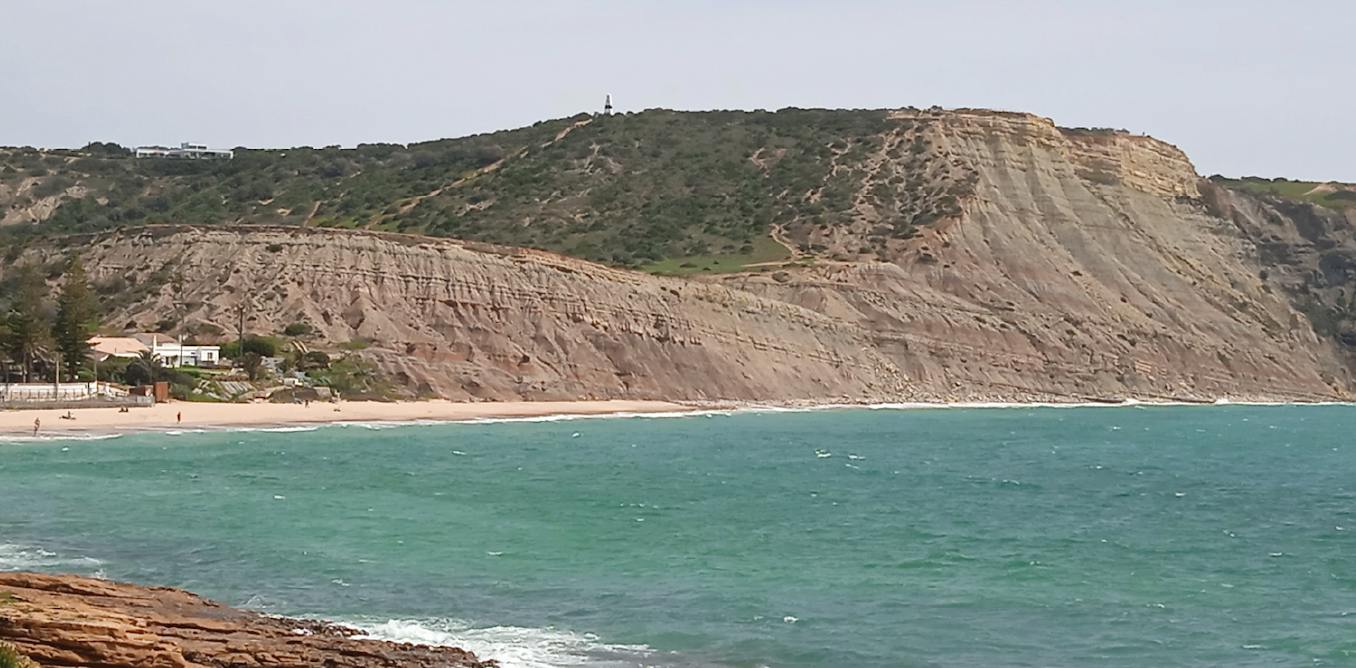
Quite a few scientific discoveries are a product of chance. You set out looking for one thing, but often end up finding something totally unexpected. In micropalaeontology, the study of microscopic fossils, this is especially common. You never know what you’re going to find until you start examining the samples under the microscope. This story began in the spring of 2024, when we were travelling through the Algarve, in southern Portugal, with the aim of determining the age of rocks there by studying fossils of charophytes, a group of green freshwater algae that includes the closest descendants of land plants. This field is known as biostratigraphy: a branch of geology that determines the age of rocks based on the fossils they contain. The Algarve, highlighted in green, is rich in fossils. Jordi Perez Cano We visited several locations that had been studied between the 1960s and the 1980s. Among them was Praia da Luz, which would hold the biggest surprises for us. We collected 120kg of rock, mostly clay, and sent it all to Barcelona – much to the disbelief of the post office clerk in the Algarve town of Loulé, when we told him the (rather heavy) parcel contained “stones”. Once in Barcelona, the samples were placed in water to break them up before being sieved. We then selected microfossils using fine brushes. At first, everything seemed to fit… until it didn’t. During the Early Cretaceous (145–100 million years ago), a family of carophyte green algae, Clavatoraceae, was predominant. Its diversity began to decline around 110 million years ago, until becoming extinct 66 million years ago. Today, only the Characeae family survives. It first appeared around 200 million years ago, though most of the present-day genera emerged around 80 million years ago. Or so it was thought… The first surprise from our research was an Echinochara, a genus within the extinct Clavatoraceae family that I knew well, having already described two species. But its characteristics were unexpected for that geological age. When I mentioned this to a non-palaeontologist friend, she remarked, “How rebellious!” And that was how Echinochara rebellis got its name. Left and centre: Electron microscope images of Echinochara rebellis. Right: a reconstruction of the species, reproduced from the original article. Jordi Perez Cano, CC BY-NC-ND Older fossils than expected We also came across two modern genera of Characeae in a place where we weren’t expecting to find them. Lychnothamnus had previously been found in Europe, Asia and the Americas, in rocks dating back some 80 million years. But we found it in Portugal, in rocks dating back 115 million years. It was a new, peculiar species that appeared to be wearing a hat. So I named it Lychnothamnus pileatus, after the pileus hats that distinguished freed slaves in ancient Rome. Another unexpected discovery was that of Nitellopsis fossils, the earliest record of which had been found in 67-million-year-old rocks in the Catalan Pyrenees. The known species were between 1.5 and 2 times larger than the one we had before us, so I named this new species Nitellopsis lilliputiensis, in homage to the tiny inhabitants of the island of Lilliput in Jonathan Swift’s Gulliver’s Travels. We classified it within the subgenus Campaniella. From left to right. Lychnothamnus pileatus (top: lateral view; bottom: apical view), Nitellopsis (Campaniella) lilliputiensis (top: side view; bottom: apex view), Acroleptochara cynetica (top: side view; bottom: apex view). Jordi Perez Cano, CC BY-NC-ND Another discovery was a member of the Characeae family whose apical cells – which make up the tissues at the tip of a plant’s roots and shoots – were thinner. I consulted specialists in Barcelona, Montpellier, Argentina and China, and none had ever seen anything like it. It was a new genus, which I named Acroleptochara, meaning “Characeae with a tapered upper part”. This particular species was named Acroleptochara cynetica in homage to the cynetes, the Algarve’s earliest recorded inhabitants. Read more: People in Europe ate seaweed for thousands of years before it largely disappeared from their diets – new research Redrawing maps and timelines Of the total of 18 species we found, some were already known. But the Praia da Luz strata contained the oldest record of them, in rocks dating back some 115 million years. What was going on? The Cretaceous period (145–66 million years ago) is generally regarded as a warm period, characterised by a strong greenhouse effect. During such periods, sea levels are higher, much like our current experience due to melting polar ice caps. However, the climate was not uniform throughout the Cretaceous. There were also cold periods, during which sea levels were lower. When this happens, the continents expand, creating lakes where charophytes thrive. Could the diversity of these algae therefore be linked to a cooling event? Our hypothesis is that, probably around 115 million years ago, a short cold period – “short” in geological terms means 2 million years – caused the sea to shrink. In the Algarve, there is no evidence of such a cooling event. However, the rocks reveal continental environments associated with such a regression, such as lakes where charophytes could live. While marine records predominate in other parts of Europe, the Algarve offers a unique window onto the continents of the past. New questions The pieces of the jigsaw suggested that the Characeae, including its present-day genera, began to expand some 30 million years earlier than previously thought, during a period of global cooling. And one group did not simply replace the other: they began to diversify while Clavatoraceae were still dominant and evolving. However, new questions are emerging that will guide future research: What happened in those continental environments? Did the chemistry of the water change? Were the Characeae better equipped to withstand changes? Were those environments less stable? Sometimes, great discoveries and new questions arise from the smallest of things and in the most unexpected ways. The people who swim every year off the cliffs at Praia da Luz may gaze at the rocks without ever realising that a chapter of the Earth’s history is written on them. Every scientific discovery is an invitation to rekindle that curiosity which makes us human. A weekly e-mail in English featuring expertise from scholars and researchers. It provides an introduction to the diversity of research coming out of the continent and considers some of the key issues facing European countries. Get the newsletter!
How we discovered a 115 million-year-old ‘algae rebellion’ in Portugal’s sea cliffs
Full Article
Original Source
Read the full article at Theconversation →KhanList aggregates and links to publicly available news content. We do not host full articles from third-party sources. Always verify important information with original sources.