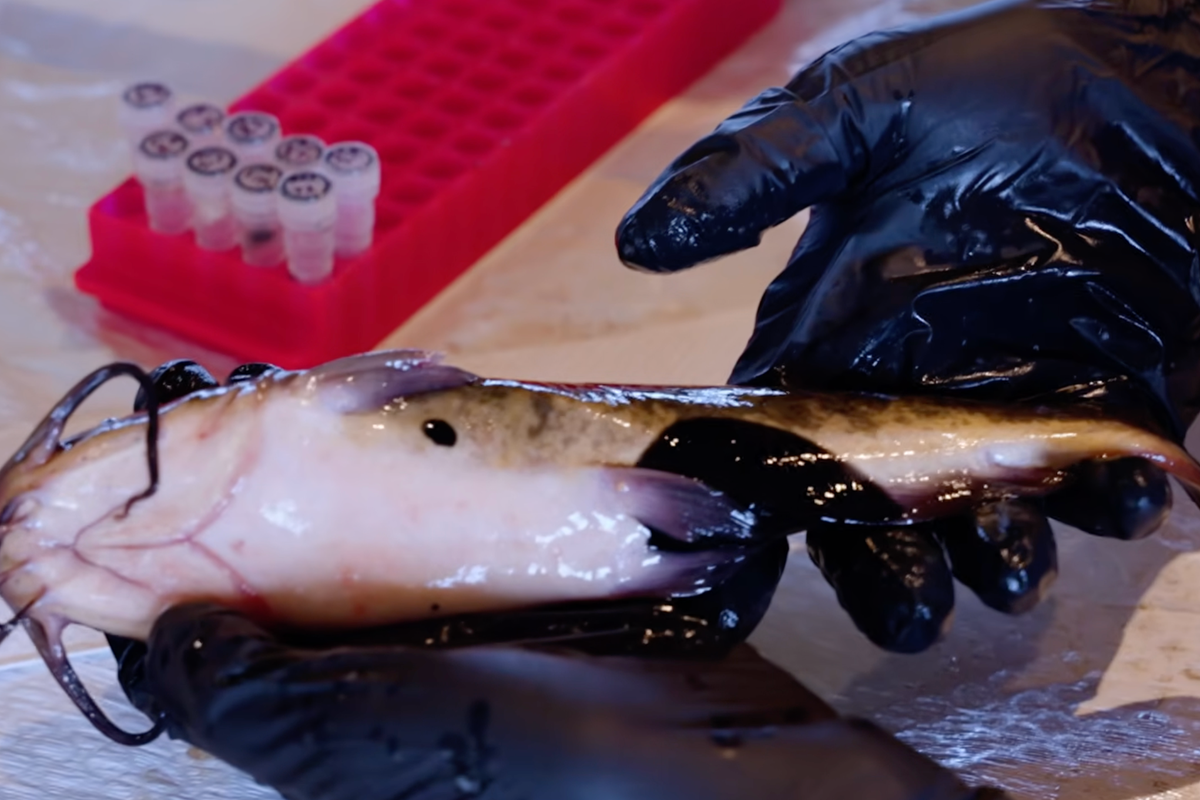
Scientists have discovered a rare transmissible form of cancer spreading between fish, according to a new study. Researchers say the discovery, which showed cancer cells behaving more like parasites than regular tumors, could actually help us to understand how cancer metastasises in the human body.The study, published on July 22 in Nature, centered on brown bullhead catfish swimming in Lake Memphremagog, a 42 square mile body of water stretching all the way from Vermont in the United States to Quebec, Canada. Mysterious dark lesions have been spotted on the catfish living there since 2012. Peter Emerson, a biologist at the Vermont Fish and Wildlife Department who worked on the study, described the markings as looking like “black tar.”“You can tell it doesn't help the fish cause they're inside the mouth, they're on the fins,” he told NPR, adding that the marks have even been spotted on specimens’ eyes, lips and gills.Scientists have discovered a form of transmissible cancer (visible as black lesions) in catfish swimming in a huge lake that stretches between Canada and the US (University of Vermont)Between 2014 and 2017, the malignant melanomas were spotted on 23-37 percent of the brown bullhead catfish sampled, the research states.Julie Dragon, an associate professor at the University of Vermont who co-authored the report, said in a press release that the discovery of the melanoma was surprising given that the fish are bottom dwellers. Eventually, through whole-genome sequencing, the researchers were able to compare tissue from the tumors with otherwise healthy samples. That was when they realised that the cancer cells in each infected fish were much more closely related to each other than they were to their hosts. Dragon says that working out how the cancer spreads could help experts to understand general cancer biology better.“By studying how cancers survive and spread outside their original host, we can learn a great deal about what keeps cancers contained - and what happens when those boundaries break down,” she suggested. “These fish provide an opportunity to look at evolution of cancer.”The transmissible cancer has been detected in brown bullhead catfish swimming in Lake Memphremagog (University of Vermont)Vincent Lynch, an evolutionary biologist at the University at Buffalo, told NPR that the discovery could help researchers understand how metastases - secondary tumors formed when cancer cells break away from the primary tumor - evolve.The cancer cells detected in Lake Memphremagog’s brown bullhead population cannot infect other species, according to the UoV release. Dragon said that infection could be taking place when fish aggregate while spawning, since young fish did not show signs of having lesions. As they brush against each other, the spines on their pectoral fins could be scratching their fellow fish, opening up a new way for the cancer cells to spread. The release also revealed that elevated levels of arsenic were discovered in the cancer cells, with the levels of arsenic in soil surrounding the lake having a correlation with the geographical distribution of the cancer.The discovery is the fourth transmissible cancer discovered in animals, after dogs, Tasmanian devils and certain mollusks.
Scientists have discovered a rare transmissible cancer between fish — and it could ultimately help humans
Full Article
Original Source
Read the full article at Independent →KhanList aggregates and links to publicly available news content. We do not host full articles from third-party sources. Always verify important information with original sources.