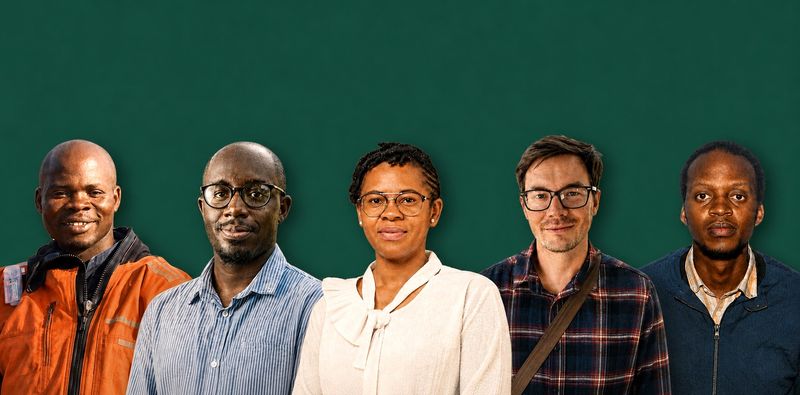
Across Africa, ecosystems are changing faster than ever before. Forests absorb carbon while enduring rising temperatures. Drylands edge towards desertification. Rivers carry pollutants and nutrients into estuaries and oceans. Freshwater systems strain under pollution, climate pressures and growing demand. Pollinators navigate landscapes increasingly fragmented by agriculture and urban growth.The challenge facing conservation scientists is not simply understanding what is happening today. It is predicting what happens next.This year’s five finalists for the $250,000 Jennifer Ward Oppenheimer Research Grant share a common ambition: to move environmental science from reaction to prediction. Whether studying microbes hidden beneath desert soils, insects moving between flowers, plankton communities in estuaries, or trees standing deep within the Congo Basin, the researchers behind each project seek early warning signs of ecological change before significant decline occurs.Together, these five projects offer a snapshot of a new generation of African science – one increasingly focused on resilience, forecasting and practical tools for decision-makers. Dr Marc van Goethem, a microbial ecologist at the University of Pretoria, studies how soil microorganisms can help predict and strengthen the resilience of Africa’s dryland ecosystems. (Photo: Supplied / Jennifer Ward Oppenheimer Research Grant) Too small to seeTwo of the five finalists are united by the premise that some of the most important signals of ecosystem health come from organisms too small to see.For South African researcher Dr Marc van Goethem, the focus is Africa’s drylands. Stretching across vast regions of the continent, these landscapes support hundreds of millions of people while remaining highly vulnerable to climate change and water scarcity.Traditionally, scientists monitor desertification through changes in vegetation cover, rainfall and soil conditions. But these indicators often reveal problems only after degradation is already underway.Van Goethem believes the earliest warning signs may appear within the microscopic communities living beneath the soil surface.His project will analyse microbial communities across Africa’s major dryland systems, including the Kalahari, Namib, Sahel and Sahara. By identifying functional changes in these microbial networks, he hopes to develop an early warning system capable of detecting ecosystems approaching critical tipping points long before vegetation visibly disappears.Stellenbosch University researcher Dr John Paul Makumbi uses microbial genomics to develop early warning systems for protecting Africa’s freshwater ecosystems. (Photo: Supplied / Jennifer Ward Oppenheimer Research Grant) A similar approach underpins the work of Ugandan researcher Dr John Paul Makumbi, although his focus lies in Africa’s freshwater ecosystems.These ecosystems across Africa face mounting pressure from pollution, urbanisation and climate change. Existing monitoring systems typically rely on chemical measurements or visible changes in biodiversity, often detecting problems only after ecological damage has already occurred.Makumbi’s project seeks to identify microbial genomic signals that emerge before broader ecosystem decline becomes apparent. By studying freshwater systems in Uganda, Ethiopia, Côte d'Ivoire, South Africa and eSwatini, he hopes to develop a predictive framework that enables water managers to detect degradation earlier and intervene before ecosystems begin to fail.In both projects, microbes become sentinels – tiny organisms capable of signalling environmental crises long before they become visible.Dr Beatrice Tchuidjang Nganso is a research scientist at the International Centre of Insect Physiology and Ecology (icipe) in Kenya. (Photo: Supplied / Jennifer Ward Oppenheimer Research Grant) Mapping relationships that sustain lifeTackling a different challenge is Cameroonian scientist Dr Beatrice Tchuidjang Nganso, revealing the ecological relationships that sustain life.Pollinators underpin food production, biodiversity and rural livelihoods across Africa. Yet surprisingly little is known about which insects pollinate which plants. Much of the available information remains fragmented, scattered across studies, institutions and countries.Nganso’s proposed AfriPollNet platform aims to change that.By bringing together existing datasets from across the continent while generating new observations in underrepresented regions, the project aims to create the first continent-wide, open-access platform mapping plant-pollinator relationships. It will also analyse the nutritional value of pollen and nectar sources used by pollinating insects.The vision extends far beyond scientific research. Farmers, conservationists, students and policymakers could use the platform to identify important pollinator habitats, better understand ecological connections and develop strategies that support both biodiversity and agricultural production.Dr Olivier Jean Leonce Manzi, a plant ecophysiologist and research fellow at the University of Rwanda, studies how African tropical forests respond to heat, drought and climate change. (Photo: Supplied / Jennifer Ward Oppenheimer Research Grant)Are African forests really resilient?Few ecosystems are as globally significant as the tropical forests of Central Africa.These forests store enormous quantities of carbon and play a critical role in regulating the Earth's climate. Yet a fundamental scientific question remains unresolved: Why have African tropical forests appeared more resilient to climate stress than forests in other tropical regions?For Dr Olivier Jean Leonce Manzi, the answer could determine whether that resilience is real – or merely temporary.His project investigates the physiological limits of African tree species. By measuring how closely trees operate to thresholds associated with drought stress and heat damage, he aims to determine whether African forests possess genuine resilience or whether they are approaching unseen vulnerabilities.The distinction matters enormously, says Manzi.If African forests are inherently more resistant to climate change, they may continue functioning as major carbon sinks for decades to come. But if their apparent stability reflects a delayed response, future declines could occur rapidly once critical thresholds are crossed.Rather than simply observing whether forests remain healthy, Manzi's research seeks to uncover the biological mechanisms that determine how much climate stress African trees can withstand – and how close they may be to their limits.University of KwaZulu-Natal ecologist Dr Gabriel Akoko Juma is one of the five researchers shortlisted for the $250,000 Jennifer Ward Oppenheimer Research Grant. His research explores how climate change reshapes the ecological connections between rivers, estuaries and the ocean. (Photo: Supplied / Jennifer Ward Oppenheimer Research Grant) Following rivers to the seaWater connects landscapes.Rain falling in distant catchments eventually reaches rivers, estuaries and oceans, carrying nutrients, sediments and pollutants along the way.Dr Gabriel Akoko Juma’s project examines this continuum from source to sea.Focusing on the Zambezi, Limpopo, Tugela and Orange river systems, he will investigate how climate-driven changes in river discharge reshape plankton communities, nutrient cycling and carbon dynamics across southern Africa’s estuaries and coastal waters.Plankton rarely attract public attention, yet they form the foundation of aquatic food webs. Changes in their abundance, diversity and composition can ripple through entire ecosystems, affecting fisheries, biodiversity and carbon storage.By combining field observations, satellite data and ecological modelling, Juma hopes to understand how climate change reshapes these interconnected systems from rivers to the sea.The work highlights a broader reality: what happens upstream inevitably affects what happens downstream.Reading Africa’s environmental futureAlthough the five projects span forests, rivers, oceans and pollinator networks, they share a common thread: each seeks to understand change before it becomes a crisis.Whether through microbial genomes, physiological thresholds, ecological networks or the changing dynamics of plankton communities, the researchers are searching for signals that reveal not only how ecosystems function, but how they may fail. For a continent confronting rapid environmental change, such knowledge could prove invaluable.Because in conservation, as in medicine, the most effective intervention is often the one made before symptoms become impossible to ignore. The five finalists will now be narrowed to three, who will present their research projects during a Tipping Points webinar on 27 August. Sign up to attend the free event here. The 2026 JWO Research Grant recipient will be announced at the 2026 Oppenheimer Research Conference in Midrand from 7–9 October 2026. DMThis article was produced with support from the research engagement agency, Jive Media Africa.
SCIENCE SNAPSHOT: Finalists — Five scientists race to read Africa’s environmental future
Full Article
Original Source
Read the full article at Dailymaverick →KhanList aggregates and links to publicly available news content. We do not host full articles from third-party sources. Always verify important information with original sources.