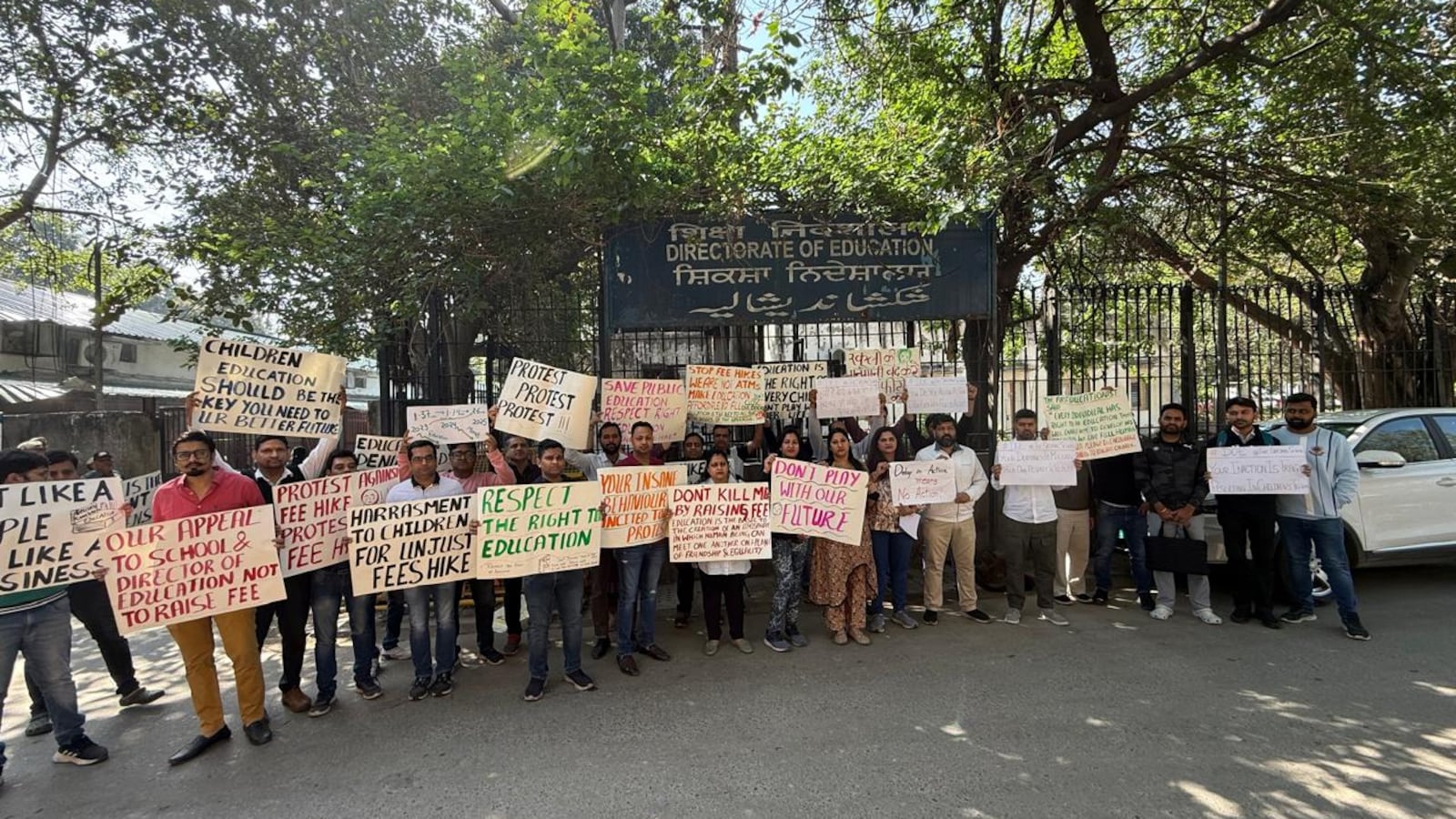
For generations, Indian parents have believed that no sacrifice is too big when it comes to a child's education.A new phone can wait. A vacation can be postponed. A bigger house can come later.But education? That has always been non-negotiable.What has changed is the price tag.Today, parents are discovering that paying school fees is only the beginning. Tuition classes, digital devices, transport, uniforms, extracurricular activities, competitive exam coaching and eventually college have turned education into one of the biggest financial commitments a family will ever make.Experts now warn that families who delay planning could end up paying a heavy price years later.The Numbers Tell A StoryThe Ministry of Statistics and Programme Implementation's (MoSPI) Comprehensive Modular Survey on Education 2025 paints a stark picture.The average annual household expenditure per student was Rs 2,863 in government schools. In non-government schools, that figure jumped to Rs 25,002.Advertisement - Scroll to continueCourse fees accounted for the largest share of expenses. Families also spent heavily on textbooks, stationery, uniforms and transport. Urban households consistently spent more than rural households.The spending doesn't stop there.Private coaching has become a regular part of education for many children. More than one in four students now receive coaching outside school. At the higher secondary level, urban families spend nearly Rs 9,950 a year on coaching, compared to Rs 4,548 in rural areas.Since nearly 95 per cent of students rely primarily on their families to fund their education, rising costs are no longer just an education issue. They have become a household finance issue.Inflation Doesn't Tell the Full StoryRozy Efzal, Director and Co-Founder of Invest4Edu, says parents often make one critical mistake. They assume education costs will rise at the same pace as general inflation.The assumption, she says, can be dangerously misleading.MoSPI's Consumer Price Index showed education inflation at 3.38 per cent year-on-year in November 2025. But parents rarely spend only on tuition. They also pay for coaching, transport, hostel accommodation, laptops, internet services, international exposure and professional courses."The broad inflation number may not fully capture what families actually pay," Efzal explains.Instead of relying on a single inflation figure, she recommends planning under multiple scenarios.Consider a professional degree costing Rs 20 lakh today. At an annual education inflation of 6 per cent, it could cost nearly Rs 48 lakh after 15 years. If costs rise by 8 per cent annually, the same course may require around Rs 63 lakh. At 10 per cent, parents could be looking at an education bill of almost Rs 84 lakh.These are planning scenarios, not official forecasts. But they underline one reality: delaying financial planning can become extremely expensive.School Fees Are Just One Part Of The BillParents say the biggest surprise isn't the annual fee. It's everything that comes after it.Arun Singh, whose daughter studies in a Delhi school, says families constantly face expenses that aren't reflected in the headline fee structure.Schools frequently collect additional charges for monthly activities, annual development funds and special programmes, he says. Parents also pay separately for sports such as table tennis and taekwondo despite already paying substantial tuition fees.To manage these recurring expenses, Singh says his family saves every month and has also invested through fixed deposits and the Sukanya Samriddhi Yojana to prepare for higher education.His experience reflects what many middle-class families face today: education budgets rarely stay fixed.The Hidden Cost Most Parents IgnoreDr Abhinav P Tripathi, Associate Professor at Christ University's Delhi NCR campus and father of two school-going boys, believes parents often underestimate the real definition of education.School fees, he says, represent only the visible layer. "The real financial burden increasingly comes from preparing children for a rapidly changing world."Parents today invest in laptops, tablets, coding courses, digital learning platforms, artificial intelligence tools, specialised certifications and exposure to emerging technologies that schools may not adequately cover.As technology transforms workplaces faster than ever, these additional investments have become essential rather than optional. "The overall cost of education is far higher and more complex than the formal fee structure printed in the school prospectus," he says.Why Early Planning MattersProfessor (Dr) B Rajanarayan Prusty, Dean of Research and Innovation at Noida International University, believes many families begin planning only when major education expenses arrive.By then, the financial pressure has already built up.He points to the widening gap between government and private school costs as evidence that education planning has become a necessity rather than a choice.Prusty says parents should focus on creating an education corpus through disciplined savings instead of depending heavily on education loans.Loans, he argues, should ideally cover only a limited portion of total expenses and be used only when absolutely necessary.A savings-first approach, he says, reduces long-term financial stress and protects family finances. He also stresses diversification.Instead of relying on a single investment product, parents should spread their savings across multiple instruments based on different time horizons.One Investment Product Is Not EnoughEfzal believes the strongest education plan combines stability with growth. For parents of daughters, Sukanya Samriddhi Yojana remains an attractive long-term option.An annual investment of Rs 60,000 for 15 years translates into a total investment of Rs 9 lakh. If the current interest rate of 8.2 per cent continues, that amount could potentially grow to around Rs 26.5 lakh to Rs 29 lakh over 21 years, depending on deposit timing.Public Provident Fund (PPF) offers another stable option suitable for all children, although it may not fully fund an expensive professional degree on its own.For parents with investment horizons of 10 to 15 years, equity SIPs provide greater long-term growth potential, though they come with market risks.Near-term requirements such as school fees or coaching expenses over the next few years may be better suited to recurring deposits, National Savings Certificates or time deposits.Efzal also emphasises that term insurance is often overlooked. A child's education, she says, should never depend solely on the earning parent's continued income.As examples of diversified mutual fund schemes that may be considered for long-term education planning, she points to ICICI Prudential Equity and Debt Fund, ICICI Prudential Large and Mid Cap Fund, HDFC Flexicap Fund, Nippon India Growth Mid Cap Fund and Bandhan Small Cap Fund. She advises investors to assess suitability based on their financial goals and risk appetite, and to consult a qualified financial adviser before investing. She also notes that, as highlighted in SEBI's investor education material, mutual fund investments are subject to market risks.Many middle-class families are realising that their annual education budgets rarely stay fixed.Education Is An Investment, Not An ExpenseDr Somnath P Patil, Pro-Chancellor of Dnyaan Prasad Global University by DY Patil Unitech Society, believes the conversation must move beyond affordability.Higher education today is no longer limited to classroom teaching. Students also need technology, industry exposure, experiential learning, research opportunities and practical skills that prepare them for a rapidly evolving economy.Families, therefore, are not simply paying for a degree. They are investing in a child's future earning potential and ability to adapt to changing careers.That, he says, places an equal responsibility on universities to deliver education that creates lasting value.The Goal Is To Keep Every Door OpenA child who dreams of becoming a doctor today may decide to pursue design, law, artificial intelligence or entrepreneurship tomorrow.No one can accurately predict where a child will eventually end up. What parents can control is whether financial constraints become the reason those dreams are abandoned.The cost of education will almost certainly continue to rise. The question is whether family savings will keep pace.For many Indian households, the time to build an education fund is no longer when college admission forms arrive. It is when the child is still learning to write their name.
'School Fees Are Just The Beginning': The Hidden Cost Of Educating Children
Full Article
📰 Original Source
Read full article at Ndtv →KhanList aggregates and links to publicly available news content. We do not host full articles from third-party sources. Always verify important information with original sources.