
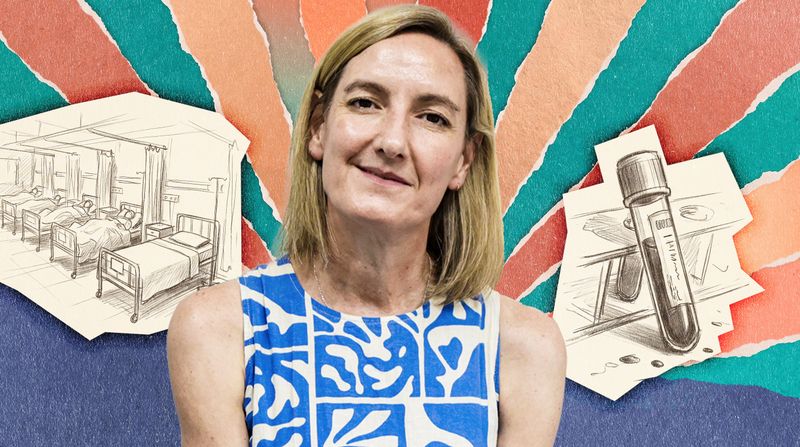
Dr Liezl du Plessis was the Northern Cape’s first and only paediatric oncologist. But after eight years of treating children and teenagers at the Robert Mangaliso Sobukwe Hospital in Kimberley, as “things fell apart”, she left, citing exhaustion and accumulated trauma. In February, Du Plessis returned to her hometown of Pretoria where now, for the first time, she practises in the private sector.There wasn’t any particular incident that made her give up on her dream of running a paediatric oncology unit in Kimberley, Du Plessis says. “It accumulates over time. I think when you leave the state [sector], you actually have post-traumatic stress disorder or something. Like, you cannot work there day in and day out and not have some form of trauma.”A broken systemReflecting on her time at Robert Mangaliso Sobukwe Hospital, she says: “You’ve got no support. Like, when you’re a doctor and you want to get a patient healthy, you rely on so many services that should function well. Lab services – when I take blood from a child, I need a functional laboratory that can run my sample in a timely manner, that can phone me when the results are abnormal, not lose my sample.”She recalls having to take her patients’ blood samples to the laboratory herself. “As doctors, we would take our own samples to the lab. You could not put it in a container and hope for the best… it will never reach the lab. [In a smoothly running hospital, when a doctor or nurse draws blood, the sample vial is put in a collection bin for internal hospital porters to collect.] So the only way to make sure that you actually get your results, you take it yourself, and you tell them it’s urgent, otherwise it will lie there.”She says maintenance of the hospital slipped into disrepair. “Back in the day, I think there were 40, 50 people that worked in the maintenance workshop that were appointed by the hospital. The workshop that fixes a toilet that’s not working, a pipe that’s leaking, basic maintenance. By the time I left, I think there were two or three people in maintenance. So you work in this environment where everything is broken.”‘They don’t know to ask for better’Du Plessis points out that many of their patients at the Kimberley hospital were from poor socioeconomic backgrounds and did not think to question the compromised state of the facility. “And you know, these are humans, sick humans that actually need to heal. But the problem is these people come from such deprived home circumstances. The expectations from these people are so low, and that’s actually really sad because they don’t know to ask for better,” she says.Robert Mangaliso Sobukwe Hospital. (Photo: Facebook / Robert Mangaliso Sobukwe Hospital) With a population of about 1.38 million, the Northern Cape covers an area of 372,889 square kilometres making it roughly 20 times the size of Gauteng. Du Plessis describes caring for children whose medical needs were compounded by poverty and difficult home circumstances. One of her patients, a boy with bone marrow failure, was eventually adopted through a social worker affiliated to the hospital, after concerns were raised about his care at home. “So, you have a boy with a very serious medical condition,” she recalls. “He lived very far away and yes, when his mother brought him to hospital, she was drunk, drunk, drunk, and he was completely out of it. Because his illness brought this child to the hospital, his social circumstances were actually exposed – which ultimately created an opportunity for him to get out of those circumstances. So something good came from that very bad and serious situation.”From Canada to Kimberley with big dreamsDu Plessis earned her medical degree in 2003 from the University of Pretoria, completing her master of medicine in paediatrics at the University of the Free State in Bloemfontein in 2012. She specialised further in paediatric haematology, oncology and bone marrow transplantation at the BC Children’s Hospital in Vancouver, Canada.On her return to South Africa, initially she struggled to find a position, until, she says, the now retired Dr Pieter Jooste, a long-time paediatrician at Kimberley Hospital Complex, recruited her in 2018 to start a paediatric oncology unit. That same year, the facility was renamed Robert Mangaliso Sobukwe Hospital.“He [Jooste] was always so open for anything new, that’s just his personality. He was always at the forefront of change and wanted to improve things even as they literally started to fall apart. So he facilitated me being appointed in the Northern Cape as a paediatric oncologist.”A unit specially for childrenIn rooms formerly used for private patients, Du Plessis set up the paediatric oncology unit with seven beds. In time, the four single rooms, with adjoining bathrooms, and a larger ward with three beds were beautifully decorated by the nonprofit Reach for a Dream, which also transformed an adjacent old storeroom into a play area. Because the Northern Cape is South Africa’s largest province, its geographical size means that most patients have to travel long distances to Kimberley, with some children needing accommodation between chemotherapy cycles. Du Plessis also tried to accommodate their caregivers in the unit.Dr Liezl du Plessis, who now works in the private sector, has a special passion for caring for children and teenagers. (Photo: Felix Dlangamandla / Daily Maverick) Treatment for adolescents and teenagers, says Du Plessis, is close to her heart, since this is a vulnerable group who need support to adhere to their treatment, both from medical staff and caregivers (hence the importance of creating a space where parents could sleep over at the unit).She adds that cancer in children and teenagers is often treatable. “Their diseases are often curable. But you need somebody that supports them through that. They get sick, you often have these periods, these months of intensive therapy, but often they are cured.”Learning to work IVAC infusion pumpsDu Plessis tells how, coming from a well-resourced training facility in Vancouver, this had been a steep learning curve. Among other things, “all of a sudden I had to learn how to work the IVACs [infusion pumps] just to put up the chemotherapy. Administering chemotherapy, that is a nursing job. But nobody could really get the ball rolling on training people. I could never establish a team. In all of eight years, that was impossible.”While she says the hospital system failed her, she mentions the CHOC Childhood Cancer Foundation of South Africa which appointed a local social worker, “a very, very dedicated woman who could speak Tswana”, to help her.Fortunately, the hospital had a chemotherapy pharmacy. “At least I didn’t have to mix the chemotherapy,” she says. "There was a chemotherapy pharmacy that mixed the chemo. The hospital had that because they had an adult oncology unit for many, many years. So there’s safety issues around working with chemotherapy and mixing it and the way you store it.”One remaining public oncologist in the entire Northern CapeDu Plessis tells Spotlight and Daily Maverick that while she was working at Robert Mangaliso Sobukwe Hospital there were three oncologists – two oncologists for adults and herself, a paediatric oncologist. But one of the others also left the public sector, to work only in the private sector in Kimberley.“I mean, there were two adult oncologists appointed at the hospital,” she says. “And while I was there, one of them left. So there was one adult oncologist for the entire province.”Currently, Spotlight and Daily Maverick understands that the one remaining public oncologist in the entire Northern Cape is based at the Robert Mangaliso Sobukwe Hospital, while also being responsible for the JF “Boeboe” van Wyk Oncology Clinic in Springbok (776km away) which, according to an official statement, admitted its first cancer patient in July. When we called the oncology clinic a receptionist said the facility was “up and running” and confirmed that the oncologist in charge was from Kimberley (we were given the same name that Du Plessis told us was the only remaining oncologist in the province).Spotlight and Daily Maverick made several attempts to obtain comment from the Northern Cape Department of Health for this article, but had not received a response by the time of publication.The JF “Boeboe” van Wyk Oncology Clinic. (Photo: Northern Cape Department of Health / Facebook) Commenting on the lack of public sector oncologists and support in the vast province, Du Plessis says: “I mean, how can anybody function in any way like that?”Research on the disparities in oncology services between provinces have found that Gauteng has the highest number of oncologists, followed by the Western Cape, with the lowest number working in the Northern Cape, Mpumalanga, North West and Limpopo. A recent response to a parliamentary question painted a similar, if incomplete picture. It also showed only one public sector oncologist in the Northern Cape.Obakeng Maphalatlasa, from Carnarvon to KimberleyMeanwhile, within this broken and underresourced system, poor and vulnerable people are falling through the cracks. Speaking from Carnarvon, the town famous as the site of the Square Kilometre Array (SKA) telescope, 400km from Kimberley, Donella Harris tells Spotlight and Daily Maverick how her son, Obakeng Maphalatlasa, now 14, was diagnosed with BCOR-sarcoma, a rare type of bone cancer.Maphalatlasa was treated at the paediatric oncology unit at Robert Mangaliso Sobukwe Hospital, where he had chemotherapy from August last year. Harris recalls: “Dr Liezl said she would call us about the [cancer test] results, and she did. And she explained to us and told us to come back to Kimberley as soon as possible, which we did.”Harris says they were transported to Kimberley by ambulance for chemotherapy. “We would start travelling from Carnarvon at 02:00 and arrive at 07:00 or 08:00. So, Dr Liezl, she would always be there. She was always up early. They would draw blood, by 10:00 or so they would have the results. And if his blood was right, he gets chemo. So at the children’s unit, he had a single room there. When he had chemo, I slept on a mattress on the floor of his room.”‘Administering chemotherapy, that is a nursing job. But nobody could really get the ball rolling on training people. I could never establish a team. In all of eight years, that was impossible,’ Dr Liezl du Plessis says. Image: Marcelo Leal / Unsplash Harris says that she and Maphalatlasa were at the hospital when Du Plessis left in February, that they had a farewell party for the oncologist. “We were so sad when she left. We were there for chemo at the time.”Harris says Maphalatlasa’s treatment continued after Du Plessis left, but that he was transferred to an adult ward. “After Dr Liezl left in February, the children had to get treatment with the adults, in the adult ward,” she says.“So what happened, there was a time when that ward was out of stock. My child was without [chemotherapy] treatment for a month. Once a week, we travelled up all the way from Carnarvon to Kimberley, but when we arrived, there wasn’t treatment. Nobody would call us to say there’s no treatment, so we travelled all that way in the ambulance for nothing. I was so desperate. Eventually they got stock and we stayed for three weeks.”Harris is unemployed and previously worked in kitchens in Cape Town. Maphalatlasa has missed school because of his treatment. Sadly, following the stockout and interrupted treatment, Harris relays that recent tests revealed new cancer development in her son.“They picked up he has cancer again, a new development,” says Harris. “Now the child doesn’t want to go again [to Robert Mangaliso Sobukwe Hospital]. My child was so traumatised in the adult ward because people were dying there next to him. In the children’s unit these things did not happen.”Travelling overnight for treatment, to arrive to nothingThe Cancer Association of South Africa’s services coordinator based in Springbok, Geraldine Farmer, tells Spotlight and Daily Maverick that she attended a breast cancer awareness event at the JF “Boeboe” van Wyk Oncology Clinic in the last week of October. She describes the facility as “beautiful and very encouraging”, adding that it had reportedly enrolled 200 patients so far. Farmer says she hopes the clinic will ease the load of people in the region having to travel to Kimberley for cancer care. Farmer corroborates Harris’s story, relaying how some patients travel all the way from Springbok to Robert Mangaliso Sobukwe Hospital for treatment overnight, only to arrive at a dead door. “I think their [the hospital’s] load is a lot. People get transferred there, taken there by ambulance and then there is no one to meet them, there is no service. They travel all the way from Namaqualand, they drive there overnight. When they arrive there isn’t even a toilet for them, it is so bad. They don’t get service, they don’t get treatment. Then they have to drive all the way back to Namaqualand. Three days out of the lives of these people, without having received treatment,” she says.Farmer also says people can’t get through to the facility on the telephone. “Why doesn’t the staff at Robert Sobukwe tell the local clinics that they don’t have treatment available; that machines are broken, or that they don’t have a doctor? So the local clinics can inform patients not to travel. At the end of the day it is the patients’ time and also the costs involved,” she says. On transport for patients, she says: “Once or twice a month an ambulance won’t pitch up. But for the most part the transport is very good. In a month, about four times a week an ambulance is traveling from Springbok to Kimberley. Some of these patients will now go to the JF “Boeboe” van Wyk Oncology Clinic.”Life Groenkloof Hospital in Pretoria. (Photo: MyHospitalNow / Wikipedia) Farmer adds that most of the serious cancer cases are ultimately referred to Bloemfontein, where the service is good. “I know of a newborn baby who was transported by ambulance to Upington and immediately by air to Bloemfontein. The diagnosis was determined as cancer in Bloemfontein. Treatment started immediately and the service was excellent,” she says. ‘I could not foresee things getting better’Meanwhile, Du Plessis says it was extremely hard to leave the children’s unit at Robert Mangaliso Sobukwe Hospital. “So there is a senior doctor, she had learned quite a bit from me and I trained her and she liked oncology and the kids. And so she helped to finish up some of the patients, some who were in the midst of a treatment plan or whatever. Many children now will be referred to Bloemfontein,” she says. Dr Liezl du Plessis. (Photo: Felix Dlangamandla / Daily Maverick) Du Plessis says that ultimately she left because she could not imagine the situation improving. “If I could foresee that things would be any better in 10 years, I think I might have stayed,” she says. “But I could not.”Walking along a corridor at Life Groenkloof Hospital in Pretoria, she smiles at fellow healthcare workers and returns their greetings. As children’s voices chirp in a nearby waiting room, she voices enthusiasm for her next chapter treating young people in Pretoria. DM This is the fifth of six articles in the series. Part 1 told the stories of two women diagnosed with breast cancer. Part 2 zoomed in on the numbers, and asked whether cancer cases are really going up in South Africa. Part 3 took stock of the huge progress we are making against some cancers, particularly cervical cancer. Part 4 looked at the long journeys many people have to undertake to receive cancer treatment far from home.
SA’S CANCER STORY (PART 5): Why the Northern Cape’s only state cancer paediatrician left for the private sector
Full Article
Original Source
Read the full article at Dailymaverick →KhanList aggregates and links to publicly available news content. We do not host full articles from third-party sources. Always verify important information with original sources.