
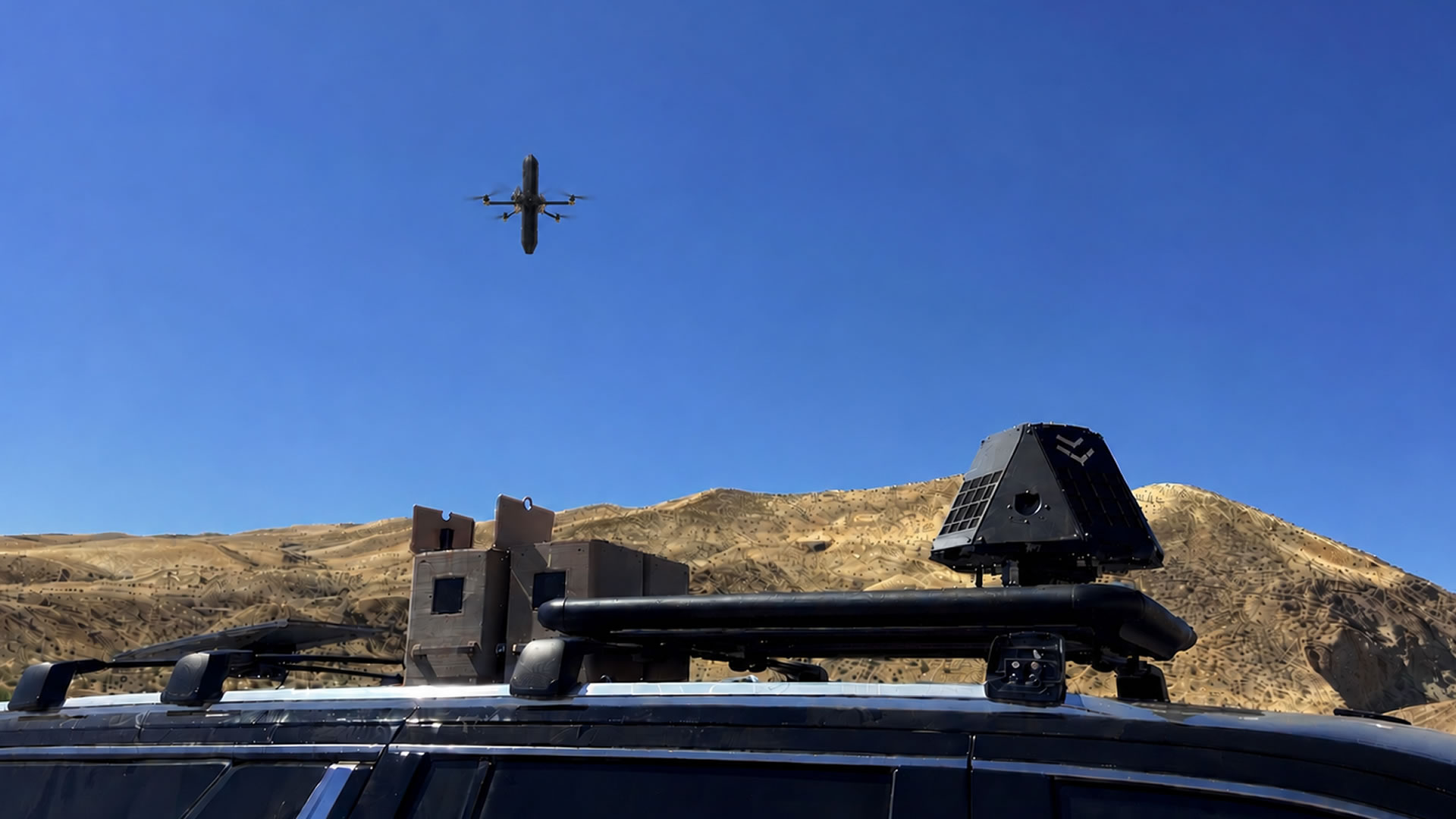
San Francisco-based Mara has secured $7 million in funding to help flesh out its proprietary counter-drone system called “Spike.” Specifically designed to counter drone swarms, the latest round of funding will help the company bring the technology to market. Spike, according to Mara, was born out of what it sees as one of the biggest problems on the modern battlefield: bringing down drones as cheaply as possible. The system can, therefore, be likened to a kind of miniature automated air-defense network for first-person-view (FPV) drones and alike. The problem at present is that an FPV drone is a relatively cheap piece of battlefield tech, typically costing around a few hundred dollars apiece. To stop one can cost many multiples of that when factoring in things like electronic warfare (EW) and interceptors like missiles. EW is also becomming less reliable as a defense with the growing trend of using fiber-optic cables or onboard autonomous navigation on the drones. Spike is, therefore, intended to provide close-in defense to take out drones when EW doesn’t work at a fraction of the cost of expensive conventional air defense systems. Killing FPV drones on a budget “Small drones changed the battlefield because they distributed the cost and capability of precise attack,” said Daniel Kofman, Co-Founder and CEO of Mara, in a press release. “Most defenses still concentrate both replacement cost and line of fire. Spike instead creates a distributed mesh of small, cheap nodes that can each aim and shoot in multiple directions at once,” he added. The system comprises two main components. The first, called the “spotter,” is effectively the eyes and brain. This includes cameras, microphones, and optionally radar, which watch the surrounding area in all directions. Artificial intelligence (AI) combines those sensor feeds, identifies likely drones, tracks them, and calculates where they’re going. The second, called the “seeker,” does the actual drone killing. Ostensibly resembling a spike (hence the name), this tiny 8.8-ounce (250-gram) interceptor is launched from a tube. It flies at around 124 mph (200 kph), steers itself toward the detected FPV and physically intercepts it. The system is not entirely automated, with human operators a critical part of the decision chain (called human on the loop). While not directly involved in controlling the system, humans give Spike rules of engagement all the while, supervising the entire system during operation. One of Spike’s key claimed advantages is its ability to engage multiple targets simultaneously using distributed launchers and interceptors. Conventional guns and directed-energy weapons generally have a single line of fire per weapon, meaning they must engage threats sequentially. A cheaper way to knock out swarms Spike can instead assign separate interceptors to multiple incoming drones at the same time. So, instead of needing to engage and kill each target in a chain, Spike can take out multiple drones at the same time. The system is also designed to be what is termed “attritable,” which means users can afford to sacrifice it if needed. As for the kinetic interceptor, it effectively acts like a miniature guided missile, or rather a smart bullet. It contains its own stabilization, navigation, and tracking hardware to “lock on” and engage a target in flight. As a kinetic interceptor, Seeker appears designed to physically strike its target rather than rely on a conventional air-defense warhead. Against a small quadcopter, damaging a propeller, motor, arm, or other critical component could be enough to bring it down. “Mara has moved rapidly from proof-of-concept to user testing for an autonomous system,” said Nicole Fraenkel, Partner at Khosla Ventures. “What caught my eye is that they’re building counter-drone autonomy with a system cost that’s orders of magnitude lower than anything else we’ve seen,” she added. Get the latest in engineering, tech, space & science - delivered daily to your inbox.Christopher graduated from Cardiff University in 2004 with a Masters Degree in Geology. Since then, he has worked exclusively within the Built Environment, Occupational Health and Safety and Environmental Consultancy industries. He is a qualified and accredited Energy Consultant, Green Deal Assessor and Practitioner member of IEMA. Chris’s main interests range from Science and Engineering, Military and Ancient History to Politics and Philosophy.
San Francisco firm that makes automated drone swarm killer system secures $7M funding
Full Article
Original Source
Read the full article at Interestingengineering →KhanList aggregates and links to publicly available news content. We do not host full articles from third-party sources. Always verify important information with original sources.