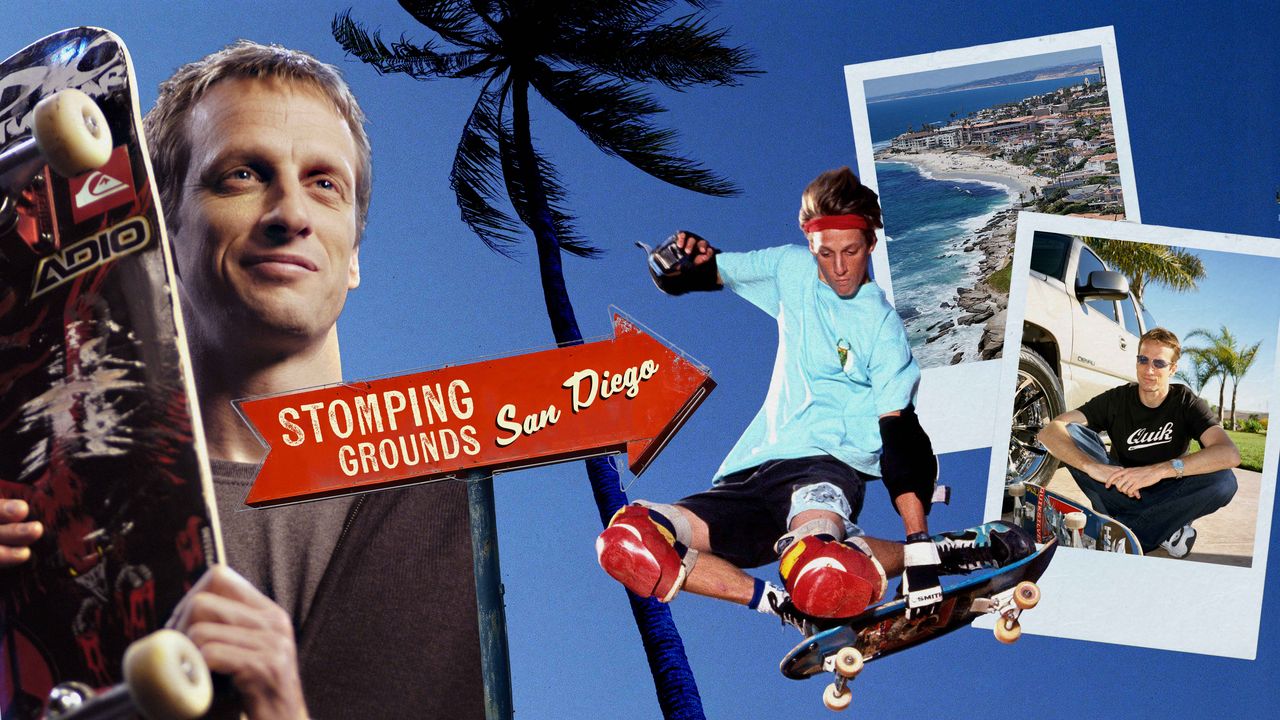
From his favorite bites to the essential skate parks, it's all too easy for Hawk.GettyTony Hawk, skate culture, and San Diego are the most inextricably, cosmically bound trifecta of all time. Hawk didn’t just rewrite the script of “vert” skateboarding (picture aerials from anything that goes horizontal to vertical: a half-pipe, ramp, or pool)—he wrote the textbook. The nearly 100 (documented) tricks that he’s invented aside, he’s also the first to execute, among a hefty list of other feats, the 900: a 900-degree mid-air rotation. That’s two-and-a-half fucking mid-air rotations on the half-pipe.Hawk’s a local legend around SD, also known for his own skateboard company, Birdhouse Skateboards and the gracing presence of some on-screen cameos here and there. Step into any millennial or Gen-Z bedroom, and you’re bound to find a copy of a Tony Hawk's Pro Skater video game that raised them. To top it all off, too, he’s just the coolest guy. San Diegan to the bone. So naturally, he knows the best spots and the best people around town—the local food scene being just one of the things he’s stoked on, hailing his new Encinitas staple, Chick & Hawk.True to the effortless charisma that defines him—and exactly what you’d expect from the humble maverick himself—Hawk skated around San Diego with Condé Nast Traveler, showing us his go-to spots and the places that made him. He spoke to us about witnessing skate culture evolve right before his eyes and how he channels that into his philanthropic projects dedicated to bringing skating to underdeveloped areas, notably The Skatepark Project. All of this, of course, bookended with the steez of a "stay classy, San Diego.” For Hawk, it's all too easy.La Jolla's beaches were a regular facet of Hawk's childhood. GettyTell me what it was like growing up in San DiegoI was born here, I was raised here, and I'm not leaving—if that validates how good San Diego is. I feel like it's the best place to live—the weather, the people, the opportunities.I grew up in Tierrasanta, but my parents moved to North County when I was a freshman in high school. Tierrasanta is a little town in the eastern part of San Diego that was mostly military housing, so a lot of Navy families were there. At the time, Tierrasanta was this sort of middle-income suburbia: we had a community park with a public pool for the neighborhood, a sort of clubhouse with a pool table, and mostly strip malls nearby. I would skate straight from middle school to Carl's Jr. and get a cheeseburger, fries, and a Coke for only $1.00. Most days though, I was just skating home as fast as I could so I could get a ride to the skate park and spend the rest of my day there.I also used to take the bus from Tierrasanta to PB (Pacific Beach) as a kid, which is insane thinking back on now because I was like 10 years old. La Jolla Shores is also an iconic spot, and going to Julian [a historic gold rush mountain town 60 miles northeast of San Diego] to go see the snow and get a pie. Julian was literally my first time in snow. Our usual field trip from my elementary school was to go to Balboa Park and/or the zoo, too. I remember the first time we saw the monkeys somewhat up close, I saw one reach his hand behind him, and I was like, "What is he doing?" All of a sudden, he whipped his poo at our whole class. I ducked in time, but it got a bunch of the girls in the front row.When I was in high school, my parents moved to North County, and I went to Torrey Pines High School. If I wasn't going straight to the skate park—and the swell was good—I would drive from school to home, grab my surfboard, and get in the water at Tamarack Beach in Carlsbad by like 4 o'clock. You constantly wanted another hour of daylight, so it was always a full panic after school to get there.Hawk does a backside ollie in the keyhole pool during the National Skateboarding Association competition at the Del Mar Skate Ranch, not far from San Diego, in August 1984. GettyYou mention Carmel Valley Skatepark as being one of your favorites today, but the now-defunct Del Mar Skate Ranch was a local haunt of yours growing up. What was the vibe like there on a typical day?Yeah, that became my home away from home. When it was first open, it was very bustling. It was exciting. There were all kinds of people there and all kinds of skill levels. I really sort of found my way and my style of skating there. I didn't realize it at the time (late 70’s, early 80’s), but skateboarding as a sport was starting to die in popularity. So, in my formative years, it was already kind of dead. The biggest sessions happening there were maybe 10 people at a time, but I didn't care. Like—I was hooked.Before I could even drive, I figured out which bus route from the school got me the closest to the skate park so I could take that bus there after school and be there until they closed. I was always testing new techniques and new moves. We were mostly skating pools, which is considered “vert” skating now. Del Mar Skate Ranch had a really good wall in this pool that was just perfect for learning maneuvers. I was always on this wall just testing things. I mean, that's where I learned to do the McTwist (a legendary 540-degree inverted aerial skateboard trick pioneered by Mike McGill in 1984, famously popularized by Hawk), where I learned how to do aerials properly and go super high, all of the sort of handplant variations, and a lot of different grinds. I mean, that park was the all-in-all for me. That was the proving ground. I can think of several days where I would go there and learn a new trick. I learned the fingerflip aerial, the first aerial where you flipped your board, there really quickly—like within a few tries—and then I went straight to Moonlight Beach and went surfing.Balboa Park in San Diego, California features heavily in Tony Hawk's Pro Skater video game. GettyThe fountain at Balboa Park is a popular spot for skateboarders to practice. GettyIn your Stomping Grounds video for us, you skate the fountain at Balboa Park. It’s a pretty legendary spot, one you feature in Tony Hawk's Pro Skater, a video game series so many newer-gen skaters grew up playing. Can you tell me more it?Oh, yeah! I think that might have been the first time I actually skated that fountain. It's so funny. When we chose to have San Diego as a city in the game, I wanted to obviously have iconic places like Balboa Park. And, I mean, I've been around. You know, I'm not like a hardcore street skater, but I did enough street skating in my day to know that the fountain is a spot. So we included it, obviously. But I guess the problematic element of Balboa Park that I didn't expect was that you could skate kind of… everything in the game… obviously. I got some pretty strongly worded letters from the people that worked at Balboa Park about how suddenly there was this surge of skaters coming in trying to skate everything for real, and they completely blamed the video game for that.When I was there skating the fountain for this, I saw there were a few people that recognized me, and they were like, "Wait a second. The guy with the game…with the fountain in the game. Like…am I seeing this for real?"Haha, it’s pretty iconic. Such a testament to how you've been an inherent part of skate culture in San Diego—everywhere really. How would you describe how much it’s changed in San Diego from when you first started skating as a kid?There’s a shift of attitude towards skating in general. When I was growing up, most kids’ parents didn’t want them skating. I used to have to hide my skateboard at school, because if I was seen with it, I would immediately get bullied or get it taken away from me. We had Del Mar Skate Ranch—that was the only park in California at one point, and in some ways, on all of the West Coast. Today, there are a ton of bigger parks with more variety in San Diego, like Linda Vista Skate Park, a few in Oceanside that are really solid like Prince Memorial Skatepark, and Alga Norte Skatepark in Carlsbad. To go from that to now, with several parks in most big towns, I think it just shows that it's come of age in the sense that parents are now encouraging their kids to skate. Cities are recognizing the value of skating and the staying power of skating—hopefully, the positive influences of skating on youth.You’re also such a great advocate for the sport, you founded the The Skatepark Project. Can you tell me more about that?I started the foundation in 2001 as a reaction to seeing that there was not much interest in skating all at once—especially in the late '90s and early 2000s—and a severe lack of facilities. Like, there were very, very, very few public places. There were some private facilities, but it was like, how could cities be in denial of this surge of interest? Then I started seeing some cities sort of figuring it out and developing skateparks, but they weren't involving the actual skaters in the design process, so the parks ended up being these terrible designs and really not fun to ride at all. I think it was through that I recognized maybe I have a voice that could affect change in this area and hopefully make cities recognize the need for skateboarding, but also to involve the skaters from the start. Most important, too, was to get funding and resources to more underserved areas where kids are at risk. In those days, it was a hard sell to pitch a skatepark to a city council, but eventually they would agree. They would see how much use it gets, and they would end up almost always building more.For sure. Just look at all the parks you’ve helped develop or rebuild right here in NYC—like Brower Park in Crown Heights, Allerton Park (Bronx Skate Park) in the Bronx, and the upcoming Mount Prospect Park project in Brooklyn.Yeah, and that just took the spark of finally getting a solid park in one of the five boroughs, then it spread like wildfire. Like, oh… kids love this place. They converge here. They feel safe here. I think people undervalue the importance of skateparks and how they can be a really great gathering place, a place to share ideas, a place of support. I mean, if you go to any skatepark right now, there are probably people there, and it's probably crowded. It’s going to be people from all walks of life: all ages, all genders, all races, all backgrounds, and even all skill levels. And there's just no other sports facility like that. You know, you're not going to go to a basketball court and see LeBron there. I just feel like skateboarding has a really unique space that it holds, and people love it because they can do it at their own pace, do it in their own style, but they'll still be part of this really great community at the end of the day.It’s really fulfilling seeing things like the X Games League, because I came from a time when skating was the furthest thing from cool. Now there's just such a supportive, eclectic community that skates, and it's not strange for anyone to be skating at all. It’s not strange to be a woman skating. It's not strange to be an old man skating. It’s just come around so far—how it should have been all along. The most fun thing for me is that I get to live vicariously through witnessing these skaters, but I also am still part of this culture and the scene.Inside Hawk's Chick & Hawk restaurant in Encinitas, skateboarding maintains a presence. Courtesy Chick and HawkThe blackened albacore sandwich from Chick & Hawk is topped with yuzu tartar sauce. Courtesy Chick and HawkWhat about your restaurant, Chick & Hawk, in Encinitas? How did you and Chef Andrew Bachelier bring that concept to life?During COVID, I was going to his restaurant (Atelier Manna in Leucadia) and getting takeout almost every day, so we got to know each other. Then we started talking about our love for food and what we would like to see in San Diego, and he and I both landed on hot chicken—like spicy chicken sandwiches—because it was still this kind of underground thing at the time. Now that there’s a groundswell of more interest, a few places have come and gone, but I feel like we have the magic recipes.Our spot in Encinitas has a lot of folklore to it. It’s an awesome spot. Our specialty is The Birdman sandwich—I order it with 720 sauce—but I feel like the dark horse menu item is The Seabird. It’s amazing…in fact, I just had one last night.You're friends with a lot of incredible chefs doing great things in San Diego right now. That includes Chef Brian Malarkey at Animae downtown, and Chef Claudette Zepeda, whom you partnered with on the restaurant Novecientos Grados at the San Diego International Airport. How did you first cross paths with them?When Chef Brian Malarkey said he was going to do a restaurant in Encinitas, I asked him about getting involved as an investor, just because I knew I'd be eating there a lot. When I went there, I realized… this is the best restaurant in San Diego for fine dining. Tara, the chef, is super cool. She has a really different perspective, a different style of cooking. She takes a lot from her Filipino roots; I really like her unique flavors.Chef Claudette Zepeda is a total renegade, super talented. She brings her Hispanic culture into her art, into her food. We met each other at an event near downtown that was sort of a one-off pop-up chef thing, and she was a dessert chef in it. We clicked instantly because we both grew up in the same era of San Diego and have similar tastes in music and our approach to life. I followed her career when she created her restaurant, Vaga, at Alila Marea Beach Resort. Then we got to do the restaurant at the airport together, and we just kind of threw our name in the hat. It was never some grand plan; it was more like, “Hey, that'd be fun. Let's say we're available to do that.”You’re a big traveler, so San Diego International Airport is a home to you, too, in a way. Whenever you get back to San Diego, what’s the one thing that makes you feel like you’re home again?Authentic Mexican food—and it’s tricky to pick just one. There's a place called Mexico Viejo, which I think is one of the most solid taco stands. Other than that, Pavlos Tacos in Encinitas, which used to be a place called Rico's. And I mean, as a San Diegan, I grew up on Roberto's Mexican Food, so I'm always kind of going there for the rolled tacos with guacamole and cheese.Bridget Knowles is an Associate Social Media Manager at Condé Nast Traveler. From San Diego, she’s lived and studied in Paris and London, earning a BA in Economics and an MBA. She’s either behind the phone filming you or talking your ear off. Often, both. ... Read MoreThe weather *is* always perfect here.
San Diego, According to Local Legend Tony Hawk
Full Article
Original Source
Read the full article at Cntraveler →KhanList aggregates and links to publicly available news content. We do not host full articles from third-party sources. Always verify important information with original sources.