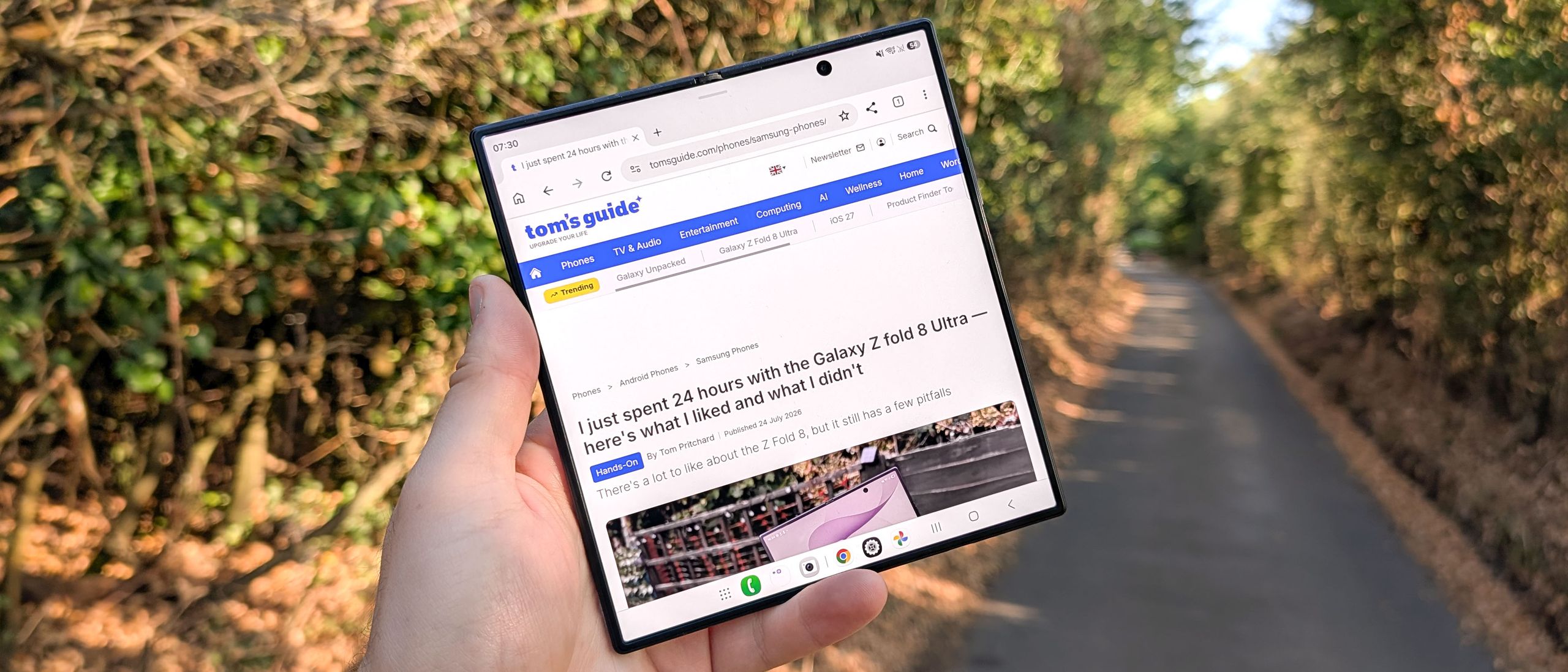
Tom's Guide Verdict The Samsung Galaxy Z Fold 8 Ultra offers one of the biggest upgrades we've seen out of Samsung for years, to the point where it feels as though real effort has been put into ensuring it lives up to the Ultra branding. Highlights include powerful performance, strong cameras, excellent battery life, and the multitude of screen upgrades. However, it doesn't change the fact there are a few aspects that let the phone down, least of which is the $100 price hike. Pros +Brighter, anti-reflective display +Excellent battery life +Strong cameras +Galaxy S26-tier performance +Helpful new AI features Cons -No S Pen -Awful telephoto camera quality -$100 price hike for the third year running Why you can trust Tom's Guide Our writers and editors spend hours analyzing and reviewing products, services, and apps to help find what's best for you. Find out more about how we test, analyze, and rate. Samsung Galaxy Z Fold 8 Ultra is the start of something new, in a way that's a lot closer to how Samsung's non-folding phones have been operating for the past several years. Foldables are going Ultra, and it feels like Samsung is trying to push the idea that this isn't just a simple rebranding — there are some real changes behind the scenes.There's more to new phones than adding flashier specs and bigger batteries, though, which is why I've been testing the Galaxy Z Fold 8 Ultra to see if it's really worthy of referring to itself as such. The good news is that this isn't just a boring incremental update with some new box art. The Z Fold 8 Ultra may share the same look as its predecessor, the Galaxy Z Fold 7, but it actually feels like one of the more noteworthy upgrades to come out of Samsung for quite a few years.Read on for our full Samsung Galaxy Z Fold 8 Ultra review.Latest Videos FromTom's GuideSamsung Galaxy Z fold 8 Ultra review: Cheat SheetWhat is it? The latest and best foldable to come out of Samsung, serving as a sequel to the Galaxy Z Fold 7 despite the addition of the Ultra branding.Who is it for? People who want the absolute best foldable experience possible, with the largest screen, and have the money to pay for itWhat does it cost? Prices start at $2,099 / £1,899 / AU$2,999 for a model with 256GB of storage and 12GB RAM. Release date is scheduled for August 7.What do we like? The Galaxy Z Fold 8 Ultra offers an incredible screen, that's brighter and less reflective than before, as well as powerful performance, good cameras, and the best battery life of any Galaxy foldable so far.What don't we like? Weak performance from the telephoto lens, the lack of S Pen stylus support, minimal design upgrades and the fact the price is $100 more than last year — marking the third consecutive Z Fold price hike.Samsung Galaxy Z Fold 8 Ultra review: Specifications Swipe to scroll horizontally Price From $2,099 / £1,899 / AU$2,999 Main display 8 inches AMOLED (2184 x 1968, 1-120Hz) Cover display 6.5 inches AMOLED (2520 x 1080, 1-120Hz) Chipset Snapdragon 8 Elite Gen 5 for Galaxy RAM 12GB (16GB for 1TB) Storage 256GB/512GB/1TB Rear cameras 200MP wide, 50MP ultra-wide, 10MP telephoto (3x optical) Cover camera 10MP Main display camera 10MP Charging 45W wired / 20W wireless Battery 5,000 mAh Dimensions 158.4 x 72.8 x 8.9 mm (6.24 x 2.87 x 0.35 inches) folded, 143.2 x 158.4 x 4.2 mm (5.64 x 6.24 x 0.16 inches) unfolded Weight 215 grams (7.5 ounces) IP Rating IP48 Colors Violet shadow, Cream, Graphite, Violet Green (online exclusive) Samsung Galaxy Z Fold 8 Ultra review: The UpsMajor battery life gains (Image credit: Future)Samsung's foldables haven't always been known for their strong battery life, even as the flagship Galaxy S series pushes up our best phone battery life page. This year sees that change, and it's no doubt thanks to the larger 5,000 mAh battery pack. Not only is that the same size as the battery in the Galaxy S26 Ultra, it's also 600 mAh larger than the one in the Z Fold 7. Swipe to scroll horizontally Row 0 - Cell 0 Hours : Minutes Charging % in 30 minutes Galaxy Z Fold 8 Ultra 14:33 76% Galaxy Z Fold 8 12:19 70% Galaxy 7 Fold 7 10:44 54% Motorola Razr Fold 14:44 73% Galaxy S26 Ultra 16:10 77% iPhone 17 Pro Max 17:54 64% During our custom battery life test, which involves web surfing over a 5G connection and setting the display to 150 nits of brightness, we recorded a battery life of 14 hours and 33 minutes. That's almost four hours more than the Z Fold 7 and more than two hours longer than the passport-shaped Galaxy Z Fold 8 and its 4,800 mAh battery.However, it's not quite enough to match the Galaxy S26 Ultra, which scored 16 hours and 10 minutes, or the 14 hours and 44 minute battery life we recorded on the Motorola Razr Fold.During my time with the Z Fold Ultra, the battery seemed fairly strong, and I regularly went to sleep without plugging the foldable in to recharge overnight because I knew it would still be alive and kicking the very next morning. The faster 45W charging meant that I could plug the Ultra in while getting ready, comfortable in the knowledge that it would recharge enough to get me through the day.Tom's Guide: Direct to Your InboxGet instant access to breaking news, the hottest reviews, great deals and helpful tips.Samsung promised that the Z Fold 8 Ultra could reclaim 67% battery after half an hour of charging, but we found the battery actually hit 76%. We're used to seeing recharge percentages differ from official figures by a percent or three, but it's rare that we see it go this far in the right direction.On top of this, if you're more inclined to wireless charging, the upgraded Qi2.2 wireless charging protocol offers up to 20W speeds. That's up from 15W, but it does lag behind the likes of Apple and Google, who have offered 25W Qi2.2 speeds.Major league performance (Image credit: Future)This year marks the first time that Samsung has used the custom "for Galaxy" chipset in a foldable phone. Normally Z Fold models are left with the standard flagship Snapdragon chip which, while no slouch, isn't as powerful as the Galaxy S-exclusive variant. This means that this year's benchmarking scores are a little higher than we initially anticipated. Swipe to scroll horizontally Row 0 - Cell 0 Geekbench (Single/Multicore) 3DMark Solar Bay Unlimited Geekbench AI Galaxy Z Fold Ultra 3,733/11,457 49.24/12,950 71715 Galaxy Z Fold 8 3,659/11,020 47.35/12,454 72242 Motorola Razr Fold 2.711/9,134 35.12/9,413 59663 Galaxy Z Fold 7 3,052/9,735 41.21/10,812 61299 Galaxy S26 Ultra 3,785 / 11,563 49.37 / 12,984 83047 (TensorFlow Lite QNN) iPhone 17 Pro Max 3,871 / 9,968 46.6 / 12,260 48549 (Quantitized Score ML/Neural Engine) Geekbench 6 benchmarking saw the Z Fold 8 Ultra's Snapdragon 8 Elite Gen 5 for Galaxy chip hit a score of 3,733 on single core testing and 11,457 on multi core tests . That's up from 3,052 and 9,735 on the Z Fold 7's Snapdragon 8 Elite chip.Graphics performance, scored using the 3DMark Solar Bay Unlimited test, also rose by a noticeable amount with a score of 12,950 and average frame rate of 49.24 fps. The Z Fold 7 only scores 10,812 and 41.21 fps. Meanwhile Geekbench AI scored 71,715 to the Z Fold 7's 61,299. The Ultra's figures also thrashed the Motorola Razr Fold, though they do trail the Galaxy S26 Ultra by a small amountThe performance improvements were noticeable to some extent too. Playing PUBG Mobile and I found that the Z Fold 8 Ultra could handle the highest graphics and performance settings without suffering any ill-effects. What's more the phone could run through a game without noticeably heating up, which suggests Samsung is putting that extra power to use in the right place.Even brighter and more reflective display (Image credit: Future)The minimized crease might be one of the main talking points for the Galaxy Z Fold 8 Ultra, but that's not the only upgrade Samsung has on offer. The Ultra now boasts an even brighter display, rated to output up to 3,000 nits of brightness, paired with a new anti-reflective coating. This means that the phone is supposed to be able to handle extremely bright conditions better than ever before.Our testing showed that the Z Fold 8 Ultra was able to hit a maximum of 2,687 nits, which is a little bit lower than Samsung promised, but is par the course for how these things tend to go. Crucially, though, this actually makes the Z Fold 8 Ultra the brightest phone we've ever tested, narrowly beating out the current title-holder the Google Pixel 10 Pro XL — which we measured at 2,555 nits.It's well ahead of the Z Fold 7's 2,245 nits, and leagues ahead of the 1,281 nit peak we recorded when testing the iPhone 17 Pro Max.Obviously big numbers are good, but they're worthless if they don't get put into practice. Thankfully the Z Fold 8 Ultra does put its money where its mouth is. We're currently experiencing an abnormally long period of clear skies and sunny weather here in the U.K., which is ideal for testing the capabilities of bright, anti-reflective screens.Not only am I able to use the Galaxy Z Fold 8 Ultra in direct sunlight without issue, the screen is bright and clear enough that I can still see exactly what I'm doing while wearing sunglasses. That wouldn't have been the case three or four years ago.(Mostly) great cameras (Image credit: Future)Seeing as how it includes the 200MP main camera lens from the S26 Ultra and Z Fold 7, alongside a new 50MP ultrawide angle camera, it's no surprise that the Galaxy Z Fold 8 Ultra takes some pretty great photos. Provided, of course, that you know which lens to utilize.The 200MP main lens really shines when compared to the iPhone 17 Pro Max — which is one of the best camera phones you can buy right now. While both phones manage to capture true to life colors in good quality, the Z Fold 8 Ultra seems to have picked up a clearer and sharper image than the iPhone. That's especially true if you zoom in a little bit and look at all the smaller details.Both phones seemed to take issue focusing on one of my dogs, though, and this is not the first time this has happened during camera testing. Once is an accident, but multiple instances of this make me wonder whether camera phones just hate my pooch.At first glance the ultrawide angle photography doesn't look all that different, but look closely and you can see how the Z Fold 8 Ultra is taking advantage of the various upgrades — the most prominent of which is the 50MP resolution bump. The details on the church are a lot sharper than on the Z Fold 7, and you can pick out the smaller details without them merging into a washed out jumble of barely-describable details.Close-up macro-style shots are similar, though both phones seemed to struggle to focus on the berries directly in front of it. However, I will say that in light of those focus issues, telling them apart isn't that easy.Low light photography has made some considerable improvements, with the Galaxy Z Fold 8 Ultra gaining access to the ProVisual engine and Advanced AP-based image processing — just like the Galaxy S26 Ultra. While the Z Fold 8 Ultra's low-light photos might look slightly darker than the Z Fold 7, they're capturing a heck of a lot more detail in the process.You get a much clearer view of the various details in almost every aspect of the photo. The patchy coloring on the church's brickwork is clearer, while the individual stone decorations are sharper and considerably less fuzzy on the Z Fold 8 Ultra. Even the leaves on the trees can be picked out, rather than forming a giant green mass.The iPhone 17 Pro Max definitely wins on the selfie front, and there's absolutely no contest. The Z Fold 8 Ultra's 10MP cameras just don't capture the same level of detail as Apple's front camera, and the lens-angle is a lot smaller so you end up capturing significantly less. Then again, both phones managed to hone in on the fact that I have a baby and haven't had anything like enough sleep in the nine months since he was born.Honestly, while the Ultra's selfie camera isn't terrible, it's also nothing to brag about. To the point where you're probably better off using the 200MP main camera to snap selfies with the help of the cover display viewfinder.When it comes to portrait mode, it feels like these are from two completely different points in time, rather than being snapped within seconds of each other. I'm not a fan of either photo, to be honest, but the iPhone 17 Pro Max still comes out ahead of the Z Fold 8 Ultra. It's a slightly clearer image, noticeably brighter, and captures a wider view of the world.I'm not impressed with the bokeh in either photo, to be honest, since both phones struggled to handle the fact my hair was being whipped around by the wind at the time.We haven't touched on the quality of the telephoto lens yet, but the truth is that the quality of those photos is so bad that I had to discuss them more in depth below.Helpful AI features (Image credit: Future)AI is a core part of the modern Galaxy experience, and the Z Fold 8 Ultra is no exception to this — though Samsung hasn't added as many features as you might have expected. The main one is the introduction of Now Nudge, a contextual AI tool that's capable of pulling up pieces of information whenever it feels you might need it — such as during phone calls or while browsing emails.The Z Fold 8 Ultra ups the ante by blending Now Nudge with multitasking. This means you can tap on your nudged prompts and open up the relevant apps in split-screen mode, and keep your existing window open. The addition of Ambient Nudge also makes the whole process a lot more subtle, surfacing those contextual prompts at the bottom of your screen rather than with an in-your-face notification.However my favorite new feature is MyFanCam, which takes your existing videos and lets you hone in on a single person and turn them into the main character. It works with all videos you've shot, even those not filmed on a Galaxy phone, and so far I haven't found a single video featuring human beings that it doesn't like.The same can't be said for animals, though, and I found that the AI refused to acknowledge that you may want to focus your video on them.Samsung Galaxy Z Fold 8 Ultra review: The DownsNo S Pen or magnets (Image credit: Future)The main issue I have with the Galaxy Z Fold 8 Ultra is that the design hasn't changed in any meaningful way since last year. It's not identical to the Z Fold 7, as I discovered when trying to use one of last year's cases on the Ultra model, but it's close enough that you wouldn't be able to tell without some well-calibrated measuring tools.This naturally means that the design choices people didn't like about the Galaxy Z Fold 7 have stuck around for another generation. My personal pet peeve is that the phone still doesn't offer magnetic wireless charging without a case, despite offering Qi2 technology. It's an issue exacerbated by the fact Samsung originally said it was avoiding Qi2 magnets because they interfered with the S Pen stylus.Though that excuse doesn't really hold weight considering the Z Fold 8 Ultra doesn't have S Pen support either. That controversial change happened last year because Samsung removed the crucial digitizer layer to reduce thickness. Samsung has confirmed that it is exploring alternative options, but that doesn't change the fact the stylus is a glaring absence from this phone.Using the Z Fold 8 Ultra and you can feel its absence. It feels like something is missing when you're using the large screen, and it's a void the stylus would have helped to fill.Awful telephoto performance (Image credit: Future)The Z Fold 8 Ultra's camera quality may be pretty good compared to its rivals, there's no denying the fact that the telephoto lens is not doing a good job. The 10MP telephoto lens pales in comparison to the other two cameras, and bumping the magnification up makes it look considerably worse.Even jumping up to 3x, the maximum level of optical zoom afforded by the lens, and you can see just how poor these photos actually are. Push it up even further and it feels like you might not have bothered taking the photos at all.These 3x pictures of berries growing near my house aren't terrible at first glance, but when you compare them to the 50MP telephoto lens on the Galaxy S26 Ultra and you can see that Samsung really dropped the ball with this particular bit of hardware.The 10x zoomed photos of a local cat are even worse, to the point where I'm starting to wonder whether it was worth trying to zoom in at all. Samsung really needs to do a lot better, because the weak telephoto performance is weighing the rest of the cameras down — which is far from ideal when you have the 200MP main lens.Another $100 price hike (Image credit: Future)The biggest issue that we can't ignore is the fact that Samsung has raised the price of its flagship foldable by $100 for the third consecutive year. This means that the starting price is now $2,099 for a Z Fold 8 Ultra with 256GB of storage and 12GB of RAM. That price rises to $2,299 for a 512GB model and $2,699 for a 1TB model with 16GB of RAM.It's no secret as to why this is happening. RAMageddon has pushed up the price of memory and storage to unprecedented levels, all while the overall cost of phone manufacturing has been rising over the past few years. A phone as difficult to mass produce as a foldable already commands a high price tag, but Samsung has clearly decided that the old prices still aren't high enough.So while the new "Ultra" designation does come with a bunch of great upgrades, it doesn't change the fact that you're paying out of your nose for them.Perhaps worst of all, Samsung isn't offering its usual "double storage" pre-order bonus this time, nor are there any other incentives to take advantage of. That means there isn't really a benefit to ordering early, unless you're absolutely desperate to get your hands on the Z Fold 8 Ultra as soon as possible.Samsung Galaxy Z fold 8 Ultra review: Verdict (Image credit: Future)It would have been really easy for Samsung to roll out the Galaxy Z Fold 8 Ultra with the usual weak-sauce upgrades, slap on the new name and call it a day. But that's not what's happened here, and while the phone may be imperfect, a lot of effort seems to have gone into making sure this is an upgrade worthy of the Ultra name.Battery and performance have made huge leaps forward, to the point where it doesn't feel as though Samsung is deliberately holding back and limiting the foldable's capabilities in comparison to its non-folding counterparts. There's still some catching up to do in this regard, but it's certainly a big step forward. Likewise the improvement in screen technology is a massive win for users, especially those that live in spots with a lot of sun.Of course there are a bunch of things Samsung should have anticipated would be a problem. Telephoto quality is appalling for a phone that costs this much, and the missing S Pen is still very noticeable. Worst of all is the increased price, which is just the latest in a long time of Galaxy price increases, and those basic flaws make it sting even harder.Overall the Z Fold 8 Ultra is a great addition to the Galaxy Foldable lineup, but that doesn't mean Samsung should get complacent and let the innovations stagnate ahead of 2027's inevitable Z Fold 9 Ultra. Tom is the Tom's Guide's UK Phones Editor, tackling the latest smartphone news and vocally expressing his opinions about upcoming features or changes. It's long way from his days as editor of Gizmodo UK, when pretty much everything was on the table. He’s usually found trying to squeeze another giant Lego set onto the shelf, draining very large cups of coffee, or complaining about how terrible his Smart TV is. You must confirm your public display name before commenting Please logout and then login again, you will then be prompted to enter your display name.
Samsung Galaxy Z Fold 8 Ultra review: A major leap forward
Full Article
Original Source
Read the full article at Tomsguide →KhanList aggregates and links to publicly available news content. We do not host full articles from third-party sources. Always verify important information with original sources.