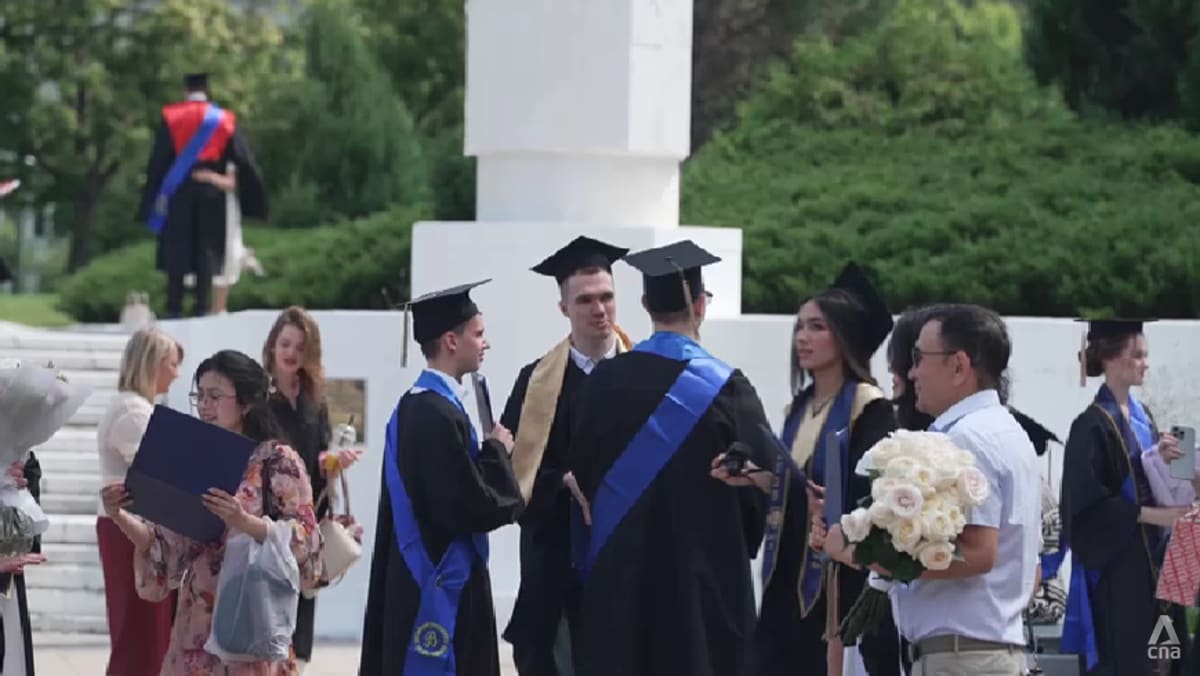
World Moscow aims to attract 500,000 international students by 2030 as it seeks to strengthen long-term partnerships with countries across Asia, Africa, the Middle East and South America. Students at RUDN University in Moscow. New: You can now listen to articles. This audio is generated by an AI tool. 31 Jul 2026 05:04PM MOSCOW: When Angelicha Malau was deciding where to pursue her university education, she had three options: Indonesia, China or Russia.The Indonesian student eventually chose Moscow, moving thousands of kilometres from home to study psychology at RUDN University.She said the opportunity to gain an international education while living and studying alongside people from around the world shaped her decision.“It will give me a new experience, especially international experience, and I will know a lot of new cultures and (meet) a lot of new people," she told CNA.Malau is among the international students Russia hopes to attract as its universities expand recruitment across Asia, Africa, the Middle East and South America. Indonesian student Angelicha Malau speaking to CNA. The effort comes as the war in Ukraine and Western sanctions continue to strain Russia's ties with the West, prompting the Kremlin to turn to higher education to strengthen long-term international partnerships.Russian President Vladimir Putin has set a target of attracting 500,000 international students by 2030, up from roughly 400,000 currently.RECRUITING BEYOND THE WESTThe shift is already visible at RUDN University, where Asia has become the institution's largest recruitment market.Around 4,500 students at the university are from Asia, with more than half from China alone.For many, Russia's political tensions with the West are outweighed by what they see as the benefits of an international education – particularly in medicine, engineering and information technology – at comparatively affordable tuition fees.Thai student Nop Laopanich said studying in Russia offered opportunities that would be difficult to find at home."I wanted to experience new things. That's why I decided to come to Russia. I learn something here that I may not learn in Thailand. Knowing Russian is very important to work with Russian companies."Laopanich added many Thai students still know little about educational opportunities in Russia, something universities are working to change. Thai student Nop Laopanich speaking to CNA. AN EFFECTIVE SOFT POWER TOOLOfficials say attracting international students is about more than boosting university enrolment."Internationalisation of education is also a way to enhance the country's image. And educating international students is an investment in long-term partnership-based relationships," said Marina Rekets, RUDN University’s vice-rector for international affairs.Analysts say education has long been one of Russia's most effective soft power tools, creating networks of graduates who later become business leaders, professionals and government officials in their home countries. Maria Prokofieva, political scientist and director of the Center for International Interaction and Cooperation, a Russian public diplomacy organisation, said the strategy serves both foreign policy and economic goals."There is interest in bringing highly qualified specialists to our labour market, but of course the goal of building bridges, of developing cooperation is here too,” she said.“Education, cooperation with young people who will define the future of those countries is vital for us, when people come to Russia, when they study here, when they discover (the) Russian soul, when they discover our culture, what our country really is." The Russian government offers about 30,000 state-funded scholarships each year to international students and has simplified enrolment procedures to make the country more attractive as a study destination.But competition for international students is intense.Western sanctions, along with weakened academic partnerships with universities in Europe and North America since the start of the Ukraine conflict, have cast doubt over the value of Russian degrees.Whether Russia can meet its international student target remains unclear, but its efforts underscore how education has become an increasingly important diplomatic tool.
Russia turns to higher education to build ties beyond the West
Full Article
Original Source
Read the full article at Channelnewsasia →KhanList aggregates and links to publicly available news content. We do not host full articles from third-party sources. Always verify important information with original sources.