
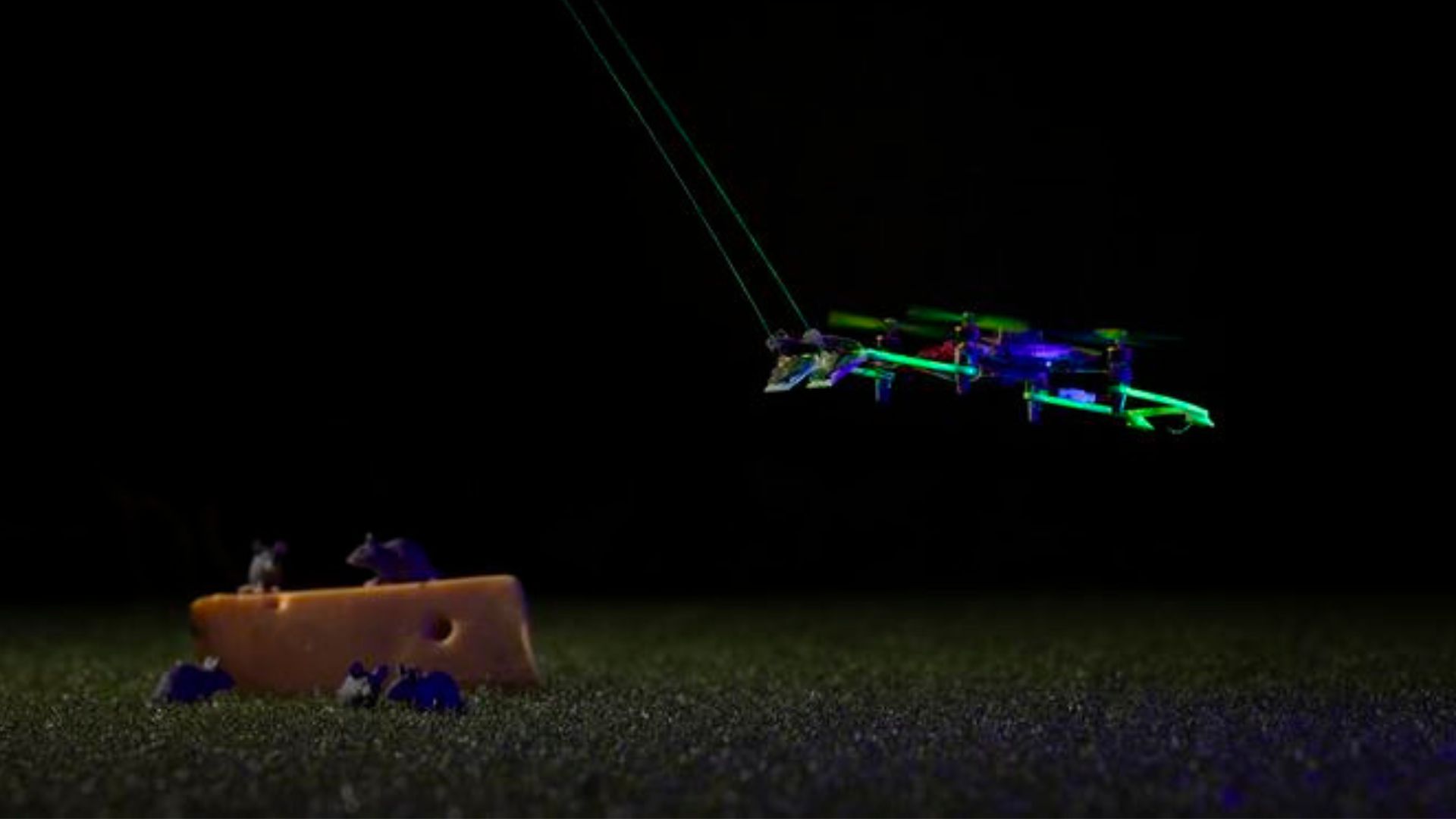
A new technology has solved one of robotics’ biggest issues: how to make tiny, ultralight drones navigate when they are essentially flying blind. Taking a direct cue from rodents scurrying through dark underground burrows, researchers developed a whisker-based tactile framework that lets drones feel their way through complex spaces. A pair of rodent-inspired artificial whiskers mounted at the front of a tiny drone provides real-time feedback as it touches its surroundings. This compact setup brings touch-based navigation directly to lightweight flying robots, replacing older systems with robotic arms or bumpers. “Here, we aim to equip drones with rich tactile sensing—not for manipulation in the air, but for a novel concept of tactile navigation: using touch to explore and fly through the unknown. Inspired by nature, we found the answer in whiskers,” explained Salua Hamaza, Associate Professor of Aerial Physical Interaction & Embodied Intelligence in Aerial Robots at Delft University of Technology, The Netherlands. The rise of whiskered drones Rats and mice rely on their whiskers (or vibrissae) as a high-precision tactile navigation system that replaces sight in the dark. Each whisker is packed with sensitive nerve endings at its base that detect tiny deflections, vibrations, and pressure changes when brushing against surfaces. Rodents can measure tight spaces, feel nearby walls, and map out their surroundings by quickly wiggling their whiskers. This lets them dash through cramped, pitch-black areas without bumping into things. Inspired by this natural technique, the development tackles a fundamental challenge in aerial robotics. Flying robots weighing under 100 grams simply cannot carry heavy LiDAR systems or energy-hungry processors. These micro-drones usually crash in low-visibility crisis zones where dust, smoke, or pitch darkness blinds cameras. Touch changes everything. Researchers created an active, real-time sensing system by mounting a pair of flexible artificial whiskers to the front of a drone. In particular, a fast, lightweight touch-sensing system was created that lets the drone navigate without relying on sight. Three miniature pressure sensors sit at the base of each whisker. When a whisker bends against a surface, these sensors measure tiny pressure shifts to calculate contact depth and location in three dimensions instantly. Cutting the noise The hardest part wasn’t sensing the walls, though. It was filtering out the drone itself. Propeller airflow creates a storm of noise, air distortion, and drift. To overcome this, the Delft team engineered a lightweight processing pipeline that runs onboard using a mere 34 kilobytes of memory. The algorithm continuously strips away the drone’s self-generated turbulence, leaving clean, millimeter-precision depth data. “We wanted to show that touch does not have to come at the cost of size or computational power,” said Chaoxiang Ye, Delft University of Technology. In flight tests, the tiny drone navigated pitch-black enclosures, mapped unknown room layouts, hugged surface contours, and located exits without a single visual cue. Swapping bulky eyes for agile whiskers makes autonomous search-and-rescue bots smaller, lighter, and smarter. In the future, these whisker-equipped micro-drones could offer advantages across several demanding fields. For instance, these machines could enter collapsed, smoke-choked buildings during earthquake or fire rescues where visual and thermal cameras become useless. Industrial operators can deploy them to inspect narrow pipelines, ventilation shafts, sewers, and underground mines for structural flaws. The technology also suits space exploration to navigate dark lunar craters and Martian lava tubes where sunlight cannot reach. The study was published in Nature Communications. Get the latest in engineering, tech, space & science - delivered daily to your inbox.Mrigakshi is a science journalist who enjoys writing about space exploration, biology, and technological innovations. Her work has been featured in well-known publications including Nature India, Supercluster, The Weather Channel and Astronomy magazine. If you have pitches in mind, please do not hesitate to email her.
Rodent-inspired whiskers help tiny drones navigate where cameras cannot see
Full Article
Original Source
Read the full article at Interestingengineering →KhanList aggregates and links to publicly available news content. We do not host full articles from third-party sources. Always verify important information with original sources.