
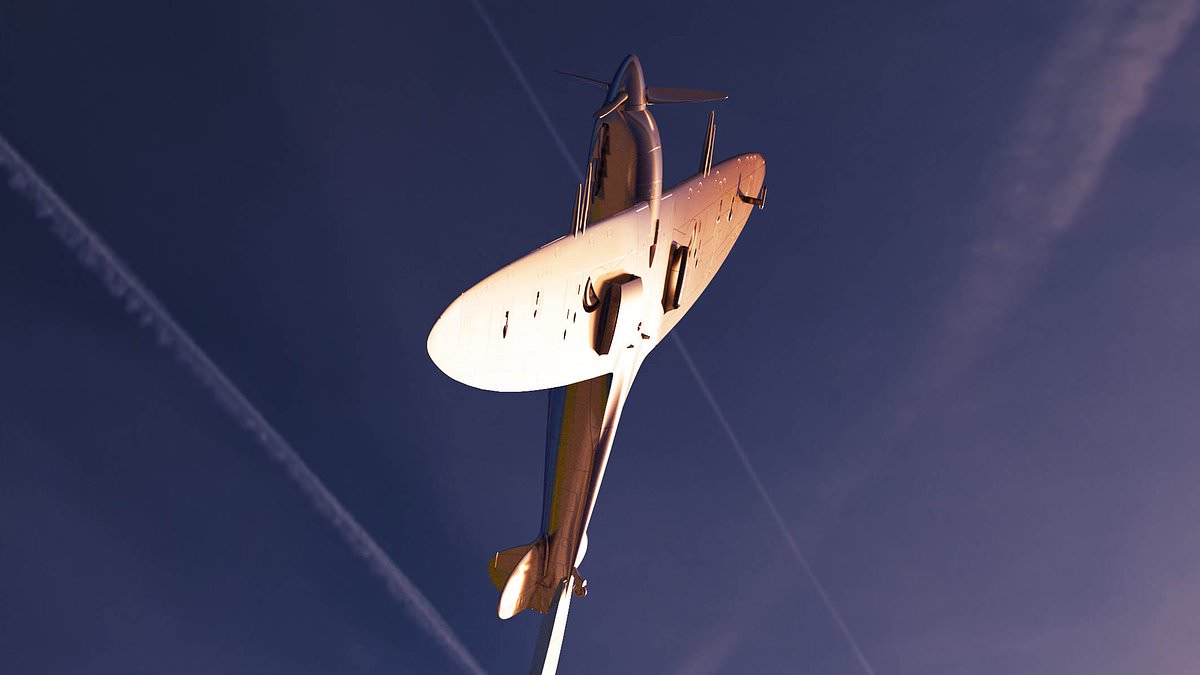
Visibility will not be an issue when it comes to this particular statue. At twice the height of the Angel of the North, this will not only be seen for miles around.It also seems entirely right that a monument to the greatest name in British aviation should be honoured where it belongs – in the air.Let no one accuse the city of Southampton of rushing things when it comes to erecting a national monument to the Spitfire. Indeed, next year will mark the 20th anniversary of the day that a determined band of south coast volunteers first met to get this thing off the ground – 131ft off the ground to be precise.Yet – with your help – we may finally be about to see movement on this glorious landmark.If the local authority finally approves the last permissions and a building licence at next month’s council meeting, then it will be a case of chocks away.And it’s safe to say that it will have been worth the wait.Just as Gateshead has its winged guardian looming over the A1 and London/Edinburgh mainline, so Southampton could soon be home to what will doubtless be christened the Saviour of the South.As a matter of fact, it’s not just double the Angel of the North. At a mere 20ft shorter than the Statue of Liberty, the National Spitfire Monument will be the largest stainless steel structure in the world. An artist’s impression of how the National Spitfire Monument in Southampton will look, which will be twice the height of the Angel of the North Robert Hardman and Royston Smith on the exact site in Mayflower Park where the National Spitfire Monument will be It was in 2007 that local worthies formed the original ‘Spitfire tribute panel’ with a view to creating the first proper national monument to Reginald Mitchell’s exalted invention. The location was obvious: Southampton.Though Mitchell was born near Stoke-on-Trent, he made his name as chief designer for Southampton-based Supermarine. It was here that his seaplane designs won the Schneider Trophy (the aviation World Cup of its day) three times in a row for Britain.It was here in Southampton that he drew up the team who would design the Spitfire. And it was here that he watched its maiden flight in March 1936, while stricken with the bowel cancer which would kill him the following year. It was in this city that Supermarine’s Woolston factory worked day and night to churn out this new breed of super-agile fighter with its trademark elliptical wing.More than 100 of those workers lost their lives in 1940 when the Luftwaffe sent fleets of bombers to smash the plant responsible for producing Britain’s devastating new weapon of war.Undaunted, the workforce then spread themselves across the region in smaller units, making Spitfires in garages, bus depots and even laundries – while further production continued in ‘shadow’ factories such as Castle Bromwich, Birmingham.Their combined efforts, together of course with the heroism of the young men who climbed into these aircraft, were a major contributing factor to the Allies’ eventual victory. At the start of the war, Britain had less than 400 operational Spitfires; by its end, more than 12,000 had taken to the skies, though thousands would not return.Such was its outstanding performance and versatility (from night fighting to photo reconnaissance and a naval version called the Seafire), that the Spitfire was the only fighter in continuous production before, during and after the war – from Mk 1 through to Mk 24.Of course, many aircraft played their part in securing victory, notably the Lancaster bomber and the Spitfire’s stablemate, the Hurricane. The latter was the workhorse for ‘the Few’ as they fought the Battle of Britain during those pivotal weeks in 1940 when Spitfire production was still catching up and this country stood on the brink of invasion.Yet, no other warplane would go on to evoke the same sense of ingenuity, grace, guts and sheer glamour. No other is still flying all over the world (with more than 100 Spitfires still airworthy). ‘It is the most iconic aeroplane ever created,’ says the aviation historian Paul Beaver, a trustee of the project. ‘It encapsulates a spirit of resistance and engineering prowess which has never been superseded.’ The Spitfire was Winston Churchill with wings. The last surviving member of ‘the Few’, Group Captain John Hemingway DFC, was singing the praises of the Spitfire in an interview with the Daily Mail shortly before his death last yearFor all these reasons and more, a national monument is long overdue. And we are now tantalisingly close to seeing it move from the drawing board to the water’s edge here at Mayflower Park overlooking Southampton Water. It’s the perfect spot.To the right is the mighty cruise ship terminal which brings three million in and out every year. To the left is The Solent and the ferry terminals for the Isle of Wight. A further one million people will see the thing each year as they fly in and out of Southampton Airport, where the Spitfire was born.A huge circular base, modelled on an RAF roundel, will jut out from the sea wall.High overhead will be Nick Hancock’s gleaming stainless steel model of a Spitfire, one and a half times the size of the real thing, supported by a vast curving stainless steel vapour trail.What is urgently needed now is the green light from the council after years of bureaucratic foot-dragging. The memorial is still waiting for councillors to approve long-needed repairs to the revetment (sea wall), even though the monument will save the council £1 million by paying for the stretch of the wall where the base will go.All now finally appears to have been resolved, though the years of delay mean that inflation has cranked up the construction costs. The trustees of the National Spitfire Project now need a further £1.5 million as a result, so we must all play our part.The computer images certainly look awesome, though they also beg the question: will this thing not blow over in a storm? ‘Don’t worry. We’ve put it through everything,’ says Royston Smith, vice-chairman of the trustees, pointing out that the monument has been subjected to the same checks by the Canadian wind-testing laboratory which approved Dubai’s Burj Khalifa, the world’s tallest building.The Spitfire monument will be tall – but not that tall.Mr Smith is a former leader of Southampton City Council who went on to spend nine years as Tory MP for Southampton Itchen.During that time he secured a Commons debate on the need for the memorial and persuaded the (Southampton-born) Chancellor of the Exchequer, Rishi Sunak, to provide £3 million of funding to match £3 million from local companies, foundations and well-wishers.A former RAF flight engineer (with a George Medal for disarming a gunman during a fatal shooting), Mr Smith believes that the monument will not only raise the profile of the city. More importantly, it will help to remind future generations of the sacrifices of the wartime generation.‘The boys who flew those Spitfire were so young, some of them just 18. And they did it day after day, just like the people of Southampton who kept on producing those aircraft.’The monument will also honour the 30 nationalities who flew the Spitfire, from Poles and Indians to Arthur Weeks from Barbados and ‘Spitfire Paddy’ Finucane, the Irishman who became the RAF’s youngest Wing Commander at just 21 (and a triple winner of the DFC). The last surviving member of ‘the Few’, Group Captain John Hemingway DFC, was also Irish. He was singing the praises of the Spitfire in an interview with the Daily Mail shortly before his death last year.This project has the support of the vast majority of a city which is immensely proud of its Spitfire heritage. Roads are named after both the plane and RJ Mitchell.Eastleigh FC, ‘the Spitfires’, play next door to what was RAF Eastleigh – scene of that maiden flight – until it became Southampton Airport. There the main approach is surmounted by a three-quarter size Spitfire above a roundabout.Rather delightfully, this is sponsored by the adjacent car dealership – Mercedes-Benz – who just happened to make the engines for its arch-rival the Messerschmitt Me-109. This weekend, the city is even opening a new indoor laser-tag complex called Battle of Britain Dodgems.At a time when young people think it acceptable to desecrate London’s Battle of Britain Memorial – as pro-Palestinian yobs did last weekend – it seems all the more important to remind future generations that such freedom can never be taken for granted.That’s why Southampton City Council can dither no longer while the rest of us give what we can – and prepare for take-off.To donate: justgiving.com/charity/nationalspitfireproject
ROBERT HARDMAN: Your chance to commemorate the mighty little plane that saved Britain
Full Article
Original Source
Read the full article at Dailymail →KhanList aggregates and links to publicly available news content. We do not host full articles from third-party sources. Always verify important information with original sources.