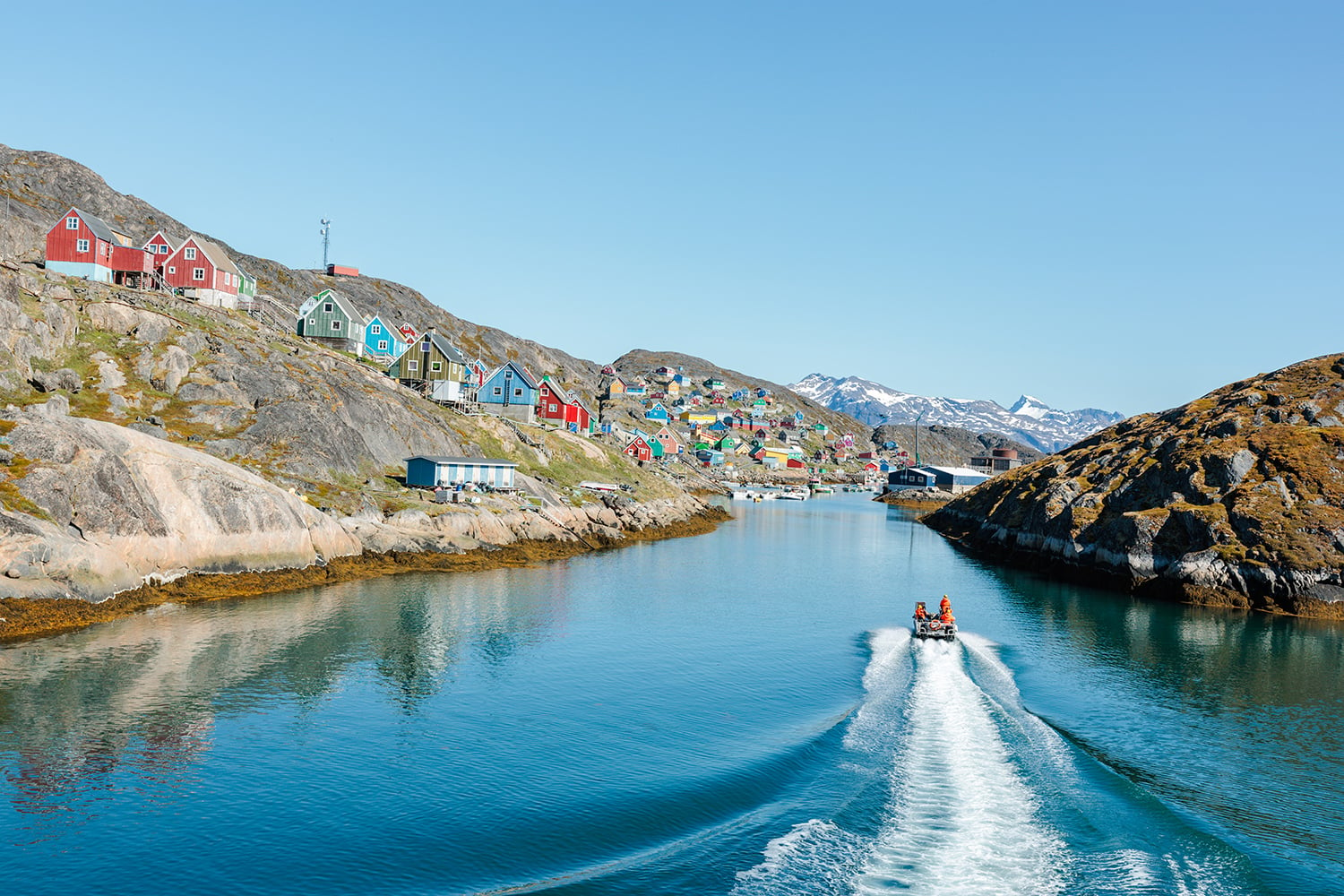
“Watch a grey spot. Don’t look away. … Always look at each spot for five seconds. When they stop, they look like a stone.” I’m on the deck of the ferry M/S Sarfaq Ittuk, steaming south along Greenland’s western shore, and Qulutannguaq Hammeken is teaching his 12-year-old daughter, Beathe, (and now me too), how to spot a reindeer. Hammeken is traveling south for the summer, and his conversation is full of hopes about the things he wants his daughter to learn now that the city of Nuuk is behind us: “All that experience I have, I want to show her [how] to travel in the landscape in the old ways.” A woman and a young child lean against the red and white railing of a ferry deck, looking out over the water toward distant, hazy snow-capped mountains. Ferry passengers scan the shoreline south of Nuuk on June 30. I’m here to find out what Greenlanders think as their country comes under extraordinary and unprecedented geopolitical pressure. What many tell me, in different forms over the course of this voyage, is that the choice between Denmark or the United States or independence is ultimately secondary. More important, they insist, is that they be understood and treated as equals in any discussion about their island’s future. Qulutannguaq and Beathe see two reindeer on the shore. Despite their careful pointing, I see only the stones. Departure: Nuuk A gray naval ship sails through open water between rocky, low-lying islands under an overcast, cloudy sky. HDMS Hvidbjørnen ( known as the Polar Bear), one of the Danish Navy’s four Thetis-class ocean patrol frigates, off the coast of Nuuk on July 2. It is June 29 when I arrive in Nuuk. The harbor still busy after midnight and the sky still light. I walk downhill past the buildings of the Danish military’s Arctic Command. Fishermen are coming in off the sea, silent in their bright waterproofs. A Danish arctic patrol boat is pulling out, one lone gun on the foredeck. A four-panel grid showing architectural, harbor, and coastal scenes, including a modern multi-story dark building, framed portraits reflected in a window, fishing boats docked against a steep cliff, and a blue building with an outdoor wooden staircase. Clockwise from top left: The building housing the new unmarked U.S. Consulate; portraits of members of the Trump administration reflected in its window; the headquarters of the Danish military’s Arctic Command; and fishing boats in the harbor, all in Nuuk in late June and early July. The city feels thrown together along a low peninsula of granite and moss. There are rows of colorful houses, many still adhering to the colonial-era color coding schema: yellow for doctors, red for teachers and priests, green for tradespeople, blue for fishermen, black for police. There are also long, 1960s apartment blocks, and, incongruously, a handful of taller modern buildings, including one housing the new U.S. Consulate. The building is painted grey and black, and behind one dark window, U.S. President Donald Trump’s portrait hangs on the wall. When we board the ferry early the next morning, the quay is crowded. The efficient rhythm of departure is only interrupted when a car arrives late, and we lower the gangway again to let it on board. People complain to me about Nuuk: The city is changing; it is getting too big and too impersonal. At moments like these, though, it still feels to me like a village. First leg: Nuuk to Qeqertarsuatsiaat An man wearing glasses and a brown hooded jacket looks out a large window while seated inside a ferry cabin. Soren Svenningsen rides the ferry on June 30. Soren Svenningsen leans on the rail as the grey hills slip past and the seaway begins to build. The ship rolls in the waves beneath our feet. In his younger years, Svenningsen braved the seas in his own boat. Retired now, he is riding the ferry again, like he did as a boy. “The sea train,” he calls it, recollecting voyages from his childhood. In the 1960s, they’d sit in the canteen watching John Wayne films, while the Labrador Sea raged outside across the deck. It does feel like a train. The boat runs up and down this coastline like clockwork in a 12-day loop, carrying passengers and mail and bits of cargo all year, except January. There aren’t any roads between cities or towns in Greenland, so for many places, the ferry is their only all-weather link to the outside world. A red and white passenger vessel docks near a rocky shore lined with green and pastel-colored houses under a pale sky. Passengers look toward shore as the ferry ties up at the dock in Qeqertarsuatsiaat on June 30. The ferry is like “an old lady,” Mikkel Burmeister, the chief engineer, tells me. “You have to attend to her quirks.” Except in the worst of weather, she almost always runs on time. “Everyone’s got a history with the ship,” says Anna Lynge. She is sitting in the canteen with her husband, whom she met in the north after taking the ferry there on holiday four decades ago. The couple, recently retired, are now moving house, traveling south by ferry from Sisimiut to Qaqortoq, where her family still lives. We arrive at Qeqertarsuatsiaat in the evening. On the dock, a man has set up a little folding table and is selling rubies to the crowd. Like most of Greenland’s small towns, Qeqertarsuatsiaat has been hollowed out, emptied by the same demographic forces affecting small towns everywhere. And despite their shiny promise, the rubies on the dock don’t promise the mining bonanza that many in Washington fantasize about. “If there were a huge swath of valuable minerals,” says Jon Rahbek-Clemmensen, an associate professor at the Royal Danish Defence College, “the Greenlanders would be mining them.” Ulrik Pram Gad, a senior researcher at the Danish Institute for International Studies, is blunter, calling talk of huge mining potential here still mostly “pie in the sky,” the dream of a MAGA-aligned “Greenland industrial complex.” A two-panel image showing a group of people gathered around a small outdoor table, next to a close-up of colorful raw gemstones and minerals arranged on a wooden surface. Ruby sellers and their wares at the dock at Qeqertarsuatsiaat on June 30. Either way, I leave the dock without any rubies. Second leg: Qeqertarsuatsiaat to Qaqortoq A person stands on a rocky hilltop taking a photograph of two people seated together nearby, set against a clear blue sky during late afternoon light. A group of Filipinos takes photos as the sun sets above Qaqortoq on July 2. I find Henrik Holm and Esther Kjaer, a young couple, smoking in the lee of the ship. They’re going to Qaqortoq to see Holm’s family, and we talk about student life in Nuuk: scraping by, working in a convenience store alongside some of the thousands of Filipinos who have begun to appear in Greenland in recent years. “I’m proud of them, they’re learning” Greenlandic, says Kjaer. Language is a sensitive topic for her. She speaks about her own childhood and years spent with her Danish father in Denmark where, as she tells me, “I lost my Greenlandic speech and culture. I don’t want to lose it again.” For many younger Greenlanders, English, picked up online, now comes more easily than Danish. As Beathe told me simply, “I prefer speaking English because of the songs.” Holm says his English comes mostly from action films and “by playing online games.” Their attitude to the United States is mixed as a result. “Denmark is not perfect but America is worse,” says Kjaer. But, Holm adds, “I still want to visit it one day.” An old, weather-worn white and teal boat rests on a gravel shore on a foggy day, with a small iceberg visible in the calm water in the background. The shoreline in Qaqortoq, seen on July 2, is scattered with fishing equipment and boats that have seen better days. As we speak, the ship glides through the gloaming into Paamiut, past the wreck of a rusted-out trawler dashed on the rocks. Like the icebergs that keep heaving into view, it is a reminder, despite the calm evening, of how savage this landscape can be. Holm smiles at the view. “The farther away from Nuuk you get, the more Greenland it gets,” he says. The next day, we make an early morning stop in Arsuk, a town so small we idle offshore while a dinghy goes in to drop off and pick up passengers. In Qaqortoq that afternoon, I sit down with Freddy Christensen. He runs a music studio and cafe in one of the oldest buildings in the town. It’s just a few yards down from a bright wooden church with a monument outside to Hans Egede, the controversial missionary who founded Nuuk and established missions among the Inuit. Christensen worries that, for the younger generation, “There’s something wrong.” Too many people drop out of school and don’t find steady work. “There will always be some who can’t continue, but the number is too high.” He looks at me, sighing, as he says, “a lot get lost.” A close-up view of a massive white glacier edge meeting deep turquoise and navy water. Icebergs, like this one off Qaqortoq on July 1, are a constant danger to shipping, particularly the “growlers” that lurk just below the surface. A two-panel image showing a red wooden church with arched windows on the left, and a view of an iceberg in open water framed by a boat window on the right. Left: A monument to Hans Egede in Qaqortoq on July 1. Monuments to the Danish missionary have been sites of protest in both Greenland and Denmark in recent years. Right: An iceberg through a ferry porthole on July 1. Niklas Hansen disembarked from the ferry with me after a few weeks away on a mine drilling course. He is hopeful this will help him to find a job in the south. He wants to stay in the south but says, “Since I was a kid, those small towns have been getting less people every year.” I ask what he thought of Kvanefjeld, the nearby uranium mine proposal outside Narsaq that was scrapped after it became a national election issue. Despite his interest in mining, he also opposed it, given the perceived environmental risks of the mine. “Those who have been born and raised in Narsaq, they’re gonna lose it all. There will be no more Narsaq” if the mine opens, he says. A view from a ship's deck showing passengers looking toward a red building on shore with "ROYAL ARCTIC" printed on its side, while one person in the foreground raises a hand. Passengers disembark in Qaqortoq on July 1. I lose sight of him in the crowd on the quay. Sometimes it feels like the whole town comes down to meet the ferry each time we dock, as if everyone knows everyone and they’ve all come out for a chat. It’s a festive atmosphere; fireworks explode, implausibly, in the still-bright sky. Third leg: Ilulissat to Sisimiut A fluffy white sled dog lies on top of a wooden doghouse on a sunny day in a grassy, rocky landscape. Dog sleds are still an important method of transportation during the Greenlandic winter. Here, a sled dog rests atop a shed in Ilulissat on July 5. From Qaqortoq, I fly north to Ilulissat to rejoin the ferry there and complete its whole southbound track. It’s an unplanned lesson in how vital the ferry is in a country of small planes and terrible weather. Despite brand new airports in Nuuk, Qaqortoq, and Ilulissat backed by Danish and Nordic financing—the funds appeared suddenly after China made an offer—it takes me three attempts over two days to get north. Repeatedly, the weather proves too bad for us to land. As the plane circles back to Qaqortoq again, I yearn for the ship’s slow and steady pace. As I finally sail out of Ilulissat, I understand why an ice hardened vessel is necessary even in high summer. We crack and nudge our way through the tightly packed icebergs of Disko Bay. Seabirds wheel in the fog and perch in flocks on the ice. Colorful wooden houses sit along a grassy slope overlooking a body of water filled with floating icebergs under a clear blue sky. Houses in view of the ice fjord off Ilulissat on July 5. I sit with Dorthe Ivalo on the deck, wrapped up against the weather. She is heading home to Sisimiut after visiting one of her daughters in the north. We sit mostly in silence, a silence I’ve learned to value here. “In other countries, they get embarrassed when there is silence. In Danish, you can’t say anything with silence,” she says. “In Greenlandic, [with silence] you can say everything. … We are used to waiting. For the fog to lift. For the storm. For the sun to rise in spring. For the reindeer to show up. For your neighbor to say something.” So together, we wait and watch as the ice cracks around us. A three-panel grid featuring a large blue iceberg floating in open water at the top, a bird flying past an ice cliff on the bottom left, and a woman looking out from a ship railing on the bottom right. Top and lower left: Icebergs dot the water and a seabird coasts above the ice near Ilulissat in early July. Lower right: Dorthe Ivalo on the deck of the ferry on July 6. Back in Qaqortoq, Christensen had explained that the silence “comes from living in small settlements in winter. You need to stay silent to keep the peace. If you disagree, what are you going to do? You can’t leave.” It’s a point of tension with outsiders too. “When Danes talk, they talk so loudly,” Kjaer told me. “We can’t hear others speak.” In between the silence are often stories. Ida and Laila Magnussen, a mother and daughter who both work as teachers, explain to me that these stories teach survival and community harmony: “When you go out alone in the ice, bad things happen,” for example. As Laila Magnussen says, “They don’t tell you directly, but they make you get scared.” Ivalo tells me a newer story about Trump. After one of his tweets, the Greenlandic government responded by suggesting that everyone stockpile five days of supplies. She laughed, she says, because in Greenland, “We are prepared all the time. I went to the store because others were going. But I didn’t need anything. We are always prepared.” Her story made me laugh too, but it also made me think about something that people told me over and over: Outsiders—both Danish and American—don’t understand us. Fourth leg: Sisimiut to Nuuk People gather on the bright red deck of a white ship, with one person playing a guitar while sitting near others on wooden chairs, surrounded by dark mountains and blue ocean water under a sunny sky. Passengers stage an impromptu concert on the ferry deck on July 6. Nivi Rosing is Greenland’s youngest MP, a member of the left-wing, pro-independence Inuit Ataqatigiit party. She is heading south to attend the 50th annual Aasivik Festival, a youth gathering held in Narsaq. We sit together as an Inuit woman sings on the deck and plays the guitar. Greenlanders are caught between the extremes, Rosing tells me, either romanticized or disparaged in the Danish media. In reality, she says, “We’re just people.” For her, the whole geopolitical question of independence vs. Denmark vs. the United States is less important than the point that, whatever happens, “It should be Inuit who decide.” As Ivalo tells me, the Danes “aren’t interested in us. If they knew something about us, they would also know what they did to us. So they ignore us and the history. … If they did know, they would be ashamed and embarrassed.” Two people sitting on wooden deck chairs outside on a ship, bundled in warm jackets and blankets, laughing together against a cloudy sky and open sea. Henrik Nielsen and Kristine Juul, Danes based in Ilulissat, wrap up against the cold as they travel south on holiday on June 30. Henrik Nielsen, a civil servant, and Kristine Juul, an academic, are Danes. Based in Ilulissat, they are traveling south for a camping holiday. We sit on wooden chairs on the stern, legs in sleeping bags to keep out the chill. Illuminated by the weak sunlight, with the wind blowing off the sea, I ask what they have learned living here. The common Danish understanding, Nielsen says, is that the country’s policy “hasn’t always been successful but it’s been well intended. But you can question if it was really well intended. Danes are very self-centered. We think of ourselves as a very just society.” “The Kingdom of Denmark as being larger than just Denmark isn’t well understood,” Juul adds. “Danes don’t understand how little Danish TV mentions Greenland.” In other words, they understand us, but we don’t understand them. Greenlanders see this lack of understanding in the suggestion, voiced by some Danes, that they should move on from the past, that they should stop dwelling on the cases of forced contraception and forced adoptions that are part of the legacy of colonial rule. This misunderstands the role of oral tradition, Ivalo says, in which the past is as current as the person telling it. According to the island’s kinship and naming traditions, the dead are understood to recur in the living people who carry their names. Only outsiders who fail to appreciate this, she suggests, would expect Greenlanders to move on. A young boy puts his hand in his mouth and an older man s behintandsd him look out from the deck of a boat toward a blue ocean and distant mountains. Passengers walk the deck of the ferry on July 6. The Americans don’t come off any better, though. Anas Hjelm, the chief purser onboard, rushes to tell me this. We’re just crossing the Arctic Circle as he arrives. I’m leaning against the cabin walls to steady myself against the ship’s slow roll, straining to see some sign that things are different across the Arctic line. “In Greenland, you don’t own land,” Hjelm says. “The land belongs to the people. Even the name of the country in Greenlandic means ‘land of the people.’” For Hjelm, when Americans come and say, “We will buy their land,” it shows how little they know. In Rahbek-Clemmensen’s words, Greenlanders “may not be interested in world politics, but world politics is interested in [them].” For many Greenlanders I speak to, the only potential benefit from this attention is that perhaps the world will come to understand them a little better. As Christensen tells me, “Denmark slept for 50 years. Trump was a wake-up call.” This is echoed by Juul, the Danish academic, who’s keeping one eye out for the humpbacks that blow every so often. “Trump brought Greenland and Denmark closer together. Danes thought we were the best colonizers. We didn’t understand why Greenland wanted to be independent.” Biinia Abelsen, a hunter loading seal meat into his uncle’s boat in Qaqortoq, tells me, “I don’t want the golden dome or whatever Trump wants to do, but he did help more people to hear about Greenland.” A view from the walkway of a ship, featuring an orange lifeboat hanging overhead, looking out over calm water toward distant, hazy mountain peaks under a morning sky. The ferry approaches Nuuk in the early morning on July 7. Again and again, people tell me that they want independence but “not yet.” For now, they are scared of what might happen next. Independence should come “when we are ready,” Christensen says. “I have two young kids. I’d like to see it before I die.” Nuuk harbor appears again through the porthole, a week after I first left it, glowing golden in the early morning light. I think back to Beathe Hammeken, scanning the shore with her father. “I don’t like Trump. All he thinks about is money,” she said. “Every single eye movement is looking for money. I look for reindeer.”
Riding the Greenland Ferry
Full Article
Original Source
Read the full article at Foreignpolicy →KhanList aggregates and links to publicly available news content. We do not host full articles from third-party sources. Always verify important information with original sources.