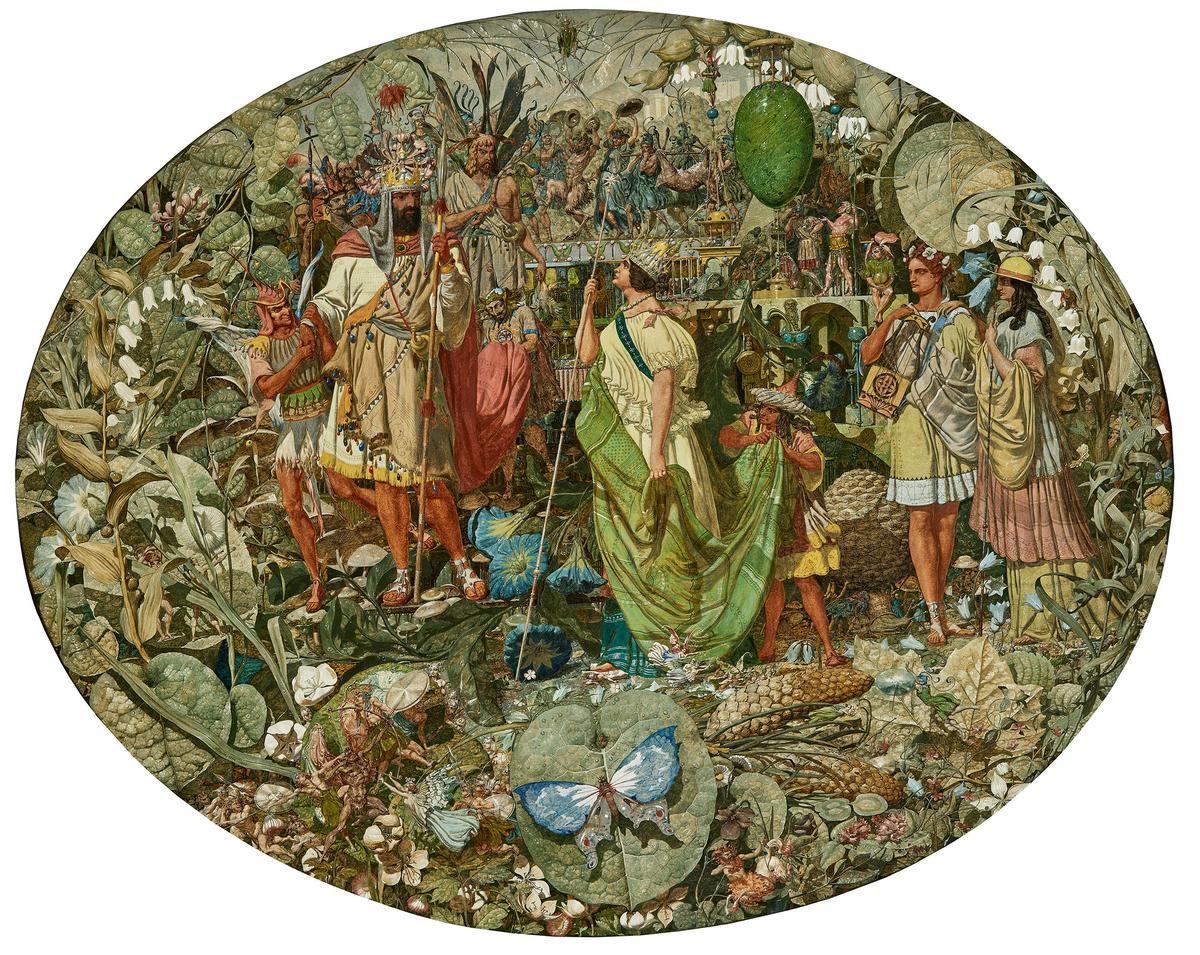
Is there a weirder modern painting than Richard Dadd’s The Fairy Feller’s Master-Stroke? There’s the hypnotic swirl of the structure — dotted with daisies — behind a barricade of stems. There’s the preposterous miniaturisation of the fairy world, for the action centres on the cracking of a hazelnut to make a carriage for the fairy Queen Mab. There is the scattering of monstrosities among the little folk — the couple with heads squashed into their necks; the strange old man under the earthen ledge surveying the scene; the even tinier folk in the earth layer above him and the pathetic chap with a white beard staring into the distance like a lunatic, which is apt enough since it was done in an asylum. The peculiar perspective, the hallucinatory detail, the swirling composition make the thing unforgettable.That’s Dadd for you. Mad as a hatter, but quite possibly a genius. Alexander Pope’s observation about great wits being to madness near allied is borne out in Dadd. He stabbed his father to death in Cobham Park to liberate the Egyptian god Osiris in 1843 (he told the stars, “Go tell the great god Osiris I have done the deed which is to set him free”), and spent the next 40 years in asylums, first Bedlam then Broadmoor, where his painting, if not his career, continued.Portrait of Richard Dadd, Henry Hering c. 1857Bethlem Museum of the Mind. Alex Fox (Roy Fox Fine Art Photography)Fairies and fantasyThis compelling exhibition at the Royal Academy, where Dadd was once a star pupil in the 1830s, is the first since the 1970s, and is overdue. We’re now sympathetic to mental illness and alive to the possibilities of the neurodivergent outlook. Dadd was a schizophrenic. As an essay in the exhibition catalogue points out, chlorpromazine, an anti-psychotic drug, would nowadays have sorted out the worst of his condition. The paintings here record a patently gifted young artist at the Royal Academy, a member of the Clique, a little group who painted each other and scenes from literature and history. His fairy pictures predate his incarceration and attracted attention at a time when the genre was hugely popular. It was a licence for nudity — for where is the harm in fairies dancing naked? — and for the kind of highly charged fantasy which was evident in contemporary literature. So we see Dadd’s weird Puck, sitting on a mushroom, bathed in an uncanny light with figures not unlike Nicholas Poussin’s Bacchae dancing round it. Same with Titania Sleeping, under an arch of peculiar instrumentalists. It trembles on the brink of twee but is way too unsettling to be cute.What’s also clear is that Dadd was a fine conventional artist. The unfortunate trip to the Middle East, which he undertook with the indefatigable Sir Thomas Phillips in 1842 as his artist-companion, may have triggered his madness (Sir Thomas observed nervously his increasing hostility on the way home) but was an occasion for closely observed sketch-making and superlative figure studies. There is a succession of wonderful drawings, of camels with their difficult feet, of rock tombs, of Turkish letter writers, of streets in Cairo, of Turkish dress, which show a keen eye for detail. His paintings of Sir Thomas in Arab dress are striking. His notebooks would be useful later as aid to memory but they also show a fine portraitist and landscape painter. The Flight Out of Egypt, done some time after his return, is a return to the bizarre and fantastical.Broadmoor’s shining starBut in the asylums under the superintendence of benign directors, he went from being a danger — he would attack others, then apologise — to the star inmate of Broadmoor, where his artistic materials were supplied, along with books and sweets. He painted his patron-protectors. Two unsettling and accomplished portraits of Sir Alexander Morison and A Young Man (perhaps Thomas Hood) are reminiscent of New World Puritan portraits and the heightened realism of the Pre-Raphaelites — a trend from which he was supposedly isolated. They are unaccountably modern and peculiarly timeless. As for the Bacchanalian Scene of 1862, it is bizarrely modern — you can see why he was a hit in the 1960s and 1970s.Richard Dadd Contradiction. Oberon and Titania, 1854-58David ParmiterIt was in Broadmoor that he completed Contradiction: Oberon and Titania and The Fairy Feller’s Master-Stroke. These repay the closest scrutiny. In the first your eye is drawn inexorably towards the beautiful butterfly on a leaf; it’s only looking closer that you see that there’s a little face looking back at you from the hole in the leaf. The detail is uncanny, hallucinatory.There were many other remarkable paintings from his years isolated from society (in theory) yet dedicated to his painting. Parricide apart, you think, if this is what madness paints, sanity may be overrated.
Richard Dadd: Beyond Bedlam at the Royal Academy: These hallucinatory wonders are truly, madly brilliant
Full Article
Original Source
Read the full article at Standard →KhanList aggregates and links to publicly available news content. We do not host full articles from third-party sources. Always verify important information with original sources.