
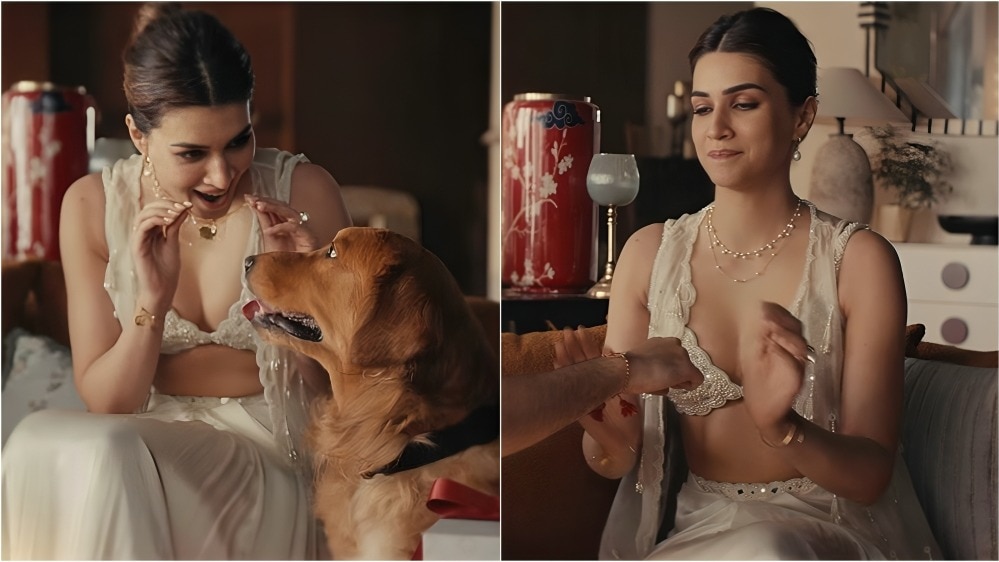
Here we go again: another festival, another woman, another outfit that becomes a matter of public morality. Kriti Sanon tied a rakhi in a jewellery advertisement wearing an ivory bralette-style blouse, a cape and a draped skirt, and suddenly the internet had a cultural emergency on its hands. Was it “appropriate” for Raksha Bandhan? Was it traditional enough? Was it respectful enough?Then Kangana Ranaut entered the conversation, questioning why Kriti would tie a rakhi in what she described as a “bikini/undergarment” when there were so many other choices available. Somewhere between the outrage and the outrage over the outrage, the original question got lost. This was never really about a rakhi. It was about a woman’s clothes.But before we decide whether Kriti’s outfit was “appropriate”, perhaps we should actually look at what the advertisement showed. She was at home, with her brother, her dog – her family – celebrating Raksha Bandhan. She was not walking into a public space dressed for the world. She was not trying to make a statement about how women should dress. She was simply in a setting meant to represent comfort, intimacy and a family celebration. And this is actually a distinction that should matter.If I am at home with my family, why would I be thinking about whether my clothes are sufficiently traditional for a stranger to approve? At home, I am allowed to be my most unguarded self. My brother is not measuring my neckline. My parents are not conducting a morality audit. I am wearing what I like because I am home. Isn’t that precisely what home is supposed to mean? Kriti’s response made that distinction rather neatly. “Culture & Traditions are in her heart, not in her neckline,” she wrote, refusing to accept the premise that her cultural respect could be measured in inches of fabric. And that is precisely the point. Since when did the depth of a blouse determine the depth of someone’s affection for their family? Kriti Sanon's statement on the backlash When did a festival celebrating a sibling bond acquire a dress code? Where, exactly, is the rule that says a woman who is "inside her home" must cover her collarbone, arms, waist or whatever other body part happens to offend the internet that day before she is allowed to participate in her own traditions? Perhaps someone should publish that rulebook and declare it holy. Chapter One: acceptable blouse lengths for Raksha Bandhan. Chapter Two: approved necklines for Diwali. Chapter Three: emergency protocols for visible midriff during Navratri. It sounds absurd because it is absurd, yet women are subjected to this audit constantly. The length/depth/colour changes, the occasion changes, but the policing remains remarkably consistent.And this is where “appropriateness” starts falling apart. Appropriate according to whom? Who gets to decide that one outfit honours a tradition while another insults it?Let's also discuss the beauty of our festivals and what really makes our culture, our religion so vibrant. There is no rule that says you must wear white on Holi. People do it because they enjoy it. Someone else wears yellow, pink or black, and nobody needs to convene a cultural tribunal. We go home for festivals precisely because, for a few days, we want to return to the people and spaces where we can be our truest selves. We want to eat what we want, laugh loudly, dress up, dress down, be silly, be sentimental and celebrate without constantly wondering whether we are performing tradition correctly. Why, then, do we suddenly demand that women bring a public dress code into their own homes?What is particularly revealing about this controversy is how quickly the conversation moved from “Is this appropriate?” to “Why are you policing her?” The moment Kriti refused to apologise for her clothes and instead questioned the judgement itself, the debate became much more uncomfortable. Because it is easy to pretend the issue is tradition. It is harder to admit that what many people actually want is conformity.There is another unfair expectation we place on women like Kriti: once they become public figures, must every choice they make represent every woman in the country? Yes, public figures have influence and accountability, but that does not make them custodians of womanhood. Kriti is an actor, not an elected representative of women’s wardrobes. She can understand her platform and still dress like a young woman who simply liked an outfit. Why must a woman become a symbol before she is allowed to simply be herself?Kangana’s criticism makes that contradiction particularly obvious. The existence of choices is meaningless if some choices come with public punishment. You can choose anything, the logic goes, as long as you choose the thing we consider respectable. Freedom with conditions is not freedom. It is permission.Even the inclusion of Kriti’s pet became part of the discussion, with the actor defending the idea that dogs are family too. And perhaps that detail says something about how quickly we lose sight of the actual emotion behind a celebration. Raksha Bandhan is not a costume competition. It is a personal ritual, a relationship, a memory. If a family wants to include a pet in that expression of affection, that is hardly a threat to civilisation or religion. Yet somehow we can spend more time debating a woman’s neckline and a dog in a festive advertisement than the bond the advertisement was actually trying to depict.The ad being pulled only makes the larger question more uncomfortable. If criticism over a woman’s outfit is enough to turn a festive campaign into a controversy, what exactly are we teaching women? That they are welcome to celebrate culture, but only if they dress for public approval? That their bodies are open to commentary the moment they appear in a campaign, a film, a public event or even a depiction of their own home?Watch the ad here:Everyone is trolling Kriti Sanon over a GIVA jewelry brand ad, claiming she is wearing a "bikini."She isn't wearing inappropriate clothing.Perhaps her attire doesn't fit your definition of "modesty."After all, the same guy who praises nude scenes in movies provided the pic.twitter.com/YGYuXv8Rbp— Preeti (@Preeti__agm) August 26, 2026No. A woman’s cultural identity does not become more authentic because her sleeves are longer or her blouse is higher. Culture lives in memory, language, rituals, relationships, food, music, family and, yes, in the ways people choose to dress. It evolves because people evolve. The moment we insist that tradition can only be respected in one approved outfit, we stop protecting culture and start policing people.So yes, Raksha Bandhan has no dress code. And perhaps it is time we stopped inventing one for women. The neckline today, the hemline tomorrow, the sleeve length the day after. The clothes will change. The outrage will change. The script will not. And that is the part we should really be embarrassed about: not what Kriti Sanon wore while tying a rakhi, but why, in 2026, we are still so invested in deciding what she should have worn.- EndsPublished On: Aug 26, 2026 16:58 IST
Raksha Bandhan has no dress code. So why does Kriti Sanon's bralette offend us?
Full Article
Original Source
Read the full article at Indiatoday →KhanList aggregates and links to publicly available news content. We do not host full articles from third-party sources. Always verify important information with original sources.