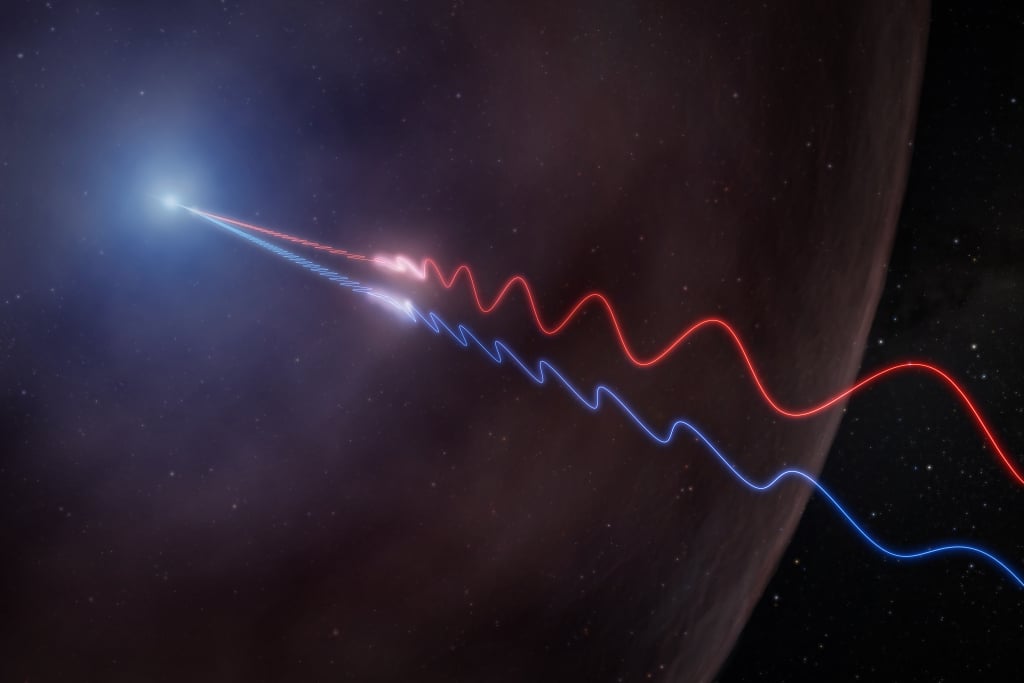
On March 10, 2026, the Fermi telescope gamma-ray burst team reported the detection of a long-duration gamma-ray burst that occurred when a star exploded inside a dense, highly magnetized cloud of hydrogen gas. That HII region is a bubble of ionized hydrogen created by winds from a massive young star. Astronomers immediately turned as many telescopes as possible to view the burst and its afterglow, including the NSF's Karl Jansky Very Large Array. The VLA detected polarized light at radio wavelengths emitted by a jet streaming away from the site of the star that exploded. Not only was it the first time such light had been seen at such frequencies, but it marked a milestone: the first time anyone has seen a phenomenon called Faraday Rotation in a GRB. Faraday rotation causes polarized light to twist as it travels away through a strong magnetic environment surrounding the site. The fact that GRB 260310A appears to have exploded inside such a region is consistent with the current idea that GRBs arise from the deaths of the most massive stars. The data from all observations of this event should help scientists understand precisely what kinds of stars and environments are capable of producing powerful GRBs. The NSF Karl Jansky Very Large Array in New Mexico was used to observe the afterglow of GRB 260310A. Courtesy Jeff Hellerman, NRAO/AUI/NSF The Mechanics of Faraday Rotation Polarized light is light that oscillates in a specific direction. We are most familiar with it if we wear polarized sunglasses, which act as filters for reflected light. As the light from the GRB passed through the highly magnetic environment surrounding the exploding star, the polarization changed across different wavelengths. This phenomenon was never seen in a GRB before, and it offers many clues about what's going on in the aftermath of the GRB. It gives information about the structure and strength of the magnetic field and magnetized plasma that the light was passing through after the explosion. The faster the rotation changed with wavelengths, for example, the stronger the magnetic field. The VLA observations showed that a magnetic field along the light’s path was thousands of times stronger than what could be explained by our own galaxy or the space between galaxies, according to Tanmoy Lasker, a professor at the University of Utah and a member of the team that studied the VLA observations. “GRBs are the most powerful explosions in the Universe, and magnetic fields are thought to play a central role in powering them, but probing those fields has been extraordinarily difficult,” said Laskar. “By detecting polarized radio emission, we can now directly measure the magnetic environment of one of the Universe’s most violent events. Our new GRB observations allow us to use the Universe as our laboratory to test our understanding of how physics operates in such extreme conditions.” About GRBs Gamma-ray bursts have long fascinated scientists since they were first observed in the 1960s. These are among the most energetic events occurring in galaxies and can outshine their galaxies before slowly fading out. Their afterglows mark the "cool down" of the event, and they show up in X-ray, ultraviolet, optical, infrared, microwave, and radio regimes. For a long time, astronomers weren't quite sure what could produce these strong outbursts of light. One problem in observing them was that they faded fairly quickly, robbing astronomers of valuable data about the first moments of the event. Artist's illustration showing the life of a massive star: nuclear fusion converts lighter elements into heavier ones; when fusion no longer generates enough pressure to counteract gravity, the star collapses into a black hole. During this collapse, energy may be released as a momentary burst of gamma rays aligned to the axis of rotation. This is very likely what causes a majority of GRBs in the Universe. Courtesy National Science Foundation For GRBs to be bright enough to be seen across millions of light-years, it meant the original explosions had to be very energetic. Lots of explanations centered around such events as neutron star collisions in distant galaxies. Eventually, as more observations using X-ray and other telescopes occurred, astronomers got a better handle on the causes of GRBs. Today, they're thought to be the explosive deaths of extremely massive stars in galaxies billions of light-years away. The explosion is heralded by an initial flash of gamma rays (hence the name), followed by other wavelengths of light as the event "cools down" and fades out. Future Observations The VLA observations capitalized on high-resolution studies of the afterglow of GRB 260310A, although it wasn't the first time astronomers tried to see it in radio, according to Collin Christy, a graduate student on the observation team and lead author on a paper describing the findings (cited below). “Previous searches for polarization in GRBs used facilities like the Atacama Large Millimeter/submillimeter Array (ALMA) telescope that measure shorter wavelengths and had to happen early, before the afterglow light faded,” said Christy. “Now, with the NSF VLA, we’ve pushed into the centimeter bands and made the first ever measurement of Faraday rotation in a GRB. Each new observation reveals another layer of the magnetic story these explosions are telling us.” Now that the VLA has successfully measured the Faraday rotation of polarized light in a GRB, it points the way for similar observations of other GRBs. “Future monitoring of GRB afterglows with the NSF VLA and other radio telescopes will allow scientists to watch magnetic field structures evolve in real time,” said Assistant Professor Dr. Kate Denham Alexander, Christy’s PhD advisor. “This is a capability that could transform our understanding of how relativistic jets form, how they are powered, and how magnetic energy is released in the most extreme environments the Universe has to offer.” For More Information Astronomers Detect Magnetic Fingerprint of a Cosmic Explosion for the First Time First Detection of Faraday Rotation in a Gamma-Ray Burst Afterglow: Low Polarization and High Rotation Measure in GRB 260310A Reveal Jet Magnetic Structure and Environment
Radio Array Detects Polarized Light From a GRB
Full Article
Original Source
Read the full article at Universetoday →KhanList aggregates and links to publicly available news content. We do not host full articles from third-party sources. Always verify important information with original sources.