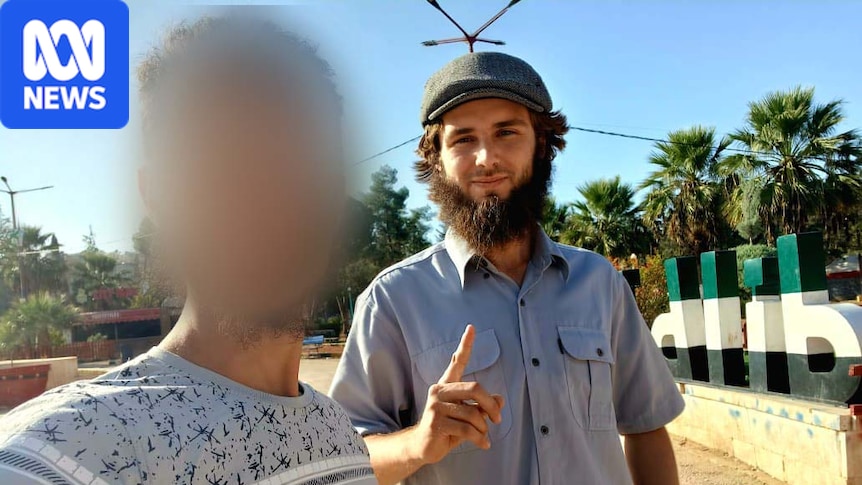
A 20-year-old Gold Coast mobile phone technician faces a possible death penalty in Syria for the alleged shooting murder of another Australian man.Patrick Stevenson has been detained for more than six months in Idlib province, in the war-scarred country's north-west, on a charge of premeditated murder: an offence punishable by death.An ABC investigation has established that Mr Stevenson, a Muslim convert with learning disorders, ADHD and suspected autism spectrum disorder, travelled to Syria last October after becoming radicalised on the Gold Coast.Mr Stevenson was arrested shortly after 40-year-old Australian citizen Abdullah Glen Charles Burgess was shot dead in the town of Darkush on December 31.Syrian authorities allege Mr Stevenson confessed to firing at least eight shots from an AK-47 at Mr Burgess inside the victim's home.Authorities initially investigated whether Mr Stevenson had links to the Islamic State group (IS) but later concluded that the killing was not linked to the terrorist group, according to information provided to his family by Australian officials and his legal team.The ABC has established that Mr Burgess moved to Syria with his Australian wife and children last year after leaving their home in northern New South Wales and spending at least six months travelling through Afghanistan.It is unknown what brought the family to Syria. The ABC does not suggest they had links to extremist groups.People who knew the two men said Mr Burgess took Mr Stevenson under his wing late last year and that they became close in the lead-up to the killing.According to Syrian authorities, Mr Burgess's wife and their daughters were in another room when he was shot but were not physically injured.Even if convicted, Mr Stevenson could be spared execution if Mr Burgess's widow, Amatullah Laurie Duniam, grants him forgiveness under Syria's legal system.Ms Duniam could instead accept a payment of blood money, known as diya, from Mr Stevenson's family.Mr Burgess's family, including Ms Duniam, declined to speak to the ABC.Mr Stevenson's legal team has told the ABC it holds grave concerns about his prospects of a fair trial and his welfare in Sarmada prison, where it says his mental health has deteriorated significantly.No Australian official has visited Mr Stevenson in prison or attended his court hearings to verify his identity and assess his welfare.Australian authorities have also been unable to independently monitor the investigation into Mr Burgess's death.Mr Stevenson's father, Clay Stevenson, travelled to Syria last week and visited his son in prison for the first time.He also attended his son's court hearing on Sunday to submit Australian medical records, including a psychiatric report documenting Patrick's ADHD and learning disorders, as well as suspected autism spectrum disorder.The ABC understands DFAT has told Mr Stevenson's family that the Syrian government has shown little engagement over the case.Unlike allies including the United States and France, Canberra has struggled to establish diplomatic ties with Syria's new government. Australian sanctions remain in place against the militant group from which Syria's new leadership emerged.The case also raises questions about whether Syria could again become a destination for radicalised Australians as it emerges from a 14-year civil war that drew thousands of foreign fighters to terrorist groups including IS.The mayor of a nearby village in Idlib province, speaking on condition of anonymity, said the quaint riverside town of Darkush, near the Turkish border, had become a stronghold for Australian former fighters and Islamists.Killing initially treated as an accidentAfter Mr Stevenson's arrest on December 31, the Department of Foreign Affairs and Trade (DFAT) told his family that Syrian authorities initially treated the shooting as accidental.But a week later, DFAT advised the family by email that Syria's "Intelligence Bureau is investigating Mr Stevenson's possible affiliation with ISIS".According to information provided to the family, that terrorism investigation ended in February when authorities referred the case to the civilian criminal courts.The civilian prosecution will be a significant test of Syria's fractured legal system and is likely to attract international scrutiny.Patrick Stevenson was living in Idlib province, the former rebel stronghold in Syria's north-west. (Supplied)Australia has no embassy or consulate in Syria, severely limiting its ability to provide consular assistance.Correspondence seen by the ABC shows DFAT repeatedly told Mr Stevenson's family that it could not obtain information from Syrian authorities and had no access to the country's detention facilities.DFAT told the ABC it was providing consular assistance to Mr Burgess's and Mr Stevenson's families but was unable to comment further because of privacy obligations."We send our deepest condolences to [Mr Burgess's] family at this difficult time," the department said in a statement.From the Gold Coast to IdlibMr Stevenson converted to Islam in his final year of high school in 2023, according to his family.By last year, he was showing signs of radicalisation, including sharing speeches online by Anwar al-Awlaki, the US-born Al Qaeda cleric and propagandist killed in a drone strike in Yemen in 2011.Mr Stevenson left the Gold Coast on a flight to Bali on October 10 and later travelled to Syria.He soon moved to Idlib province, Syria's former rebel stronghold, in the country's north-west.Patrick Stevenson converted to Islam in 2023. (Supplied)The province is home to former foreign fighters, including Australians, some of whom have been stripped of their passports.Idlib was governed for years by Hay'at Tahrir al-Sham (HTS) before the group led the offensive that toppled dictator Bashar al-Assad. HTS formally dissolved in January 2025.The former Al Qaeda affiliate, previously known as Jabhat al-Nusra, remains a designated terrorist organisation in Australia.Patrick Stevenson previously worked as a mobile phone technician on the Gold Coast. (Supplied)Syrian legal sources told the ABC it could take up to a year for the court to reach a verdict.Mr Stevenson's fate may ultimately depend as much on diplomacy and clemency as on the evidence against him.Under Syrian law, a death sentence imposed by an ordinary criminal court must be reviewed by the Court of Cassation, considered by a special clemency committee and approved by the president before it can be carried out.
Queenslander could face death penalty over alleged killing of Australian in Syria
Full Article
Original Source
Read the full article at Abc →KhanList aggregates and links to publicly available news content. We do not host full articles from third-party sources. Always verify important information with original sources.